
Key takeaways
- High-income earners are constantly checking their inbox – but getting opened still depends on a subject line that feels relevant and worth their time.
- Most emails fail because they’re too long or too vague. Clear, concise messages are far more likely to get a response.
- From verifying the right email address to following up the right way, each step impacts whether your message gets seen or ignored.
Email is bar none the best way to reach the VIPs who make things happen. Getting a personal meeting is tough, and important executives famously dodge phone calls. The inbox is your best bet to make a connection, but how do you get decision-makers to actually read your emails? Here are a few tips you can use today.
Many people are trying to email CEOs and other high-profile executives for all sorts of reasons. You may find yourself trying to reach someone important to:
- Secure a hard-to-get position
- Pitch your product or service to a decision-maker
- Make a deal or partnership happen
- Invite a thought leader on your podcast or conference
- Get an exclusive quote for your article
- Ask a question and get business advice.
With all of the other people trying to reach your target, you should still put your best foot forward and try to get noticed.
The data reflects that high-income earners are in the inbox the most. They’re most likely to “always be on.” The majority of executives check their work emails even on vacation and after hours. We know they’re spending time in the inbox — you just have to get through to them.
So how do you do that?
Let’s begin.
Related: 6 Phrases to Avoid in Cold Emails — And What to Say Instead
#1 Find the right email address — and make sure it’s valid
It’s not uncommon for VIPs to keep their email addresses out of company directories or to take even stronger measures to dodge communication. Put yourself in their shoes. They may get hundreds of emails a day, sometimes from people offering or wanting the same thing you are.
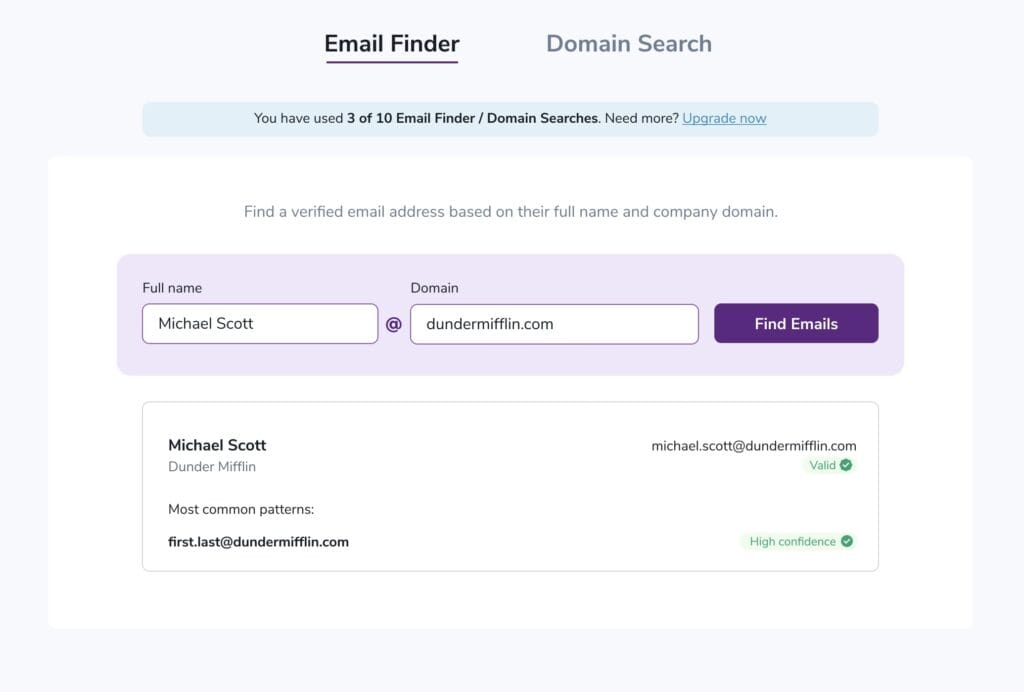
Since you know your target’s name and company, you can use a quality email finder to identify their email address. It’s not unusual for these decision-makers to use a different format than their team in order to prevent people from guessing. While everyone else uses first initial then last name (e.g. asmith@ for Amy Smith), the CEO may just be Pat@ to avoid detection. One in-demand contact I made used a single character “J@.” It’s all about flying under the radar.
While some email finders scrape up every email address associated with a contact, you can use a more rigorous email finding tool that will provide you with the correct email address in real time. Furthermore, a good email finder includes email validation built in. The tool will check that the email address is valid.
This is an important feature because you could waste time writing messages to email addresses that will bounce. This won’t only be frustrating, it will also hurt your sender reputation. A tarnished sender reputation means that more and more people will stop seeing your emails because your messages begin to be directed to the spam folder.
You can avoid deliverability problems by never emailing a contact until you’ve used an email validation service to verify that the email address is good. You don’t want an email to bounce or, even worse, be a spam trap.
Never forget this: you must also immediately stop emailing anyone who asks you not to. If you don’t, they may hit the spam button on you, and that will affect you even more negatively than getting a bounce.
#2 Come up with a great subject line
Here comes a bit of pressure. If your subject line is poor, your email may reach the inbox, but never be opened. So what are the reasons a subject line might be a nonstarter?
- It’s too vague or generic (e.g., “Hey” or “Quick question”) and gives no reason to open
- It’s spammy or overly promotional (all caps, hypey language, excessive punctuation)
- It’s so long that it’s overwhelming. The key message even gets cut off on mobile.
- It lacks relevance to the recipient, so it doesn’t feel worth the few seconds to find out.
The secret? Do your best to get into the recipient’s head. If the subject line doesn’t either provoke curiosity or provide the recipient with something they want or need, try to come up with something that does.
Let’s be real – some people are more inwardly focused than others. If that describes your target, a subject line that is about them will be irresistible.
I like to use this simple trick if I’m stumped. I think about what the recipient of my email cares about and my objective. Now, where do they intersect? That’s the subject line. You won’t always be able to do this with every email, but it tends to work when you can find a succinct way to express that idea.
The other idea is to choose a subject line that piques their curiosity without revealing everything. What will make them impatient to see what the message says? Just make sure to satisfy what they’re wondering about.
#3 Write a relevant, as short as possible email
Make sure that what you write is undoubtedly relevant to the recipient. If you’re questioning whether it will connect with the VIP, you’re not ready to send the message. Brainstorm your idea until it’s more powerful.
Relevance will also help you with the next requirement, and here is where good writing is your friend. Many people think good writing is about giving every detail. The reality is that decision-makers typically prefer descriptive directness, but above all, conciseness.
So get to the point. Decision-makers and executives are used to it, and they prefer brevity. In general, the shorter the better.
Let’s take a look at two emails. The first email is 47 words and invites a VIP to appear on a webinar.
Hi [Name],
I wanted to share our latest webinar: [link]. It covers [brief topic]. Would you be interested in joining us as a guest for an upcoming session in the series? I think your perspective would resonate with our audience – happy to share details if you’re open to it.

That email was 47 words. In the rewrite, let’s see if we can cut even more words.
Hi [Name],
Here’s our latest webinar: [link]. Would you be interested in joining a future session as a guest? I’d love to include your perspective.

That email is only 25 words – greeting, closing and all! The body of the email note fits on one line. The great thing is that the email provokes curiosity. You don’t have to tell the recipient everything.
For instance, you don’t have to tell them that you’re “happy to answer any questions or concerns.” Why? Because they already know that they could follow up with a question. Why would they think they couldn’t?
I realize not everyone agrees with sending such brief emails. My experience has been that they get better results. Try sending a very short email – maybe even just one sentence.
Read back your email and make sure it is easy to understand. Then, don’t hesitate. Hit send.
You’ll be surprised by how many more times the answer is “yes” or the dialogue begins when you are direct.
Remember: the fewer words you write, the more of those words people will read. This is always true! Get to the point.

People can always do research if they want to find out more about you or a certain subject, and you can always link to a landing page or one-pager for more information.
#4 Sometimes give instead of ask for something
When you’re a decision-maker, you’ve got hordes of people who want you to do something for them. If you want to forge a relationship, it may help to set aside your desires. Helping people is good for you and takes a lot of pressure off you.
It’s a good practice to regularly help others – not just those who can help you. In doing so, you’ll make it a habit and get better at finding ways to be of service. When trying to develop a relationship with a key figure, you can give them something of value. The sky’s the limit!
Here’s an example: You can quote something they said and give them credit for it in an article or blog. Other options include sharing information that would be very valuable to them.
Reciprocation is an effective tool. People want to help those who help them. If you can mutually benefit one another, both parties win. Furthermore, it moves you from being strangers to acquaintances or even friends.
Email is the perfect place to start that reciprocal relationship.
#5 Follow up, but don’t pester
I would never advise not following up. There are so many deals or relationships that would not be realized if the initiator didn’t reach out just one more time. The important thing is to follow up in a way that isn’t pesky or aggressive.
In general, if you don’t hear back, wait at least a week before emailing again. This may seem like a long time to wait, but you’ll see better results if you’re patient. There may be circumstances where you must write back sooner than that, like if the reason for your correspondence is time-sensitive or there’s an opportunity with a limited window.
What if you still get radio silence? You shouldn’t follow up more than two times. If you think there’s a decent chance of a good outcome, three times is the absolute maximum. Here’s why: if you pester the person on the other end, you run the risk of being thought of as an annoying sound. You may become someone they classify as someone to avoid rather than someone worth responding to.
This strategy has paid off for me. It’s rare, but I’ve had individuals whom I contacted years ago respond to the original message (with apologies) and spark a collaboration or make a deal. Never underestimate the power of email!
Don’t get intimidated — email is the great equalizer
I’ve emailed billionaires and the world famous. Guess what? They’re people just like you. Decision-makers and CEOs have good days and bad days. These are people who also tend to value clever or useful emailing.
Remember how our study showed high-earners tend to spend the most time checking email? They’re even more likely to check work email in the bathroom, while driving, at a funeral, or in bed with their significant other.
Now that you know what high-profile decision-makers are focused on, you can put your best foot forward so that they will open your email and pay attention to what you have to say.

Related Posts
-
 Read Story
Learn how clean email data and accurate call attribution help you reduce wasted spend and invest in the channels that drive revenu...
-
 Read Story
Key takeaways Looking spammy can hurt even legitimate email senders. Small mistakes can raise red flags with both mailbox provider...
-
 Read Story
Want people to read your emails? The rule is simpler than you think: send emails people actually want to receive. It’s been 55 yea...
-
 Read Story
Email marketing is the number one revenue generator, but SMS marketing skips the inbox to send marketing messages directly to cust...
-
 Read Story
You can have the most sophisticated email journeys in the world: beautifully designed, perfectly timed, fully automated — and stil...
-
 Read Story
Key points: Authenticity stands out in an AI-saturated inbox: As more professionals rely on AI to draft emails, messages are start...