
Docs
Docs
When registering for your new ZeroBounce account, you will receive an automated email with a confirmation link. Be sure to check your inbox when receiving the notification, and follow the link inside the email.
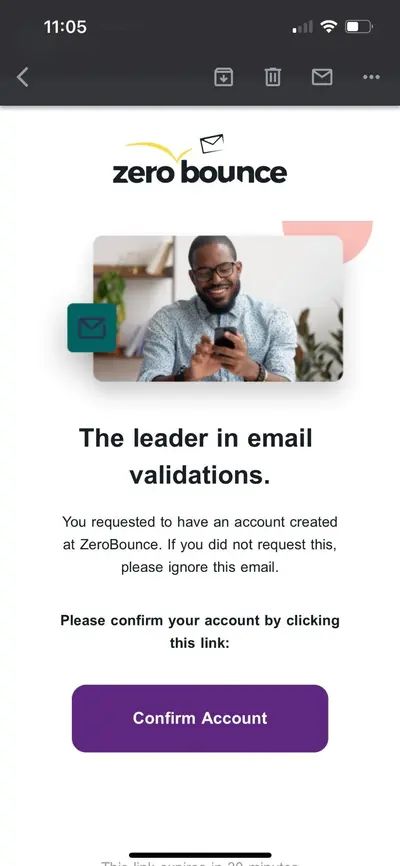
After clicking the Confirm Account button, you’ll be automatically redirected to the ZeroBounce sign in screen. You can now use your email address and password to sign in to your new account.
If you are unable to sign in to ZeroBounce after confirming your email address, please try the following actions:
If you did not automatically receive your account confirmation email, please follow these troubleshooting steps.
Disabling password-protected downloads
How often should I verify my email list?
Can I verify my emails in real time as they’re collected?
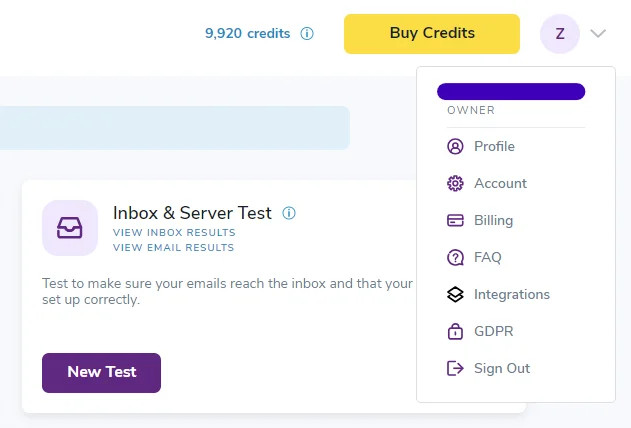
If you forgot your ZeroBounce password or wish to update it for security reasons, you can do so anytime by visiting your profile settings.

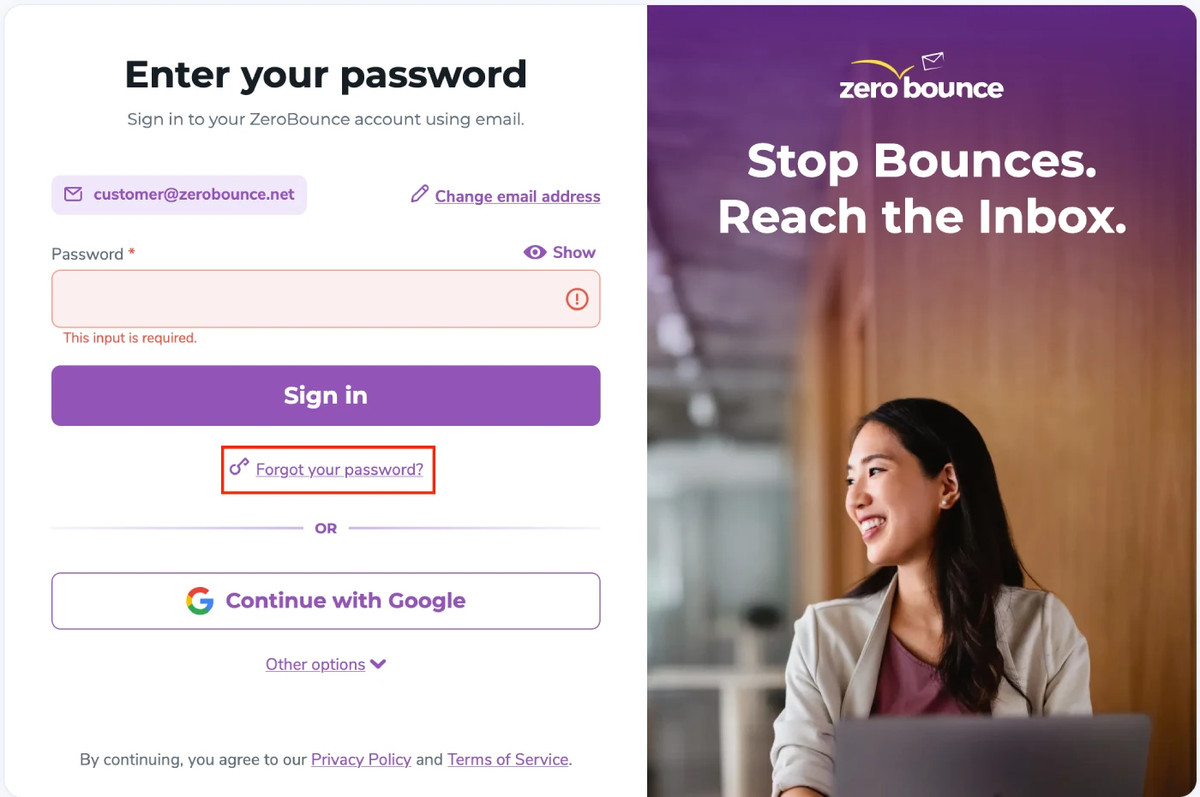
In the event that you forget your ZeroBounce password, you can retrieve it by visiting the sign in page.
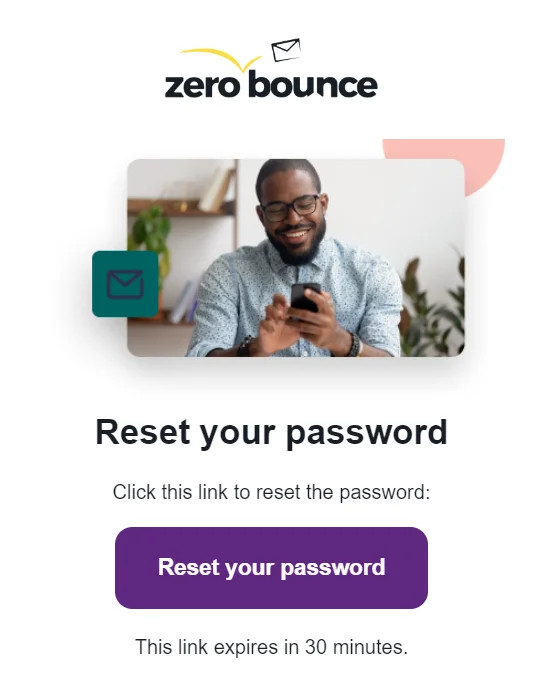
Alternatively - you can find a 6-digit code at the bottom of the email that you can enter on the webpage you used to begin the password retrieval process.
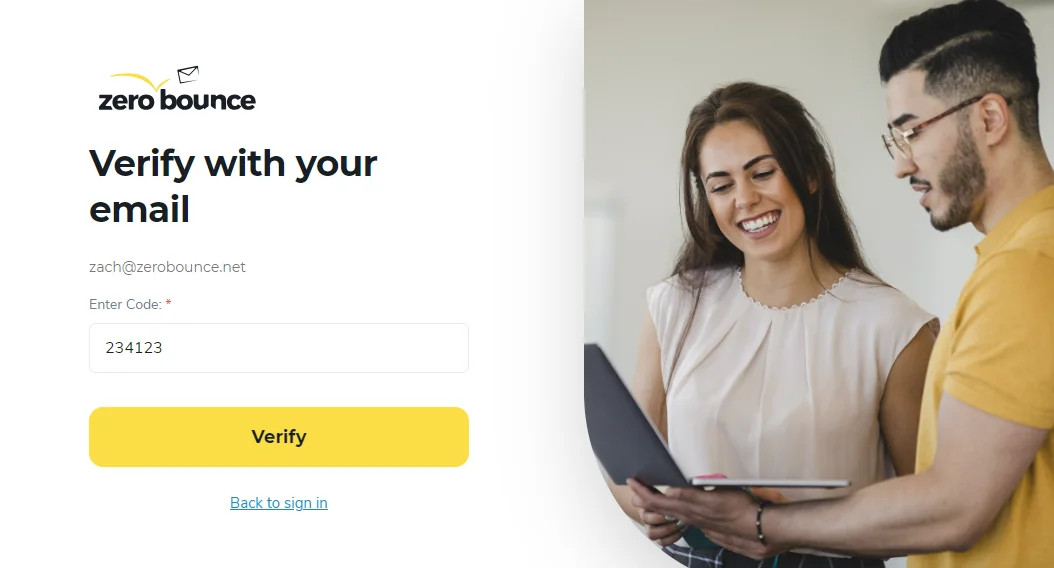
Note - You only have 30 minutes to complete this process. If time expires, you must re-enter your email address and request a new password reset link.
If you cannot access the inbox of the email address associated with your ZeroBounce account, please contact customer support - available by phone or live chat 24/7.
Please be prepared to provide any identifying information that may assist our support team in ensuring you are the account owner.
Email validation and account information
Disabling password-protected downloads
How often should I verify my email list?
Can I verify my emails in real time as they’re collected?
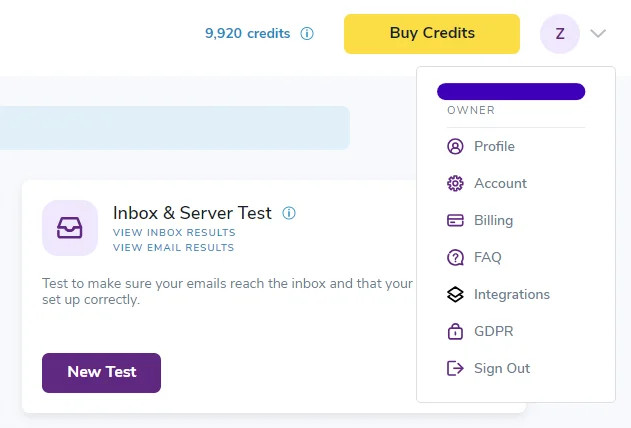
If you wish to disable password-protected downloads, you can do so by visiting your ZeroBounce profile settings.
Warning - It’s strongly advised not to disable password-protected downloads. This feature protects your sensitive data. ZeroBounce security measures ensure all users receive a unique, encrypted password when downloading email validation results from their accounts.
This is essential as it adds an additional layer of data protection in the event that your ZeroBounce account becomes compromised. While the attacker may be able to sign in to your account, they cannot view your contacts, email data, or results without the download password.
Removing this additional layer of protection leaves your sensitive data vulnerable if someone gains access to your sign in credentials. The attacker no longer needs a unique password to view your contacts or email addresses uploaded from your company’s database.
If you need to turn off password-protected downloads for any reason, follow these steps:
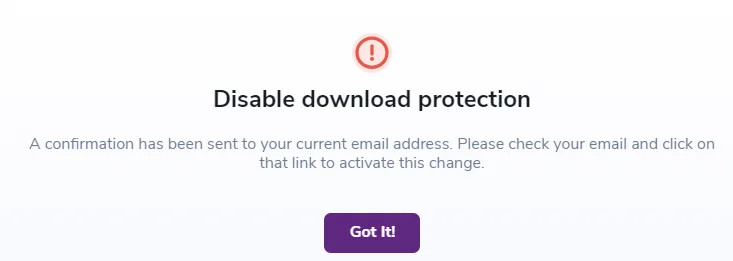
Check your email for the notification and click Approve Change to verify your request.
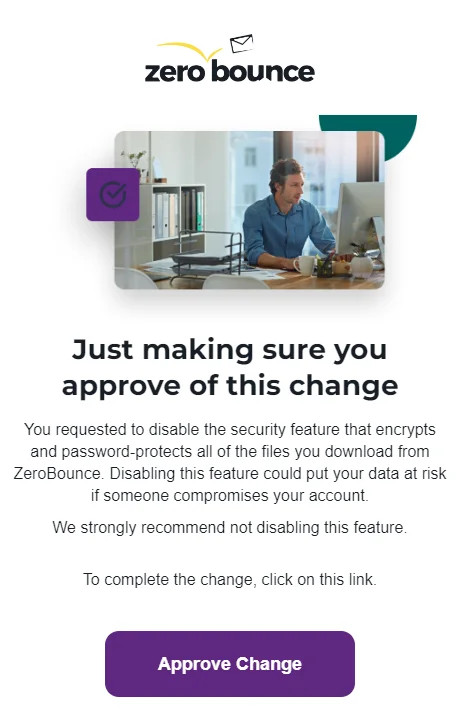
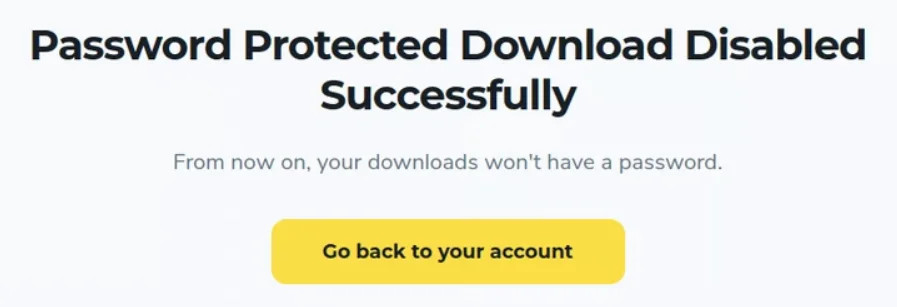
If you need to disable password-protected downloads, it’s recommended to re-enable the security feature at your earliest convenience. Your data privacy is essential, and ZeroBounce will always do everything possible to secure your account. Keeping password-protected downloads aids in this endeavor.
If you wish to re-enable password-protected downloads, you can visit your Profile settings and adjust the toggle again under Security Settings.
Email validation and account information
How often should I verify my email list?
Can I verify my emails in real time as they’re collected?
Verifying your email list at least once per quarter or every three months is recommended. Cleaning your list at this frequency is enough to help most businesses combat email decay while keeping up with their email list growth.
However, you may wish to verify your email list more frequently if you’re a larger business that regularly sees a high volume of new email leads.
In addition to these suggested time frames, reviewing key email marketing metrics is recommended regularly. Identifying and understanding problems in these areas can also indicate a need to clean your email list.
Internet and email service providers look for senders to maintain a 2-5% bounce rate. However, you must keep it at 2% or lower to protect your sender reputation.
Bounced emails are a telltale sign that some contacts on your email list are invalid. Verifying your email list will identify those outdated email addresses so that you can remove them from your list.
When someone reports your emails as spam or abuse, it increases your spam complaint rate. Internet service providers have a low tolerance for spam complaints and suggest that you keep it below 0.1% (1 in 1,000 emails sent).
If you notice a rise in spam complaints, it’s time to verify your email list. You’ll be able to identify problematic contacts on your email list, which we call abuse emails. These contacts are chronic complainers that misuse the report abuse function to your detriment.
Verifying your email list will help you spot them so you can purge them from your list.
Using an email verification APIⓘ is recommended to clean new email addresses at the time of registration. If you get a high volume of new email signups and are not using an API on your registration forms, you should clean those new emails in batches.
Alternatively, you can install the real-time email verification APIⓘ to your website, landing pages, and wherever you collect new email addresses.
To gain even more insight into clean email, along with when and how to verify your email list, - check out the Marketer’s Guide to Clean Email.
Email validation and account information
Disabling password-protected downloads
Can I verify my emails in real time as they’re collected?
You can verify your emails as they’re collected in real time by using an email verification APIⓘ.
The API (Application Programming Interface) allows you to integrate your email verifier with your favorite platforms, websites, databases, or wherever you collect email addresses.
Verifying your emails in real time effectively lets you customize how you wish to clean your email list.
First - you’ll need to integrate your email verifier’s API code into your location of choice. A great place to install the real-time email verification APIⓘ is in your website’s account sign-up section.
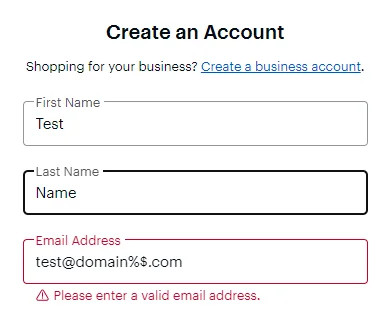
Usually - users could enter any name or email address into the registration form. With the help of the real-time API, your email verifier will automatically detect invalid email addresses. Your visitors can only register for an account or mailing list once they provide a valid email address.
The real-time API is also helpful for detecting problematic, risky emails like abuse emails, spam traps, and disposable emailsⓘ. These email address types use a valid format but can damage your campaign performance and sender reputation. They can also put your email domain on a blacklist.
You’ll need two things to get started with a real-time email verification APIⓘ:
You’ll need to sign up for an account with an email verification service to obtain an API key if you don't have one. Some services allow you to create multiple API keys for different platforms.
Then, just add your API key to the appropriate field within the API code to verify emails in real time.
Free ZeroBounce accounts come with 100 credits. However, if you need to verify more emails in real time, you’ll need to add more credits to your ZeroBounce account.
For a more in-depth tutorial on setting up a real-time email verification APIⓘ, be sure to review our dedicated documentation.
Installing the API is simple and requires no coding expertise. However, if you prefer help and have questions about our API, contact the support team via phone or live chat, available 24/7.
Email validation and account information
Email verification is essential for any business to protect its email domain reputation and deliverability. Whether you rely heavily on email marketing or use email for crucial communications, being able to reach your customers and prospects is critical.
These are the primary ways that email verification will impact your business.
Email verification will lower your email bounce rate by eliminating invalid email addresses from your database. It will also help correct typos and remove duplicate emails so you can confidently send your campaigns to valid contacts.
Internet and email service providers look for senders to keep a bounce rate of 2% or lower. Email verification will help you decrease it to zero.
The ZeroBounce email verifier can identify known spam complainers, also known as abuse emails. These users are known to misuse and abuse the report function, which can add to your business’s spam complaint rate. The more spam complaints you get, the more your emails will likely land in the spam folder or be rejected.
Senders must keep their spam complaint rate at 0.1% or lower (1 in 1,000 emails sent).
Every business that uses email has a sender reputation. Internet service providers use this numerical score to describe the quality and trustworthiness of your emails.
If your business domain has a poor sender reputation, it’s more likely for your emails to land in spam or be rejected by service providers. You’ll have a more challenging time reaching the inbox for prime visibility, also called your email deliverabilityⓘ.
The two factors mentioned above, bounce rate and spam complaint rate, directly impact your sender reputation. Email verification will keep these metrics in check and protect your sender reputation.
Email verification preserves your sender reputation, which leads to better email deliverability.
Email delivery simply means that the email was delivered. Your email may land in the inbox, the promotions folder, or even spam.
Email deliverabilityⓘ refers to your ability to reach your subscribers’ inboxes - the area they will visit the most.
Without email verification, your email list becomes cluttered with invalid emails and unengaged subscribers. Basing your email content on an outdated list can skew your performance and lead to poor results.
First, email verification will eliminate expired email addresses to boost your deliverability and reach the inbox.
Second, it can identify the subscribers who do not open or engage with your content so that you can phase them out of your list over time.
Cleaning your list with email verification leaves you with valid, active email subscribers. You’ll have more accurate insights regarding what type of content resonates with your audience so that you can adjust your campaigns accordingly.
Finally, email verification is the number one way to boost your campaign ROI.
You’ll no longer need to waste your budget or time storing and reaching out to outdated, disinterested email subscribers. Your email content will reach the customers who want to hear from you.
Your bounce rate decreases, you find the inbox reliably, and you gain actionable feedback on boosting your email conversions.
What happens during the email verification process?
What is the difference between hard and soft bounces?
Why do emails bounce in the first place?
What is a disposable email, and why is it problematic?
Verifying your email list is a simple process for the user. Download the list from your database, upload it to ZeroBounce, and we’ll handle the rest.
But what exactly happens during the email verification process?
Let’s break down each step so that you can better understand what happens to your email addresses after you upload them.
A preliminary check begins after uploading your list via the bulk upload tool or the API.
This check verifies that the email address follows the proper syntax. Proper syntax includes the correct structure (username followed by email domain) and allowed characters (certain special characters are not permitted in different parts of the email address).
It will also identify typos or misspellings and attempt to correct them until it provides a valid format.
An email domain needs to be configured with the proper DNS records (MX or A-type) to receive incoming email messages.
The second step verifies that the domain has these records, allowing us to perform a real-time SMTP checkⓘ.
Before attempting the SMTP check, ZeroBounce scans each email address for known spam signatures associated with spam traps.
A spam trap is a tool internet and blacklist services use to identify spoofers and spammers. Different types of spam traps exist, and they typically appear to be regular email addresses. Old email addresses no longer in use are often repurposed as spam traps.
If the verifier identifies spam traps in this step, it marks them accordingly.
![A flow chart showing the ZeroBounce 10-step ,[object Object], process from email upload to completion](https://www.zerobounce.net/cdn-cgi/image/fit=scale-down,format=auto,quality=90,width=1920,metadata=none/docs/assets_next_docs/docs/faq/VerificationProcess1.webp)
An SMTP (Simple Mail Transfer Protocol) check is a test that attempts to connect to the email server and measures the response time. The test measures the email server’s health and whether or not it’s properly configured to send and receive emails.
A failed SMTP checkⓘ can indicate issues with the email server, such as improper configuration, which will cause incoming emails to bounce. Some email servers are also not configured to receive incoming mail.
At this step, ZeroBounce leverages its proprietary technologies to continue testing the validity of the email address. This step allows the verifier to deliver our 99.6% accuracy guarantee and lets it identify more than 30 types of email statuses.
If an email address fails any checks at this step of the email verification process, it is marked invalid. The email verifier then proceeds to the following address on your list.
Any emails that pass all prior checks will undergo further investigation. Myriad processes take place, which allow us to further qualify the email address into one of the following categories when applicable:
The verifier marks the email address with the corresponding status. These high-risk emails are unsafe and should be eliminated from your list.
At this late stage, the verifier will know whether most of your email addresses are valid or invalid, along with the address type. However, there may still be some unknowns based on the success rate of previous checks.
The email verification process allows the email verifier to retest these “unknown” results using new IP addresses from different geographical locations. This strategy will enable it to work around specific anti-spam prevention tactics, such as greylisting.
In most cases, this process is successful and grants you the greatest percentage of known results.
ZeroBounce enriches your email list with key data points at the final step of the email verification process. The appended data can include the following:
The email verification process moves quickly, allowing ZeroBounce to verify 100,000 email addresses in approximately 45 minutes. Additional time may be required depending on specific SMTP configurations and anti-spam technologies.
This email verification process gives customers the most accurate results available (99.6% guaranteed). It also identifies more than 30 types of email addresses and enriches your email list with any additional social or email server data.
Why is email verification crucial for businesses?
What is the difference between hard and soft bounces?
Why do emails bounce in the first place?
What is a disposable email, and why is it problematic?
There are two primary types of email bounces - hard and soft.
A hard bounceⓘ refers to a failed email delivery caused by some permanent reason. A soft bounceⓘ, on the other hand, is temporary and will generally resolve with time or a manual fix.
The most common cause of a hard bounceⓘ is an invalid email address.
An invalid email address will always lead to a hard bounceⓘ as there is no destination for the email address. Here are some reasons for an invalid email address:
Soft bounces can occur for several reasons - all of which are temporary and can be resolved. Some examples include:
You can overcome many soft bounces by simply reattempting the email send. For example, greylisting only initially blocks emails from unknown domains but will allow the email after a set time expires (usually 15 minutes). You can reach the inbox successfully with no additional action by configuring your SMTP settings correctly to retry sending automatically.
You’ll need to revisit your email for other issues like spammy content. Once you identify what’s activating the spam filter, you can adjust your email to reach the inbox.
Hard bounces will cause more damage to your email sender reputation. However, soft bounces can still make an impact.
Soft bounces, however, allow some room for grace. When you encounter greylisting, for example, you can automatically retry sending the email and reach the inbox within a specific period.
However, it’s important to note that soft and hard bounces are rolled into one metric. So, the more you soft bounceⓘ emails for reasons like content or file size, the more they can negatively impact you.
Learn more about hard and soft bounces - and how to deal with them.
Why is email verification crucial for businesses?
What happens during the email verification process?
Why do emails bounce in the first place?
What is a disposable email, and why is it problematic?
The most common reason for an email bounce is an invalid email address. If the username or email domain doesn’t exist, your message will bounce back.
However, an email bounce can bounce for various reasons, with some causes being permanent (a hard bounceⓘ) and others being temporary issues (soft bounceⓘ).
If you bounce an email, it will eventually return to your inbox or the bounce address assigned in your campaign settings.
It will also contain helpful information, such as when the email bounced along with the error cause. This information can help you determine whether you should reattempt the email delivery or remedy issues with the recipient's email address.
However, you shouldn’t get in the habit of testing emails blindly and waiting for a bounce. The average bounce rate of your email domain affects your sender reputation, which can lead to more email bounces in the future.
If your email hard bounces, it’s due to an invalid email address. This means that the email address contains one or more of the following issues:
You can also bounce emails thanks to common, temporary issues, including:
The sender or the receiver can remedy the bounce cause, allowing future emails to reach the inbox successfully.
You can stop email bounces with email verification. This process will leave your email list with clean emails.
Email verification and validation identifies valid and invalid email addresses. Then, you can scrub the invalid contacts from your list to prevent hard bounces.
However, it will also identify high-risk email types, such as spam traps or disposable emails. These email addresses may technically be valid but still pose a high risk of bouncing or damage to your email reputation.
> Learn more about email statuses
Why is email verification crucial for businesses?
What happens during the email verification process?
What is the difference between hard and soft bounces?
What is a disposable email, and why is it problematic?
A disposable email is a type of email address that expires after a set duration of time. A person can use the address for the active period (usually 15-60 minutes), after which the email address becomes invalid.
The primary issue with disposable emailsⓘ is that they eventually expire. Once the address self-destructs, it is invalid, which means all attempted email deliveries will bounce back.
However, they’re more problematic than an outright invalid email due to the initial active period. Visitors can successfully register or sign up for offers with a disposable email domain, as the address is valid during this time.
You then add this email address to your list, believing it’s a valid contact, only to discover later that your email bounced.
This will negatively affect your email sender reputation, as you need to keep your email bounce rateⓘ at 2% or lower. Failure to do this will result in more bounces as email and internet service providers begin to see your email domain as untrustworthy.
The most effective way to combat disposable emailsⓘ is with ZeroBounce’s real-time email verification. Our 99.6% accurate email verifier performs additional checks, which allows us to spot disposable email domain providers.
> Real-time email verification API docs
You can add real-time email verifiers to your websites or registration forms to detect invalid email addresses. The ZeroBounce email verifier can also identify risky email types, including disposable emailsⓘ, so you can block those from entering your list.
You can also motivate visitors to use their actual email addresses by ensuring that your website is secure and communicating how you protect customer privacy.
To learn how to block them effectively, check out the definitive email marketer’s guide to disposable emails.
Why is email verification crucial for businesses?
What happens during the email verification process?
An email finderⓘ service helps businesses discover and connect with new prospects, customers, and fellow professionals. By providing information such as a person’s name or email domain, the email finderⓘ service will look for a valid email address so that you can reliably make contact.
In addition to this, an email finderⓘ can help your business in the following key ways.
One trickier part of looking for new email addresses is verifying their validity. You can guess and attempt to email different variations of an email address, but each incorrect address adds to your email bounce rate.
A high email bounce rate negatively impacts your sender reputation, which leads to poor email deliverability.
A trustworthy email finderⓘ helps your business circumvent this process by providing valid email addresses. You’ll have confidence that the person you’re attempting to reach is on the receiving end of the newly-discovered address.
A crucial part of the email-finding process is identifying the email address pattern used by the company. A domain-based email finder searches for business email patterns, including:
The email finderⓘ will identify the different email patterns and how confident it is that a particular pattern is being used. Adding a person’s name for a name-based email finderⓘ search drastically improves the likelihood of a valid result.
This information helps connect you with the right contacts. If you can identify a person at a company better suited to receive your emails, you can plug their name or role into the suggested pattern to find a valid email address.
When your business relies on email for critical communications, you can’t afford to hurt your email deliverabilityⓘ.
Whenever an email says “delivered,” it doesn’t necessarily mean “delivered to the inbox.” Your emails can hit the inbox, spam folder, or bounce, depending on your deliverability. The worse yours is, the less likely you are to connect with your email contacts.
Using Email Finderⓘ to search for valid email addresses, you ensure your email list stays clean. A clean email listⓘ results in more reliable inbox placement so that you can connect with and convert more customers.
Learn more about ZeroBounce’s Email Finder service
How does email finding differ from email verification?
What are the primary sources used by email finder services?
How accurate are the emails found using email finder tools?
Why is it crucial to have accurate email finding for businesses?
What are the risks associated with using inaccurate or outdated emails?
How can businesses maximize the benefits of email finder services?
While the ZeroBounce Email Finderⓘ uses email verification during the search, the two services differ in the following ways.
Email verification determines the validity of an email address. In other words, once you have an email address, you can use email verification to determine if an actual person uses it. You can and should verify a list of email addresses to avoid unnecessary email bounces.
Email Finding features multiple processes that help search for a person’s email address using key data points. You can perform an email finderⓘ search just by providing a company domain. The email finderⓘ then guesses and tests possible email address patterns for the provided email domain. This search does not involve email verification.
The ZeroBounce Email Finderⓘ, however, incorporates its email validationⓘ technology into the email-finding process. The email finderⓘ searches for possible address patterns whenever you provide a domain and the contact's name. Then, it will attempt to verify different addresses in real time until it yields a valid result.
No. In fact, the ZeroBounce Email Finderⓘ is the only email finderⓘ that guarantees a valid email address.
Most email finders merely do the guesswork described above, the initial, basic step involved with email finding. Because email verification does not take place, there is nothing to guarantee that the email address is valid.
Thanks to our proprietary internal technologies, the ZeroBounce Email Finderⓘ can search for patterns and verify emails in real time. It also preserves our existing customers' privacy and security rights as it never uses stored or processed data to provide email finderⓘ search results.
Using an address found with email finding without email verification poses a risk to your email deliverability.
Even if the email finder provides a probable email address pattern for the provided company domain, there’s no guarantee that it’s still in use. Employees frequently switch roles and leave for new jobs, leaving once-valid emails outdated. The company may also choose to update its email address format.
The following can happen to an outdated email address:
All of these scenarios negatively impact your sender reputation and email deliverability. They’re little more than dead ends and provide little to no benefit to your email marketing efforts.
Learn more about the ZeroBounce email-finding process ->
What is the purpose of an email finder service?
What are the primary sources used by email finder services?
How accurate are the emails found using email finder tools?
Why is it crucial to have accurate email finding for businesses?
What are the risks associated with using inaccurate or outdated emails?
How can businesses maximize the benefits of email finder services?
The sources used by email finderⓘ services differ depending on the type of email finderⓘ. Let’s look at some common email-finding methods and how ZeroBounce’s Email Finderⓘ differs.
Many email finders are little more than web scrapers that scour the HTML of publicly available web pages and pull found email addresses. While scraping is technically allowed, many sites have privacy policies prohibiting emailing users who did not opt into your messaging.
Some email finders scour publicly available email databases to identify email addresses in use. This method is not unlike using a phonebook to look up a telephone number, which can work if the email address in question is listed.
Both web scraping and database searching can potentially pull data from the following sources:
The problem with these methods is that they rely entirely on source accuracy. In addition, emails decay rapidly (as much as 23% annually), quickly making these already-limited sources outdated and unreliable.
Other email finders apply a guesswork system to determine if an email address is in use. They attempt this by generating a list of potential email address patterns used by a company domain.
The email finderⓘ tests every pattern using a Simple Mail Transfer Protocol (SMTP) check. Every email server has an SMTP protocol that allows it to send and receive email communications. When you email a server, it checks for the address you provided and accepts or rejects the message based on the result.
In other words, it can receive the email if the address exists. If the address is invalid, the email finderⓘ discards the pattern and moves on to the next test.
First, ZeroBounce never scrapes the internet for email addresses. Privacy and security are our top priorities, and we work hard to ensure our platform complies with policies and regulations worldwide.
While we cannot give away the complete secrets of how Email Finderⓘ works, it does contain a domain pattern-guessing component. Our tool uses our internal proprietary technologies to discover and test probable email address patterns used by the provided company domain.
What makes Email Finderⓘ different from other tools is that we can leverage our 99.6% accurate email verification technology to test possible email addresses further. To emphasize our privacy compliance, these tests occur in real time and never utilize existing or stored customer data from email validationⓘ.
The verification process takes our sophisticated domain guesswork further by identifying and ruling out problematic email address types, such as role-based catch-alls and toxic domains.
All processes together allow us to search for and provide trustworthy, valid business email addresses that you can safely add to your email list.
What is the purpose of an email finder service?
How does email finding differ from email verification?
How accurate are the emails found using email finder tools?
Why is it crucial to have accurate email finding for businesses?
What are the risks associated with using inaccurate or outdated emails?
How can businesses maximize the benefits of email finder services?
The accuracy of an email finderⓘ tool is highly variable, depending upon the methods and technologies used to find an email address.
Below, we’ll look at what impacts email-finder accuracy and how accurate each email-finding method is.
The following factors have a direct impact on email finderⓘ results:
Some email-finding processes, like web scraping or database searching, rely more heavily on source accuracy. These email finderⓘ tools use automated methods to scour online resources such as directories, social media, and websites to pull existing email information. If these sources are not vigilantly kept up-to-date, the emails found are more likely to be inaccurate and invalid.
Pattern detection uses a different approach. This method guesses possible email address patterns that may be in use by a given email domain. The tool then performs an SMTP checkⓘ to determine if the email address exists.
However, it does not further qualify the email address. As with scraping and searching, this can be problematic if the address is outdated or not meant for incoming emails.
Some email-finding processes, like web scraping or database searching, rely more heavily on source accuracy. These email finderⓘ tools use automated methods to scour online resources such as directories, social media, and websites to pull existing email information. If these sources are not vigilantly kept up-to-date, the emails found are more likely to be inaccurate and invalid.
The only way to protect your email deliverability when using an email finder is to pair it with email verification.
Validating and determining the status of discovered emails will allow you to filter out invalid and risky email types such as catch-alls, role-based catch-alls, and problematic domains.
To summarize, email finder accuracy is impacted by:
The ZeroBounce Email Finder provides sophisticated domain pattern detection along with 99.6% email verification, guaranteeing valid, accurate email finder results.
Learn more about how ZeroBounce Email Finder works ->
What is the purpose of an email finder service?
How does email finding differ from email verification?
What are the primary sources used by email finder services?
Why is it crucial to have accurate email finding for businesses?
What are the risks associated with using inaccurate or outdated emails?
How can businesses maximize the benefits of email finder services?
Every business can benefit from expanding its email database with an email finder. However, the email discovery tool is only as good as its accuracy.
But an inaccurate email finder won’t just give you useless email addresses. It can negatively impact all of your future email efforts.
Every business needs to keep a clean email list. Your bounce rate will climb if your contact database contains invalid or risky email addresses.
Therefore, your email finder results must be accurate to maintain your email list hygiene. The trial-and-error approach with your email discovery will almost certainly deliver unneeded email bounces.
Instead, you should use an email finder with email verification or verify your email finder results immediately after receiving them.
A high bounce rate negatively affects your domain sender reputation. You must keep your bounce rate at 2% or lower, or internet service providers begin to view you as an untrustworthy sender.
However, bounces aren’t the only risk.
If your email finder provides questionable results, you may have risky email addresses on your list. Some of these include catch-alls, role-based catch-alls, emails with toxic domains, and spam traps.
While some may pass as “valid,” they’re not meant to receive incoming emails and may even land your domain on an email blacklist.
Test your email finder results with email verification ->
Though many people go to great lengths to hide their business email addresses, your business is not who they’re hiding from.
By ensuring you can obtain accurate email addresses, you can quickly expand your email marketing list in no time. Just know who you’re contacting, and craft the perfect content for the reader as you usually would.
An accurate email finderⓘ can open a new world to healthy, responsive email contacts that can potentially become new clients. Conversely, emailing a bunch of duds and bouncing too many emails can quickly derail your email marketing efforts.
ZeroBounce Email Finder provides a valid email address thanks to sophisticated pattern detection and email verification.
Check out Email Finder with your free account today to test your results.
What is the purpose of an email finder service?
How does email finding differ from email verification?
What are the primary sources used by email finder services?
How accurate are the emails found using email finder tools?
What are the risks associated with using inaccurate or outdated emails?
How can businesses maximize the benefits of email finder services?
Using inaccurate or outdated emails for your email marketing will guarantee future bounces.
However, while the occasional email bounce is acceptable (and expected), bouncing too many emails can harm your business’s domain reputation in the following ways.
The immediate risk associated with an outdated email is a high bounce rate.
When an email address is inaccurate or outdated, your email has no target destination. The message bounces back to your bounce address and increases the bounce rate for that campaign.
Internet service providers also keep tabs on the average bounce rate for your email domain. If you use an inaccurate email finder service to generate new leads, your email bounce rate will increase quickly.
Many believe that email bounces aren’t an issue. You can delete the contact from your list if your email bounces back because the address is invalid.
The problem is that the more email bounces you have, the harder it is to deliver future emails. We use the term “deliverability” to describe your email domain’s ability to reach the inbox. When your domain has a high average bounce rate, your ability to deliver messages to the inbox declines.
In short, inaccurate emails lead to high bounces, lowering overall email engagement.
Spamming and spoofing is a legitimate issue in email. Internet service providers (ISPs) look for bad actors and use email hygiene to measure a domain’s behavior.
An email bounce rateⓘ higher than 2% will impact your domain reputation. Because your deliverability declines, your open and click rates will also suffer. This lowered email engagement is also a warning sign for ISPs.
The effects of emailing a batch of outdated, inaccurate emails quickly compound and can leave you looking like a spammer. When your domain is no longer trustworthy, many ISPs may reject your emails, and some may even add you to a blacklist.
Similar to ISPs, your email service provider also has rigid terms regarding your emailing behaviors. Some of these requirements include:
If your domain violates these terms, they may revoke your emailing privileges.
In summary, using inaccurate or outdated emails found with an email finderⓘ harms you in the following ways:
It’s essential to use email verification to keep your email list clean and your campaigns running smoothly.
Learn more about how to keep clean emails on your list ->
What is the purpose of an email finder service?
How does email finding differ from email verification?
What are the primary sources used by email finder services?
How accurate are the emails found using email finder tools?
Why is it crucial to have accurate email finding for businesses?
How can businesses maximize the benefits of email finder services?
The best way to maximize the benefits of email finderⓘ services is to verify your newly-found email addresses. Businesses can use email finders for various purposes, but none amount to much if the discovered emails are invalid.
It’s best practice to do one of the following when using an email finderⓘ:
The accuracy of email finders can significantly vary depending on the processes used and the complexity of the email address. Some only guess at possible patterns, while others use publicly available resources that may be outdated.
Thus, attempting to email various new unknown contacts can result in a high volume of bounces. The potential benefits are quickly lost as your email deliverability plummets and your sender reputation declines.
By using an email finder like ZeroBounce with built-in email verification, you’ll know the status of each discovered email address before you click send.
The legality of emailing contacts found with an email finderⓘ can be confusing. Most, if not all, of your email contacts came from organic signups, whether from your newsletter or paid advertising. You can email those contacts freely if you feature an unsubscribe option.
You can more easily navigate privacy regulations by opting for an email finderⓘ that’s also compliant. Look for a service compliant with laws like GDPR, CCPA, and other data protection acts. This means the email finderⓘ service only uses data from publicly available sources.
The most common reason for using an email finder service is to generate more viable leads.
However, limiting yourself to just lead-gen will cause you to miss out on more than a dozen additional benefits for your business. Some examples include talent recruitment, partnership opportunities, and more.
Check out 21 benefits of an email finder service ->
What is the purpose of an email finder service?
How does email finding differ from email verification?
What are the primary sources used by email finder services?
How accurate are the emails found using email finder tools?
Why is it crucial to have accurate email finding for businesses?
What are the risks associated with using inaccurate or outdated emails?
ZeroBounce accepts the following file formats for email validation, email scoring, and Email Finder:
When uploading your data using one of these file formats, ensuring your column data matches what we find is essential. This data not only allows you to use email verification and email-finding services, but it also lets you enhance your email contacts.
For example, when you mark a column as “First Name,” ZeroBounce uses data from that column to help determine gender. “First Name” also aids email finderⓘ searches in discovering valid emails instead of only generating possible patterns.
If you mark one of your columns as “IP Address,” ZeroBounce can use that data to identify the location of that IP address.
Your original columns will remain intact whenever you receive your new results file. Our email verifier will then append all new columns to the uploaded file with the label “ZB {Column Name}”.
If you have issues with our accepted file formats, you can upload your file using the cloud or one of our existing integrations.
The bulk file uploader allows you to easily select one of the following cloud-based services for file upload:
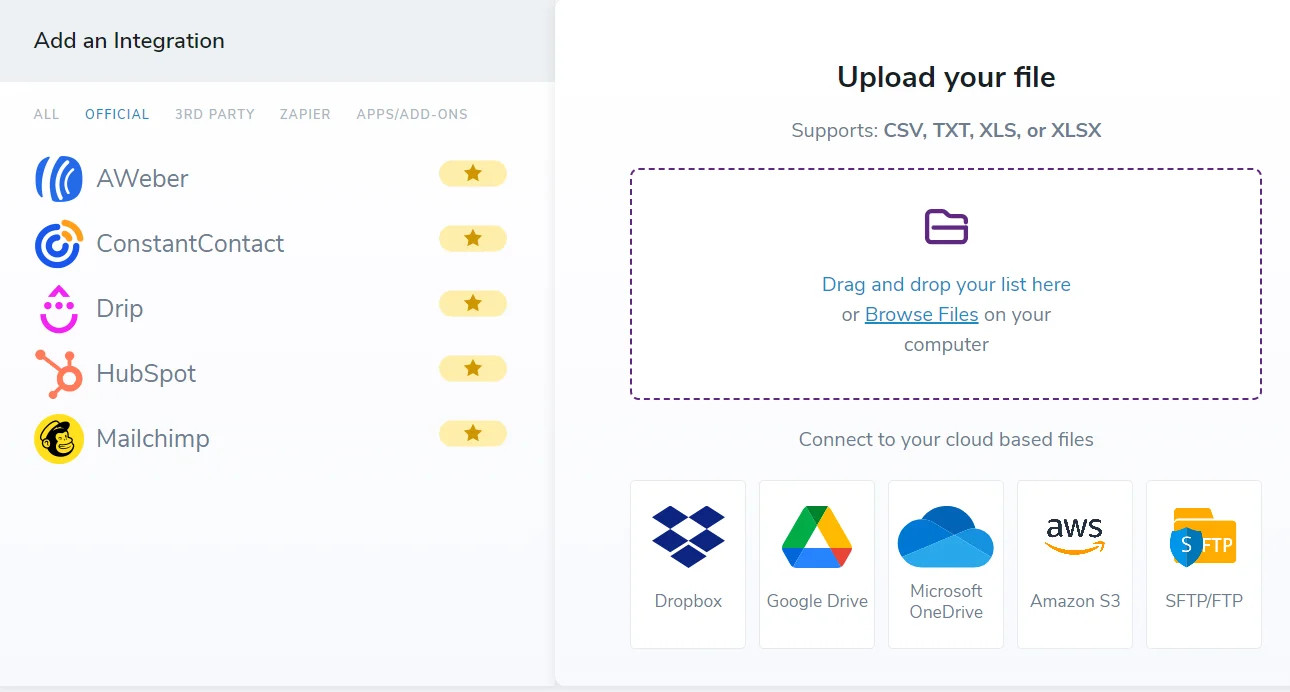
For email validationⓘ, you only need to provide the email address. The email validator then verifies the email and provides a results file with new columns that dictate the status and sub-status.
While other columns are not required, the verifier can use additional data, such as names and IPs, to enhance your email database.
For email finderⓘ, the company domain is required to perform a search. To obtain a validated email address, you must also provide a name.
ZeroBounce features more than 60 official, third-party, and Zapier integrations.
You can quickly sign in and connect your accounts in the bulk upload area for official integrations. For third-party integrations and Zapier integrations, you can find instructions for setup through the third-party provider or the integrations page.
Why did I receive the “too many invalid emails found” error?
What do I do if my file delimiter is missing?
Why are my results not in the same order as uploaded?
Why are there fewer results after validation?
When uploading a list of emails for email validation, you may receive the following error:
“Too many invalid emails found”
This error message can appear for one of the following reasons.
Whenever you upload a .CSV, .XLS, or .XLSX file, you must ensure your file’s columns match the upload tool’s findings.
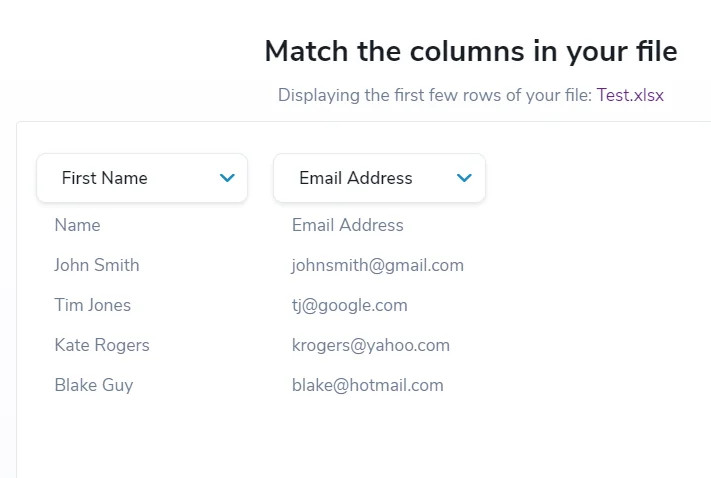
You must use the select to match the “email address” tag with your email address column. You will receive an error if you mistakenly match the “email address” tag with another column, such as names.
If you receive the “too many invalid emails found” error, double-check your column labels and re-upload your email list. Then, ensure the “email address” tag matches the appropriate column before continuing.
The “too many invalid emails found” error can also occur if there are issues with the data in your email address column.
All email addresses must follow the correct syntax, which is
username@domain.topleveldomain
Any email addresses that do not use the proper syntax are considered malformed. Malformed email addresses are automatically regarded as invalid, which can create problems uploading your list.
In addition to this, too many blank cells in your email address column can trigger this error. If there’s no data to verify, we cannot accept your list for validation.
Review your list and verify that your email addresses follow a valid format.
If you performed both troubleshooting steps above and still receive the error, please contact ZeroBounce support.
The live chat support team is highly responsive and available 24/7, and you can access it by clicking the “Chat” button in the bottom-right corner of any ZeroBounce website page. One of our email experts will be eager to review your file and diagnose the issue.
If you prefer to contact ZeroBounce by email, reach out at support@zerobounce.net. Let the support team know that you’re experiencing the “too many invalid emails found” error, and attach a sample file to examine. Please take care to protect your data, and do not email your entire email list directly.
What file formats does ZeroBounce accept?
What do I do if my file delimiter is missing?
Why are my results not in the same order as uploaded?
Why are there fewer results after validation?
ZeroBounce accepts the most common file delimiters/separators, including commas, colons, or pipes. However, there may be instances where your uploaded file uses an unsupported file delimiter type. These are referred to as “custom delimiters/separators.”
If you experience an error with your file delimiter, or if your file delimiter does not match any listed in our dropdown, please update your file with one of the supported file delimiter types.
When uploading your list, you must use one of the following file delimiters:
If you attempt to separate your file data with a different file delimiter, the email verifier will regard it as a single-column file.
Alternatively, using spreadsheet software such as Microsoft Excel or Google Sheets, you can select a new separator using these instructions:
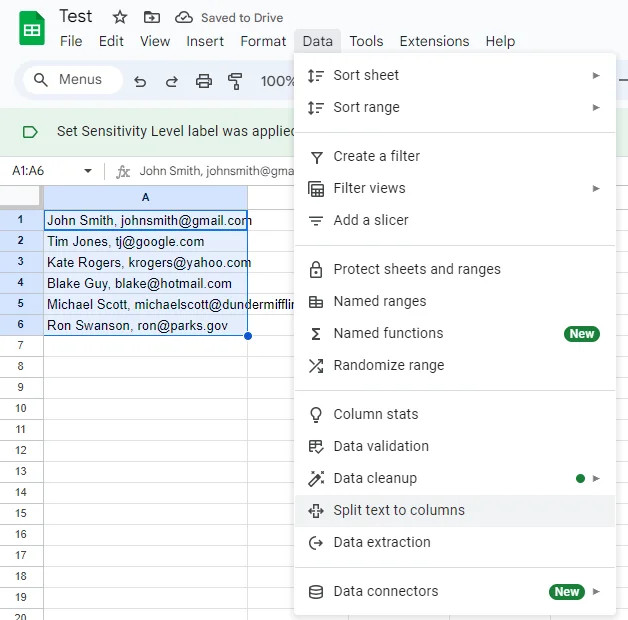
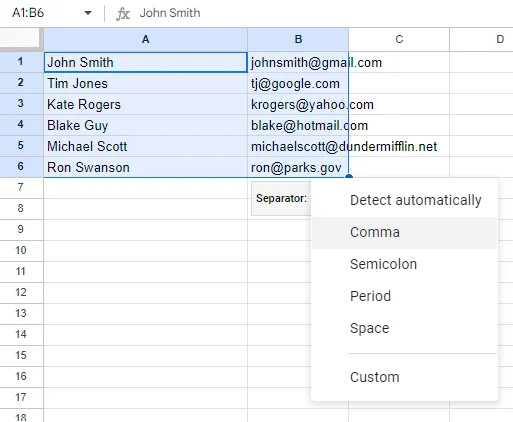
This will automatically split your file data into their respective columns using the correct file delimiter.
Please reattempt your upload after you update your file with one of the supported file delimiters.
If you continue to experience errors with your file delimiter while uploading, please contact ZeroBounce support. The team is available 24/7/365 and can swiftly help you resolve file upload issues.
To contact support via live chat, click the "Chat" button in the bottom-right corner of any ZeroBounce website page.
Alternatively, you can email support@zerobounce.net to notify the team of any outstanding issues with your experience.
What file formats does ZeroBounce accept?
Why did I receive the “too many invalid emails found” error?
Why are my results not in the same order as uploaded?
Why are there fewer results after validation?
Some email addresses take longer to validate than others. The most straightforward email address to verify will appear earlier in your results list, while more complex addresses will appear later. For this reason, your results will appear in a different order than in your original uploaded file.
ZeroBounce uses a multi-threaded email validation process to verify various complex email addresses as quickly as possible. Major ESP domains such as Yahoo, Gmail, and Hotmail validate quickly, while smaller company domains generally require further testing.
Creating a numbered column in your original spreadsheet is recommended if the order of the emails in your results is vital. This numbered column is associated with the email address, similar to the owner's name or IP address.
When you upload your file for email verification, we preserve that column and include it in your results file. You can then use that column to quickly re-sort your results.
ZeroBounce can validate emails quickly, verifying roughly 100,000 mixed email addresses in just 45 minutes. However, some addresses will return a result more rapidly than others.
The following factors can impact how quickly you obtain email verification results:
To expedite the email verification process, it's recommended to separate your email list by domain type. This is because it's much easier and quicker to verify addresses that use major freemail domains, such as Google or Yahoo.
By separating your freemail domains from less common ones, you can upload separate files for faster validation. You can then upload a dedicated list of more complex domains, which generally require additional testing.
Ultimately, the additional time taken on more complex domains allows you to obtain an accurate result. Not all company domains require complicated verification steps. The duration it takes to verify these addresses depends upon the nature of the email address and the specific domain configuration.
What file formats does ZeroBounce accept?
Why did I receive the “too many invalid emails found” error?
What do I do if my file delimiter is missing?
Why are there fewer results after validation?
Email validation files are separated by status code and zipped into their own files to assist with list segmentation. By zipping your results into separate files, you can more easily separate your invalid and high-risk email addresses and import valid emails only into your CRM.
The "Valid" file contains every email address that's verified as valid. You can safely upload this to your CRM or mailing platform. Replace your existing list with this file so you're only left with quality data.
The "catch-all" file contains every catch-all email address on your list.
A catch-all is an email address used by a company to catch incoming emails sent to incorrect or nonexistent addresses using that domain. Whether or not the catch-all address is active and checked frequently depends on the business using it.
For this reason, we recommend uploading your "Catch-All" file to your CRM or mailing platform, but as a segmented list. Emailing these addresses poses a potential risk, as some can be active or invalid. However, some may be active and regularly supervised by the owner, making them valid leads.
For all other email types, we provide results your results for reference. It's worthwhile to check which emails are invalid or high-risk to give you greater insight into your email list.
You need a program on your computer that can unzip files to gain access to your results. Zipping your results into files segments your list and compresses the data to take up less storage. It also allows us to deliver it to you quickly.
You can search for and download a free program like Winzip or 7-Zip for quick file extraction. These tools are useful to keep on your device so you can easily retrieve files from other sources or zip your data when needed.
What file formats does ZeroBounce accept?
Why did I receive the “too many invalid emails found” error?
What do I do if my file delimiter is missing?
Why are my results not in the same order as uploaded?
Why are there fewer results after validation?
The ZeroBounce email verifier automatically eliminates all duplicate and malformed email addresses from your uploaded files. This is done to clean redundant data from your list and to help you avoid using credits unnecessarily.
For example, if you upload a file containing 1,000 emails, and 10 are duplicate emails, you'll receive 990 results when verification is completed. You won't lose ten emails from your list; instead, you eliminate the unnecessary duplicates.
You can navigate to your download results screen whenever your email verification file finishes processing. Here, you will find any excluded records along with the exclusion reason.
In addition, excluded records will be in your zipped files. Those duplicate and malformed addresses exist in the file titled "_rejected.csv".
A malformed record or email address is an email that doesn't use the correct syntax. All uploaded email addresses must follow the valid format of
Username@domain.top_level_domain
For example, john@zerobounce.net uses the proper syntax.
‘John@zerobounce.n’ contains typos at the end, making it a malformed email address. Because it doesn't use the correct format, it's automatically invalid and cannot be processed.
You can safely eliminate duplicate emails from your list. However, examine any malformed emails to check for misspellings or typos that can be easily fixed.
No. ZeroBounce automatically identifies and eliminates duplicates and malformed records at no charge. Once they are identified, they are removed and ignored.
When using the ZeroBounce email verifier, you'll never need to worry about spending your credits unnecessarily on redundant data. The email verifier handles the deduplication for you, so that you can focus on more critical tasks.
What file formats does ZeroBounce accept?
Why did I receive the “too many invalid emails found” error?
What do I do if my file delimiter is missing?
ZeroBounce uses PayPal and Stripe as their primary payment processor. Therefore, you can use all payment methods that either platform accepts. Payments through Link are also now available.
PayPal currently accepts the following payment methods:
Learn more about PayPal payment methods via their Acceptance page. You can also view which countries are supported by PayPal payments to determine if you or your business is in a valid location.
ZeroBounce now supports expanded payment options through Stripe, including some popular platforms used internationally. These payment platforms include:
In addition to this, ZeroBounce supports 135 international currencies for Pay-As-You-Go purchases. When attempting checkout with a Pay-As-You-Go order, the currency will be determined based on your location.
You can find the full list of Stripe’s supported currencies on their website.
Any payment via PayPal or Stripe may be used for your ZeroBounce purchases.
You can pay for your credit or subscription via bank wire or Automated Clearing House. Please contact support@zerobounce.net for more information.
To pay for your ZeroBounce purchase with PayPal, follow these steps:
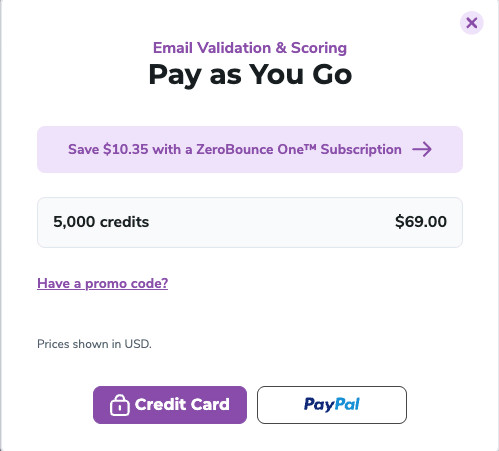
You can now use Link for a simple, one-click checkout.
To do so, follow these steps:
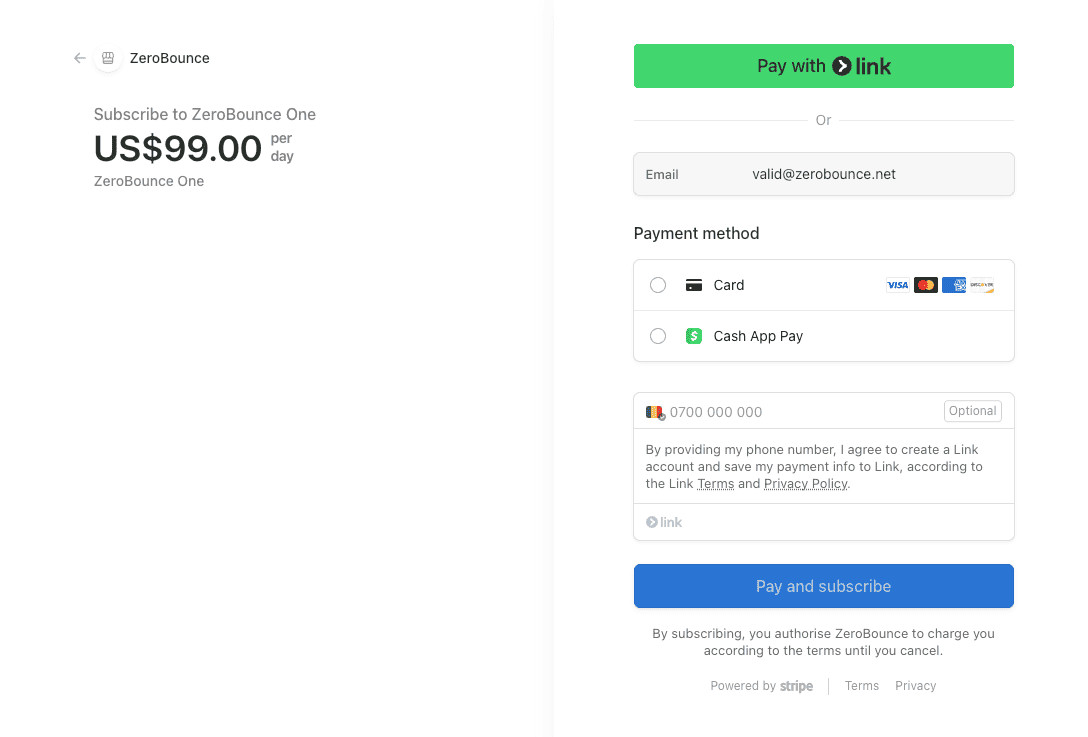
You can also securely save your Link information for future purchases by checking the box at the bottom.
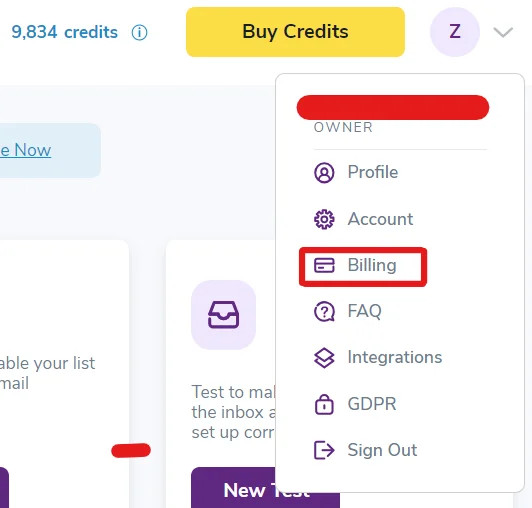
To change your payment method on file with ZeroBounce, proceed with the following steps:

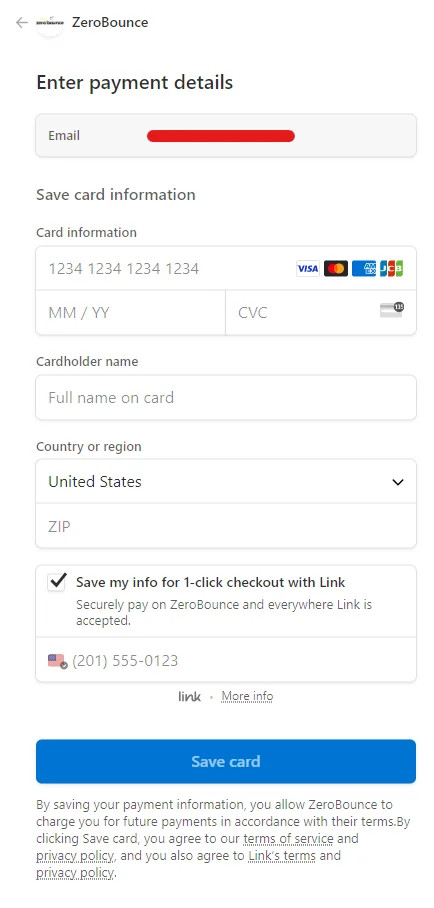
If you prefer to use the Link checkout method, check the box next to 'Save my info for 1-click checkout with Link.'
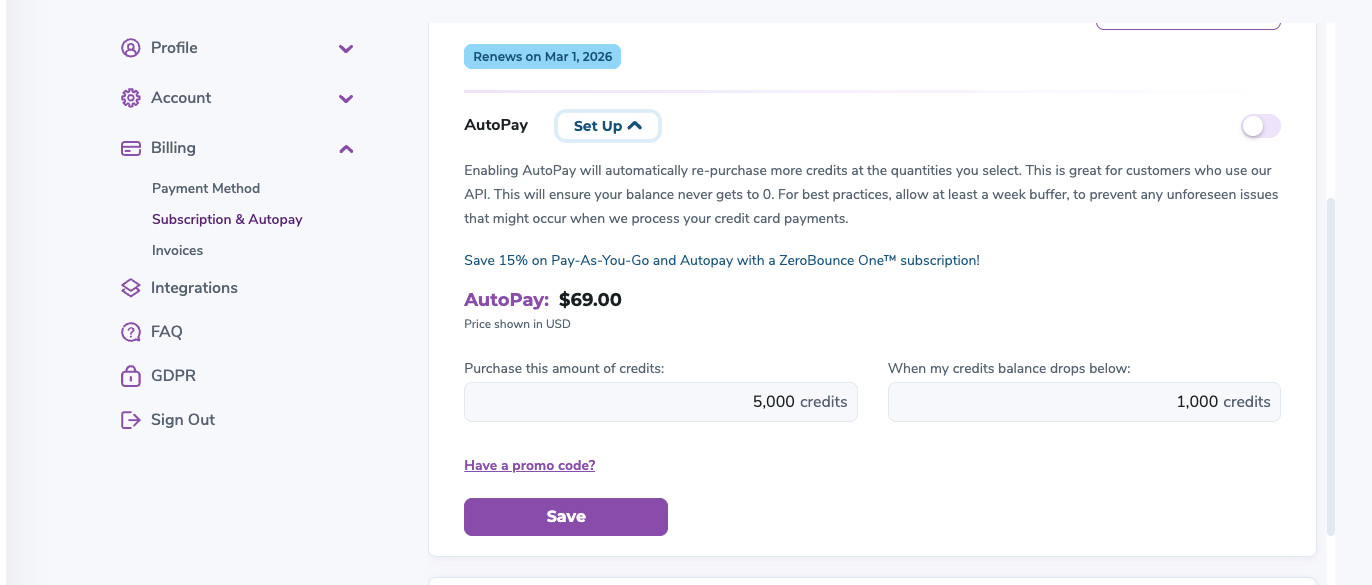
You can use any of the above payment methods to automatically add new credits to your account when your balance runs low.
To set up Autopay, follow these steps:
How do I check out as a guest with PayPal?
What does my bank decline code mean?
How is pricing determined for email verification?
Are there any discounts for bulk verification?
How to assign and update payment methods for subscriptions?
Though PayPal is one of ZeroBounce's primary customer payment methods, you don't need a PayPal account to complete your purchase. You can temporarily add your credit or debit card to PayPal to process your transaction through their service.
To temporarily add your debit or credit card to PayPal, follow these steps:

PayPal payment screen: After choosing this option, you'll see the screen below to enter your credit card information.
Be aware that sometimes, PayPal won't allow you to check out as a guest. Their reasoning can be related to browser choice, existing cookies, location, or IP address. If you have issues using the guest checkout feature, contact PayPal support for more information.
Yes. ZeroBounce also processes debit and card payments via Stripe. Click Credit Card to enter your billing information when visiting the checkout screen. You can then select whether or not you wish to save your credit card information for future payments.
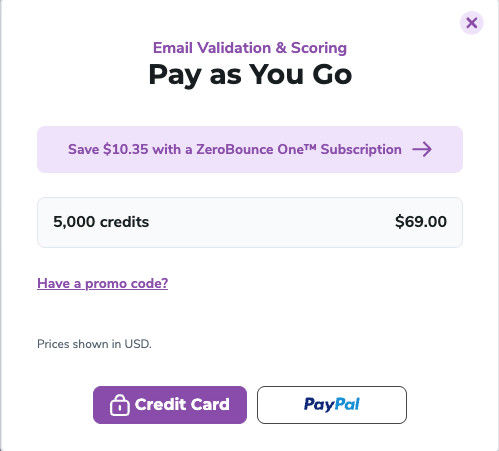
Click Credit Card to enter your debit or credit information directly.
After, we'll redirect you to our Stripe checkout screen. Here, you can also enable Stripe's "Pay with Link" feature for easy, 1-click checkouts.
Check out our complete list of accepted payment options to ensure Stripe supports your payment method.
What Payment Methods Does ZeroBounce Accept?
What does my bank decline code mean?
How is pricing determined for email verification?
Are there any discounts for bulk verification?
How to assign and update payment methods for subscriptions?
Your entire ZeroBounce invoice history is stored in your account. To access those invoices, follow these steps:
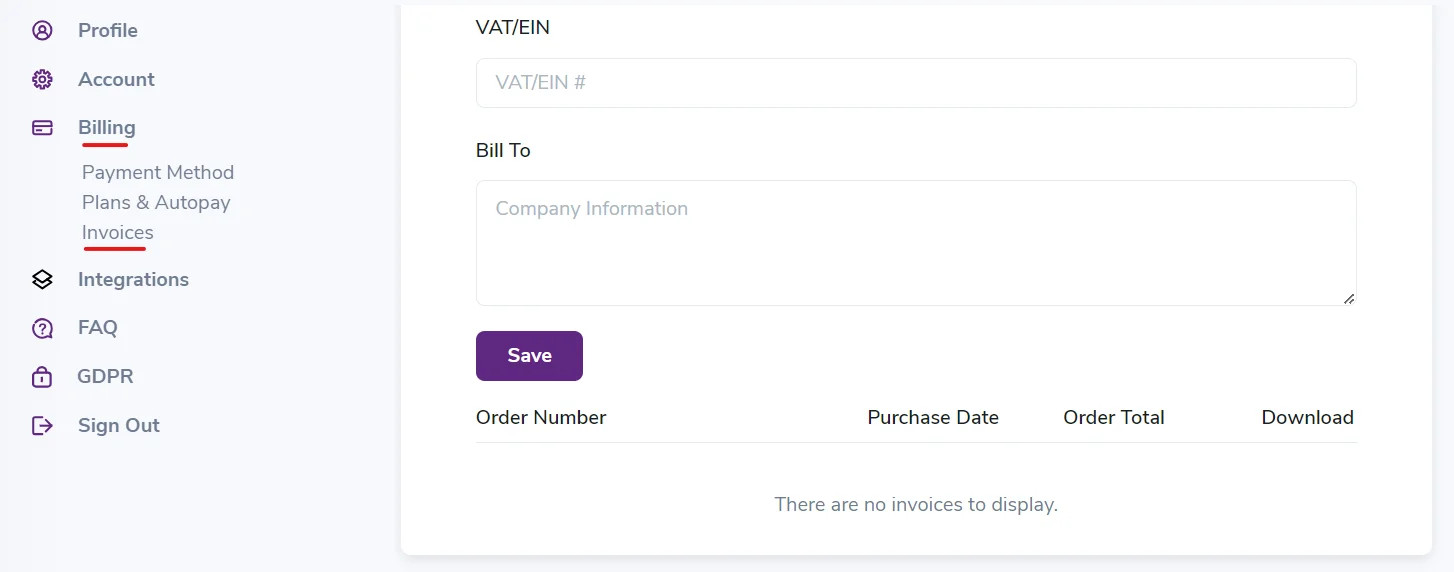
You can find your invoice history by visiting the Billing section in your ZeroBounce account settings.
Please note that the invoices in your account settings are only for your convenience. They may be missing information needed for tax-related expenses or account purposes, as PayPal does not provide this data.
ZeroBounce only has access to the information that PayPal agrees to provide, which is typically limited. Like ZeroBounce, PayPal protects their customers' payment data and doesn't transmit or share any unnecessary information to the vendor for order completion.
However, PayPal will also issue you a receipt after each ZeroBounce purchase. It's strongly recommended to store and file these receipts for your records, as they will contain complete information regarding each transaction.
You can also add documents to your invoice history.
After accessing Invoices from your Billing settings, enter an Employer Identification Number (EIN) or Value Added Tax (VAT) number in the field provided. You can also enter your invoice's relevant business name in the Bill To section.
Then, click Save.
You can then find and download invoices in your list of orders.
You can download any past invoices for your records.
Locate the invoice in your list of past orders. Then, click the download link located to the right of the order total.
What Payment Methods Does ZeroBounce Accept?
How do I check out as a guest with PayPal?
What does my bank decline code mean?
How is pricing determined for email verification?
Are there any discounts for bulk verification?
How to assign and update payment methods for subscriptions?
In some instances, your bank or card issuer may decline payment when attempting to make a purchase. They may provide a decline code that details why the transaction was declined.
Below is a list of possible decline codes and a corresponding explanation. You can also find instructions on resolving your payment issues as soon as possible.
Decline Code
If you have any additional questions regarding your declined payment, contact the support team via live chat or support@zerobounce.net.
What Payment Methods Does ZeroBounce Accept?
How do I check out as a guest with PayPal?
What does my bank decline code mean?
How is pricing determined for email verification?
Are there any discounts for bulk verification?
How to assign and update payment methods for subscriptions?
ZeroBounce uses a volume-based pricing structure for email verification. The more emails on your list you need to clean, the lower the price per email verification credit.
The minimum email verification credit purchase is 2,000 credits. You can verify one email address at the cost of one credit. Currently, 2,000 credits cost $39.00 (~$0.0195 per credit). The price per credit decreases as your purchase volume increases.
ZeroBounce does not charge for removing duplicate email addresses or for unknown results. Credits never expireⓘ.
See the table below for volume price scaling.
Be aware that you also receive 100 monthly credits for creating a free ZeroBounce account.
For the best value, a ZeroBounce ONE™ subscription provides you with 10,000 email verification credits monthly for $99 per month ($79 per month annually). Here's everything included in a ZeroBounce ONE™ subscription:
ZeroBounce ONE™ also provides a 15% discount on any additional email verification credit purchases. There are no contracts, and you can cancel a subscription at any time.
There are no contracts, and you can cancel a ZeroBounce subscription anytime.
Learn more about email verification pricing
Unique Enterprise pricing is available for purchases or monthly subscriptions over one million email verification credits.
ZeroBounce's scalable enterprise plans include:
Plans also include 1,500 testing credits to help you ensure the ZeroBounce email verifier is suitable for your company.
Learn more about enterprise plans
What Payment Methods Does ZeroBounce Accept?
How do I check out as a guest with PayPal?
What does my bank decline code mean?
Are there any discounts for bulk verification?
How to assign and update payment methods for subscriptions?
All email verification pricing is volume-based and scales with how many emails you need to verify. This scalability applies to both one-time Pay-as-you-go purchases and monthly subscription plans.
For example, with the volume discount, 2,000 email verification credits will cost more per credit than 10,000.
You can verify one email at the cost of one credit. ZeroBounce does not charge credits for duplicate emails or unknown results.
ZeroBounce credits never expireⓘ, making bulk verification purchases even better for future email list cleanings.
Check out the volume pricing scale below.
Pay-as-you-go price scaling
Monthly subscription pricing
For the best value, a ZeroBounce ONE™ subscription provides you with 10,000 email verification credits monthly for $99 per month ($79 per month annually). Here's everything included in a ZeroBounce ONE™ subscription:
ZeroBounce ONE™ also provides a 15% discount on any additional email verification credit purchases. There are no contracts, and you can cancel a subscription at any time.
In keeping with scalable volume pricing, ZeroBounce offers custom plans for enterprises with over one million email addresses.
In addition to discounted volume pricing, enterprise plans come with all of ZeroBounce's top features, including a dedicated account manager, personalized onboarding, email verification training, team accounts, unlimited email testing, and more.
You can discuss a custom enterprise pricing plan with the ZeroBounce team today. They also provide 1,500 email verification credits to test the tool before you sign up.
Learn more about ZeroBounce enterprise plans
What Payment Methods Does ZeroBounce Accept?
How do I check out as a guest with PayPal?
What does my bank decline code mean?
How is pricing determined for email verification?
To assign a payment method for ZeroBounce or credit Autopay, ensure that you have a payment method on file.
Then, follow the instructions below based on your current scenario.
If you don't have a ZeroBounce ONE™ subscription, you can get started by accessing:
If using the latter, scroll down to Subscription & Autopay and select Update Subscription. Both methods will take you to the same screen.
Next, follow these steps:
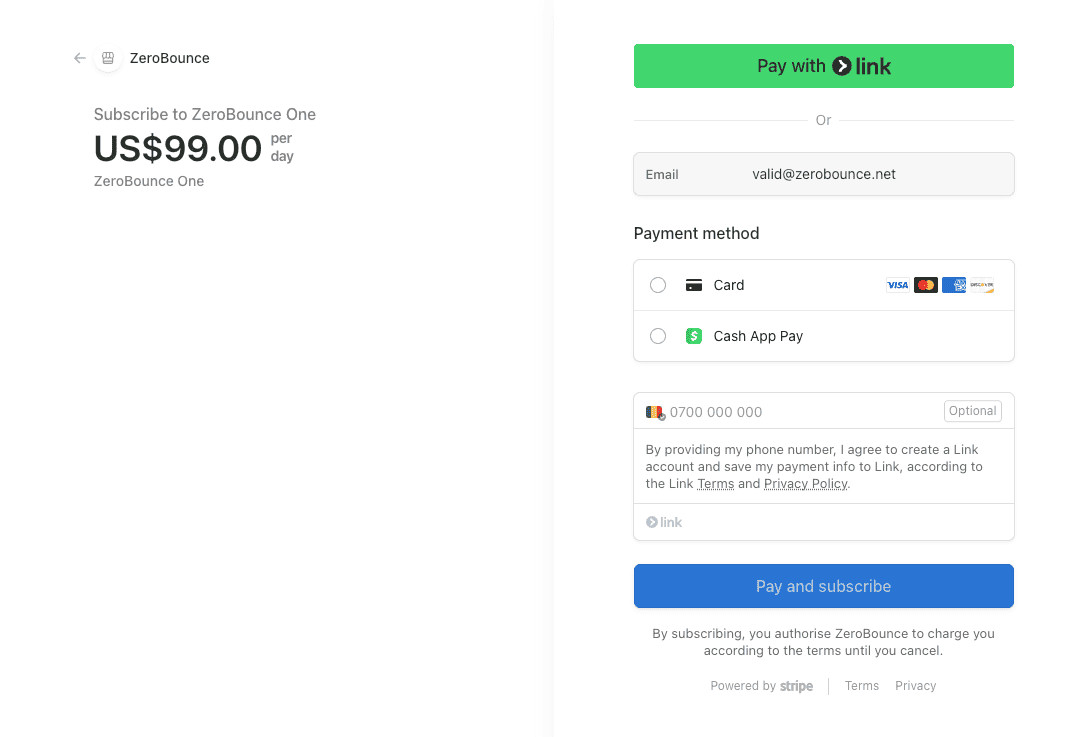
Your subscription will now appear under Billing > Subscription & Autopay. You can edit your payment method at any time from this menu.
Moving forward, you'll be able to edit your payment method attached to Autopay from the Billing menu.
If you already have a subscription and wish to update your payment method, follow these steps:
What Payment Methods Does ZeroBounce Accept?
How do I check out as a guest with PayPal?
What does my bank decline code mean?
How is pricing determined for email verification?
Are there any discounts for bulk verification?
With this new feature, we aim to enhance the user experience during identity verification, which is now simplified into four easy steps.
When a payment is put into review, a pop-up will be displayed, asking you to provide your identity. An email will also be sent to inform you that you need to verify your identity.
To confirm your identity, you'll need to complete the following steps:
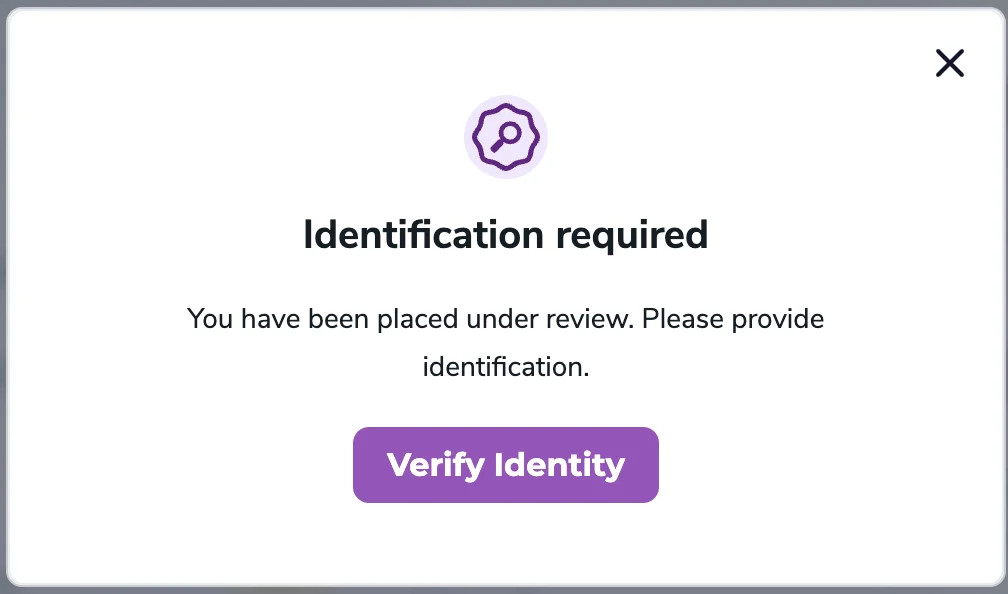
Step 1. Once you click on the 'Verify Identity' button, you'll receive a prompt from Stripe asking you to upload the required documents.
Step 2. After successfully uploading the required documents, your identity verification process begins.
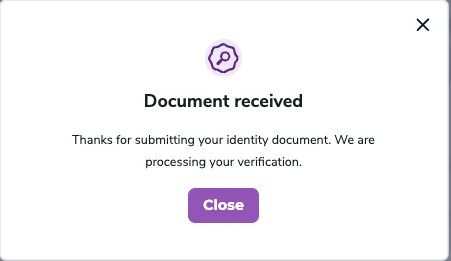

Note:
If the uploaded documents are valid, the process can take anywhere from a few minutes to a few hours.
Step 3. If the submitted documents are valid and your identity verification is successful, we'll approve your payment, and you'll receive the associated benefits.
Step 3a. If the identity verification process fails, you'll need to try again (repeat Step 2).
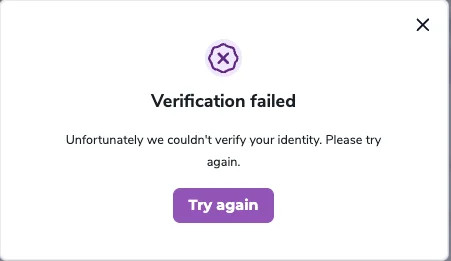
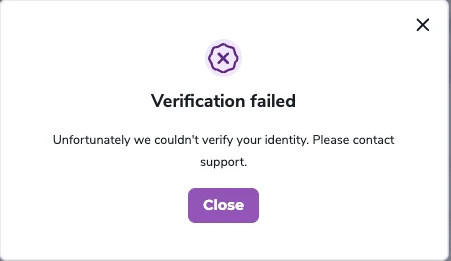
Step 4. If your identity verification process fails for the second time, you'll receive a prompt to contact support for further assistance.
A catch-all, or accept-all, domain is configured to accept emails sent to addresses at that domain even when the individual mailbox may not exist.
This makes catch-all emailsⓘ more difficult to validate. A mail server may accept both real and nonexistent addresses, so server acceptance alone doesn’t always confirm whether an individual mailbox is valid.
Businesses may use catch-all configurations to avoid missing important messages sent to incorrect or outdated email addresses.
For example, if someone mistypes an employee’s email address or sends a message to a mailbox that no longer exists, a catch-all configuration may allow the mail server to accept the message instead of immediately rejecting it.
Catch-all configurations can also make it more difficult for outside senders to determine which individual mailboxes exist at a domain.
With a typical email address, the receiving mail server may provide enough information to determine whether the individual mailbox can accept email.
Catch-all servers behave differently. Because they may accept messages for any address at the domain, including nonexistent mailboxes, traditional validation methods can have difficulty determining whether a specific address is Valid or Invalid.
That doesn’t mean every catch-all email is invalid or unsafe. Some belong to real, active mailboxes and may represent valuable contacts. The challenge is getting enough information to distinguish those addresses from ones that don’t exist.
ZeroBounce can validate many catch-all email addresses during standard email validationⓘ and return a Valid or Invalid result without requiring an additional validation phase.
This capability works across widely used email platforms, including Google Workspace, Microsoft 365, and major Secure Email Gateway (SEG) providers.
ZeroBounce also preserves the domain-level Catch-all indicator. This means an individual address can receive a Valid or Invalid result while your validation data still shows that the domain itself is configured as catch-all.
Addresses that can’t be resolved during standard validation remain classified as Catch-all.
When Verify+ is enabled, ZeroBounce can take eligible unresolved catch-all addresses through an additional validation phase called Catch-all Email Validationⓘ.
During this phase, Verify+ performs additional checks to determine whether more individual addresses can be classified as Valid or Invalid. Addresses that still can’t be resolved remain Catch-all.
→ See: Email List Validation › Verify+ for details.
No. When Verify+ is enabled and your list is eligible for Catch-all Email Validationⓘ, the additional validation phase begins after standard validation.
You can follow the progress in the same list-results view. Once the additional validation is complete, your results and downloadable files will reflect the latest classifications.
Don’t automatically assume that every unresolved catch-all email is invalid. At the same time, sending to an address that remains unconfirmed carries more risk than sending to an address ZeroBounce has validated as Valid.
Consider segmenting unresolved Catch-all results separately from your Valid contacts and use additional information before deciding whether to email them. ZeroBounce Email Scoring and your own engagement data can provide additional signals when evaluating these contacts.
Remember that Email Scoringⓘ does not determine whether an individual mailbox is Valid or Invalid. It should be used as an additional source of information rather than as a substitute for email validationⓘ or Verify+.
Check out the complete guide to catch-all email domains ->
How do you detect abuse emails?
Do my email validation credits expire?
How does ZeroBounce differ from other email verification services?
What makes ZeroBounce’s technology superior?
What industries or businesses benefit most from ZeroBounce?
You can detect abuse emails thanks to several different knowledge-gathering methods: email feedback loops, individual opt-in links found in people's emails, and reporting from reputable companies in the email sector.
ZeroBounce uses each of these methods and has curated critical relationships, all of which aid in reliably detecting abuse emails.
But first, let's explain abuse emails.
Abuse emails are email address owners frequently clicking the "Report Spam" link in their email options. Any time you receive an email, you can report it to your email service provider (ESP) as spam.
While this is a worthwhile and necessary feature, it's meant for actual spam emails. Spam emails are messages from unknown sources, are delivered at a high frequency, or contain malicious content meant to scam readers out of money or sensitive data.
The problem occurs when an email address owner reports legitimate emails as spam. If subscribers no longer wish to receive your content, they should click the unsubscribe link. These "abuse emails", however, will report spam instead.
An email feedback loop is a service in which your ESP notifies you of received spam reports. Whenever you send out your email marketing campaigns, the ESP reports your spam complaints as well, which addresses issued the complaints.
ZeroBounce uses feedback loops like these to gather large volumes of data on which email addresses issue spam complaints. They're classified as abuse emails if they're keen to submit a report rather than unsubscribe.
Adding abuse emails to your mailing list is a difficult decision and should be managed on a case-by-case basis.
When using ZeroBounce email verification, the verifier can only inform you whether an address is an abuse email. No one can predict the future and determine if the address owner will report your emails as spam.
Ultimately, it's a decision that's reliant on the knowledge of your subscribers and customers. If you have reason to believe that the contact is genuinely interested in your products or services, then you can attempt to email them. You may segment abuse emails from your standard campaigns if you're trying to message several potentially problematic recipients.
However, if you bought an email list, it's recommended to avoid them. It's more likely that the list has been resold multiple times, and the owner is likely ready to report abuse due to a previous influx of spam.
Learn more with our abuse email guide
Do my email validation credits expire?
How does ZeroBounce differ from other email verification services?
What makes ZeroBounce’s technology superior?
What industries or businesses benefit most from ZeroBounce?
You can contact ZeroBounce via email, phone, or live chat.
US/EU: support@zerobounce.net
IN: support@zerobounce.in
Phone
US: 1-888-500-9521
UK: +44-330-808-4814
IN: 1-877-924-6342
Live Chat
Accessible by visiting any page on the ZeroBounce website by clicking the "Chat" button in the bottom-right corner.
Products & Sales is available from 5 AM - 7 PM Eastern Standard Time. For Help and support, you can connect with a ZeroBounce team member 24/7, 365 days a year.
Social Media
The best way to contact your sales rep or account manager is by emailing them directly with the email they provided. If, for some reason, you don't have their business email address, please reach out to support@zerobounce.net. One of our team members can answer your questions or redirect you to the appropriate contact if necessary.
You can contact ZeroBounce regarding questions about your service using phone, email, or live chat. The live chat service is recommended for the quickest response, as a representative will always be available 24/7.
Our support team email experts can assist with any issues regarding any aspect of the ZeroBounce service. They'll also be able to provide you with resources or documentation regarding your concern.
ZeroBounce support is available 24/7, 365 days a year. You can access the live chat by visiting any page on the ZeroBounce website and clicking the "Chat" button in the bottom-right corner. You will be connected to a team member within seconds.
Yes. The ZeroBounce live chat is available 365 days a year, including all holidays recognized globally.
ZeroBounce uses Zendesk as its support ticketing system and is instrumental in helping the team keep track of all customer communications.
You can find us on social media via our profiles below:
Be aware that our response time is limited to standard business hours EST. If you need immediate support, have a specific question about your account, or need help troubleshooting, it's recommended to contact ZeroBounce directly via live chat or email.
How do you detect abuse emails?
Do my email validation credits expire?
How does ZeroBounce differ from other email verification services?
What makes ZeroBounce’s technology superior?
What industries or businesses benefit most from ZeroBounce?
Credit expiration depends on when you created your ZeroBounce account.
If you have an active ZeroBounce ONE subscription, your credits remain valid and do not expire for as long as your subscription is active.
If you created your ZeroBounce account on or before June 1, 2026, your credits never expireⓘ.
If you created your account after June 1, 2026, purchased credits expire two years after your most recent credit purchase. Each new credit purchase resets the two-year expiration period.
ZeroBounce will make reasonable efforts to notify you at your account registration email address before your credits expire.
No. Your credits remain valid and do not expire while your ZeroBounce ONE subscription is active, regardless of when you purchased them.
If you created your account after June 1, 2026 and your ZeroBounce ONE subscription ends, any unused credits will expire two years after the last day of your subscription period.
If you created your account on or before June 1, 2026, your credits never expireⓘ.
If you created your account after June 1, 2026, your unused credits do not expire immediately when your ZeroBounce ONE subscription ends. They remain valid for two years from the last day of your subscription period.
Credits purchased through promotions or promo codes are subject to the same credit expiration policy.
For accounts created on or before June 1, 2026, credits never expireⓘ. For accounts created after June 1, 2026, purchased credits expire two years after the most recent credit purchase unless you maintain an active ZeroBounce ONE subscription.
Credits are usable on email validationⓘ, Email Scoringⓘ, and Email Finderⓘ.
Email validationⓘ and Email Scoringⓘ require one credit per result, per service. For example, if you validate an email and score it, you use two credits total.
Email Finderⓘ costs 20 credits per valid result. If the result is a spam trap, suppression result, or catch-all domain, it costs one credit. No credits are consumed for Unknown results.
How do you detect abuse emails?
How does ZeroBounce differ from other email verification services?
What makes ZeroBounce’s technology superior?
What industries or businesses benefit most from ZeroBounce?
ZeroBounce differs from other email verification services in the following ways:
Below, you can find a deeper analysis of each advantage of ZeroBounce's email verification service.
ZeroBounce is one of the most accurate, in-depth email verification tools available. It can identify virtually every email type and provide the data you need to make educated decisions regarding each email contact.
Whenever you upload your email list for cleaning, you can expect 99.6% accurate results. If the service fails to deliver on its promise, you're fully entitled to a full refund of your money and credits. ZeroBounce support will also work closely with you to determine what's causing errors when validating your email list.
Many email verification services report high levels of accuracy. However, what's not stated is that those services tend to deliver higher levels of "unknown" results. The email verification tool can technically be called accurate as long as the email verification tool does not inaccurately label an email address.
However, "unknown" results leave you with no more information than you started with. If the email verification service cannot determine certain email address types or struggles to process certain domains, you won't be able to clean your email list accurately.
In addition to these results, many will contain a descriptive sub-status. ZeroBounce's detailed email verification results allow you to make the most educated decisions when keeping or deleting email addresses on your list.
Check out our email verification status codes ->
As seen above, ZeroBounce is one of the only email verification services that promises to identify spam traps and abuse email addresses accurately. Most other services don't attempt to identify these or can't do so.
In addition to detecting the email address type, ZeroBounce can provide supplemental details about the address when available, including:
All of this data is included for free with your email verification. However, you can also append Activity Data to your email verification results. This report tells you how active each email contact is based on actions taken in the last 30-180 days.
Finally, you can upload your list of clean email contacts for scoring. Email scoring uses artificial intelligence to provide a quality score for each contact on your email list so that you know which contacts are predicted to demonstrate the highest levels of engagement.
Cleaning your email list with email verification is just the first step in email marketing. ZeroBounce provides additional tools like mail server and inbox placement testing to help you maximize your email deliverability.
Finally, ZeroBounce provides email domain and reputation monitoring tools, such as blacklist and DMARC monitoring.
Other email verification services only provide the base tool. ZeroBounce provides these additional security tools to protect your email marketing from spammers, spoofers, and other bad actors.
How do you detect abuse emails?
Do my email validation credits expire?
What makes ZeroBounce’s technology superior?
What industries or businesses benefit most from ZeroBounce?
ZeroBounce's email validationⓘ technology is superior to competitor technology in the following ways:
ZeroBounce's email validation is 99.6% accurate with a money-back guarantee. More competitors are beginning to list their accuracy as 99.6%, but many still provide a high volume of "unknown" results. As long as they're not mistakenly identifying an email address with an incorrect status, they can technically classify the result as accurate.
However, an "unknown" result is not helpful when cleaning your email list.
ZeroBounce can identify more types of email addresses more accurately, leaving you with fewer unknown results than competitor email validation.
ZeroBounce achieves the highest level of accuracy thanks to its ability to identify more than 30 email statuses and sub-statuses. This extensive list includes catch-all, abuse, and spam trap emails, along with countless others.
You can review the complete list of possible email status codes via the documentation.
Many email validationⓘ services cannot identify spam traps and abuse emails. Some make the claim that accurately identifying a spam trap is impossible.
ZeroBounce works to curate relationships with crucial information providers in the email sector, which aids in helping us identify more spam trap domains and abuse emails. The company also effectively uses feedback loops (FBLs) to detect abuse emails.
While spam traps and abuse emails will not result in a bounce, they harm your campaign performance and sender reputation.
Along with accuracy, security and privacy are priority number one at ZeroBounce. No matter how vast your email list is, ZeroBounce provides sophisticated military-grade protection at every step and never stores or shares your data. Only you can see your email data before, during, and after email validationⓘ.
Some of ZeroBounce's security and privacy highlights include the following:
Most email validationⓘ services can identify catch-all emailsⓘ. However, catch-all emailsⓘ are tricky to manage as they can either be valid leads or be a one-way ticket to bounces or spam. It's better than an "unknown" result, but it can still leave you unsure how to proceed.
ZeroBounce offers Email Scoringⓘ technology that can help you better understand your catch-all emailsⓘ. Using artificial intelligence, ZeroBounce grades those catch-all emailsⓘ on a scale of 0-10, with 10 showing the most significant confidence level in contact quality and 0 being unknown.
ZeroBounce uses anti-greylisting technology to bypass standard spam filters to provide more accurate email validationⓘ results. Many email validationⓘ services cannot obtain a verification result upon meeting standard greylisting, which temporarily causes an email to bounce after the first sending attempt.
ZeroBounce's anti-greylisting technology circumvents this by automatically reattempting verification without expending additional credits.
Finally, ZeroBounce technology is available to integrate with over 60 major SaaS, CRM, sales, and email marketing platforms. These seamless integrations allow you to accurately validate emails without interrupting your standard workflow.
How do you detect abuse emails?
Do my email validation credits expire?
How does ZeroBounce differ from other email verification services?
What industries or businesses benefit most from ZeroBounce?
Any business or industry that uses mass email communications for marketing or messaging will benefit from ZeroBounce's email validationⓘ. Unlike general consumers who send out relatively few emails, by comparison, most businesses send out tens, if not hundreds, of thousands of emails weekly. For this reason, those businesses and industries must perform their due diligence in ensuring they use the safest and best practices when sending emails to subscribers.
Businesses need email validationⓘ to protect their sender reputation and distinguish themselves from spammers. Spammers are the only other email sender that regularly emails a massive list simultaneously. They do this to deceive recipients or steal their data using various phishing methods.
To protect recipients from spam content, internet service providers (ISP) issue email domains and IP addresses an email sender scoreⓘ. This numerical grade communicates a company's behavioral habits when sending emails. Companies with low sender scores are deemed untrustworthy, making it more difficult to deliver messages to the inbox.
Email validationⓘ helps boost your sender scoreⓘ by eliminating invalid email addresses from your subscriber database. Any email you send to an invalid email will result in a bounce. The higher your email bounce rateⓘ, the lower your sender scoreⓘ.
Thus, legitimate businesses and industries require email validationⓘ to protect their reputation and deliver emails successfully.
B2B and B2C businesses benefit equally from ZeroBounce's email verification. The only difference is that B2C businesses message personal email addresses, while B2B businesses target professional emails. In both cases, the business needs a list of valid emails to avoid a high bounce rate.
B2C will likely have more free email addresses (i.e., Google, Yahoo, etc.). B2B businesses generally have email address lists featuring other company domains (i.e., johnsmith@company.com). In either case, ZeroBounce's email validator can accurately identify the validity of any email address, regardless of the domain type.
Questions About Our Services FAQs
How do you detect abuse emails?
Do my email validation credits expire?
How does ZeroBounce differ from other email verification services?
ZeroBounce ensures the privacy of customer email lists by providing military-grade security and strict adherence to international privacy laws and regulations. ZeroBounce also relies solely on proprietary infrastructure. No email data is shared with external parties, giving the company complete control over your privacy and security.
Below is a list of existing security and compliance measures practiced and observed by the ZeroBounce team.
To date, ZeroBounce currently possesses the following certifications regarding customer data privacy:
ZeroBounce continues to monitor changes to existing privacy regulations as well as new laws, including the newly-announced India Digital Personal Data Protection Bill.
In an ongoing effort to ensure the privacy of your email list and personal data, ZeroBounce is committed to undergoing regular examinations by the necessary parties to ensure that their platform security is up to standards.
The ZeroBounce security and compliance team also monitors, tests, and improves platform cybersecurity with the following actions:
ZeroBounce works closely with internationally recognized cybersecurity experts such as Intigriti and BitSentinel to scrutinize its security measures from every possible angle.
Finally, ZeroBounce ensures the privacy of your email list by providing several identity protection tools, enabling you to control who has access to your account.
The list of identity protection features includes the following:
In addition to these features, all uploaded email list data is automatically deleted from your account after 30 days. The only person who can download your email list and email validation results is the user with the encrypted password key.
After 30 days, ZeroBounce auto-deletes your email list data, and users will no longer have access to those files.
View ZeroBounce's complete list of security features
Are my emails stored after verification?
Why is it essential to choose a secure email verification provider?
What risks are associated with the insecure handling of email lists?
What is GDPR, and why is it relevant to email marketing?
ZeroBounce never stores your email data. At no point can a ZeroBounce employee review your data or results without your consent. Your emails only interact with ZeroBounce tools for verification. Then, those emails and the email validation results are placed into an encrypted file with an encryption key only you receive.
Your encrypted email verification results file is available for download 30 days after validation. ZeroBounce will also email you when your file is a few days from auto-deletion.
All email validation results files are stored in encrypted folders. To open this encrypted file, you will require the one-time encryption key delivered to you via your account when the verification process is complete.
ZeroBounce cannot access this verification key and upholds strict security measures to minimize external threats and protect your account.
Any person with team access to your ZeroBounce account can download verification results before the 30 days expire. Additionally, you can use your encryption key to open your results files and share the data with team members from the security of your infrastructure.
The ZeroBounce team can investigate and troubleshoot any potential issues with the email validationⓘ service without the need to view your emails. If necessary, a support representative may work with you regarding your email list to troubleshoot any possible issues with your list.
In all situations, ZeroBounce takes every measure to eliminate the need for you to share email data or risk your company's or your customers' privacy. For this reason, you never need to worry about your data being compromised or stolen from a stored location.
How Does ZeroBounce Ensure the Privacy of My Email List?
Why is it essential to choose a secure email verification provider?
What risks are associated with the insecure handling of email lists?
What is GDPR, and why is it relevant to email marketing?
Choosing a secure email verification provider is essential because your company has a personal and legal obligation to protect sensitive customer data. Subscribers and clients only agree to share their data with your company, and risking their privacy can potentially violate national and international privacy regulations. Attackers may be able to access your email list data and use their information for spam and phishing scams.
In addition, attackers who target an unsecure email verification platform can link your company with your email list data. Your company and email domain may become a prime target for spammers to use when selecting a domain to impersonate to appear legitimate. Your customers may mistake illegitimate emails as being from your team, causing you to lose your audience's trust.
The legal consequences of sharing email address data without permission depend upon the address owner's location. Below are some digital personal data privacy laws to be aware of:
Any customer that places their data into your company's hands is putting their trust in your security. A violation of that trust traced back to your business will result in lost trust from those customers and any potential customers who learn about the security breach.
This rule applies not only to email address data but also to names, addresses, financial data, and any other sensitive information belonging to the customer. While the email verification provider may be responsible for the security breach, your company will suffer damage to its reputation.
It's strongly recommended to thoroughly research different email verification providers and inquire about their security and privacy practices. Choose an email verification company that values customer privacy as your business does.
How Does ZeroBounce Ensure the Privacy of My Email List?
Are my emails stored after verification?
What risks are associated with the insecure handling of email lists?
What is GDPR, and why is it relevant to email marketing?
As a business, failure to maintain the privacy and security of subscribers on your email lists presents both professional and legal risks. Unknowingly or accidentally sharing customer data due to insufficient security measures can result in lost consumer confidence as well as financial penalties.
When a customer creates an account, registers for a mailing list, or purchases with your company, they're trusting you with their confidential information. There's an implicit understanding that it's your business's responsibility to secure and protect its data and to delete it when it's no longer needed.
Consumers are intelligent and are aware when their information is shared without their consent or compromised. If your company is responsible for a sudden influx of spam, phishing scams, or even online fraud, your reputation will take a hit. Additionally, affected customers can take legal action if the compromised data results in personal or financial losses.
Aside from legal consequences, consumers only want to shop with secure businesses. A single mishandling of your email lists can cause a customer to lose confidence in your business for life. It takes a huge investment to build trust and just one mistake to lose it.
There are numerous laws throughout the world regarding data privacy, and those rules can differ based on the person's location. Some of these regulations include the following:
These laws describe the rights of persons and the rules a company must follow when collecting, using, or sharing personal information. Email address and email list data are included in these data protection rules.
The rights and rules guaranteed by each bill differ in various ways, but the general highlights are as follows:
The insecure handling of email lists can result in compromising your customers' data. Violating your responsibility to protect your customers' personal information can result in heavy fines depending on the size of the offense and the number of affected customers.
Insecure handling of email lists presents risks that your company can't afford to take. When choosing an email verification company, be sure to investigate its security and privacy measures to ensure that the necessary processes are in place to protect your email lists.
How Does ZeroBounce Ensure the Privacy of My Email List?
Are my emails stored after verification?
Why is it essential to choose a secure email verification provider?
What is GDPR, and why is it relevant to email marketing?
GDPR, which stands for General Data Protection Regulation, is a European Union privacy law that communicates the rights of persons regarding the handling and protection of their personal data.
Knowledge and compliance with EU GDPR are critical for anyone in email marketing. These rules will determine when you can email a person and what you may do with their email address or other identifying information.
Here are some significant highlights of GDPR you must know as an email marketer:
All of these listed items are immediately relevant to anyone sending marketing emails. These rules effectively make businesses responsible for securing and organizing customer email data responsibly. When businesses take greater care of their email data, there's less chance of a person's email data being misused or stolen in spam attacks or phishing scams.
Violating GDPR, whether through accidental or intentional means, is a criminal offense and comes with severe financial penalties. However, minor infringements with no prior violations may result in a warning.
As a rule, the penalties for violating GDPR are proportional to the nature of the offense. For severe offenses, the punishment is a multi-million dollar fine or a percentage of the company's prior year's fiscal earnings, whichever is higher.
Understanding and complying with GDPR is also essential for earning the trust of your subscribers and customers located in the EU.
Your company has both an email sender reputation (determined by internet service providers) as well as a word-of-mouth reputation that will follow it online. If you fail to honor GDPR law, you can expect to experience a higher volume of spam complaints, more bounced emails, and lower email deliverability.
In addition, customers are less likely to do business with a company that doesn't take customer security and privacy as seriously as they should.
Complying with EU GDPR not only maintains public trust but will improve your email sender reputation with ISPs as well as your email deliverability. All will positively impact the results and ROI of your email marketing efforts.
How Does ZeroBounce Ensure the Privacy of My Email List?
Are my emails stored after verification?
Why is it essential to choose a secure email verification provider?
What risks are associated with the insecure handling of email lists?
Email validationⓘ file processing can take a variable amount of time, depending on how frequently ZeroBounce encounters anti-spam technology during verification. The most common of these is email greylisting. Whenever the email validator encounters greylisting (a 421 response code), it will delay the entire file processing time by up to 35 minutes. Though processing time is extended, ZeroBounce's anti-greylisting technology allows you to obtain more accurate validation results and fewer unknowns.
Greylisting is an email spam prevention tactic in which mail servers temporarily reject or bounce incoming emails from unknown domains. It's an excellent way to ward off spam messages from email domains that don't have the proper configuration to reattempt delivery.
Many remote mail servers with greylisting will issue a 421 response code initially. Then, after a period (usually up to 30 minutes), they will allow emails to be delivered from the originally greylisted domain. Greylisting is a problem for email validation as it will automatically reject initial attempts to verify an email address.
To combat this and provide accurate email validation results, ZeroBounce deploys breakthrough anti-greylisting technology. If an email address in your file yields the 421 response code, the email validator delays your processing time by up to 35 minutes to bypass the greylisting. It can then successfully validate the email addresses.
Typically, it takes around one to three hours to validate 100,000 mixed domain email addresses. So, if your file contains 1 million email addresses, you might use math and assume validation will take between 10 and 30 hours.
The good news is that the effects of email greylisting aren't multiplied. A file containing 1 million email addresses will take between three and twenty-three hours to validate, but the average is closer to seven hours.
In addition, there will be little to no wait time to start processing your file. However, it's possible that if many customers submit large files simultaneously, it may create a minor delay before your file begins processing. When ZeroBounce experiences high queue times, the email validation company adds additional servers to compensate for the additional stress. The company uses all resources necessary to care for all customers adequately.
ZeroBounce validates email addresses as quickly as technology allows while still providing 99.6% accurate results. Processing times will always be dependent upon the complexity of the uploaded domains and the configuration of those mail servers.
Compare this to many other email validation services that boast high accuracy levels. While some may return your file faster, you'll immediately notice that more of your email addresses have the validation status of "unknown". Unknown results are of no use for your email marketing.
Additionally, ZeroBounce continuously works to improve its email validation and scoring services to provide faster processing while maintaining its superior accuracy levels. All processing times are comparable, if not often faster, than competitor email validation services.
Why do I need a password to open my processed file?
How do I get a password to decrypt my file?
Why is my Overview PDF report blank?
Why are some emails missing append features?
Why do I get the error “unable to expand” with Archive Utility?
Where can I get software to open the CSV file?
Why is my bounce rate high after email cleaning?
Why can’t I find my file on Windows?
Why is the CSV I downloaded incorrectly formatted in Excel?
ZeroBounce users will require a password to open a processed email validation file for data security purposes.
ZeroBounce takes your data privacy and security seriously. When you download a processed file, a unique password is automatically generated and emailed to the address associated with your account. You will need this password to access your email validation results.
This additional security layer ensures that no one other than you may access your private data. If someone were to compromise your ZeroBounce account, your data would remain protected as they cannot access your file data without the encryption key.
The password you receive via email only applies to the file you downloaded as well as that specific instance of the download. If you were to redownload the same file a second time, ZeroBounce would email you a new password to access that version of the same file.
You can expect a new password any time you attempt to download a processed file with your account.
You may disable password-protected downloads. However, this is strongly discouraged as it puts your email data at risk. If at any point your ZeroBounce account is compromised, any person will be able to download and access your processed files.
If you still wish to disable password-protected downloads, you can do so by visiting your Profile settings within your account. Then, scroll down to Security Settings and switch the toggle off next to Password-Protected Downloads. You'll receive a follow-up email requesting you to click on a confirmation link to confirm your choice.
You can re-enable password-protected downloads at any time by switching the toggle back on in your settings.
By disabling password-protected downloads, any person with access to the file can view the data inside. In the event of an unauthorized attempt to access your ZeroBounce account or personal device, the attacking person will be able to access your private email data easily. Not only is this a violation of your security, but it jeopardizes the privacy of all of your email subscribers and customers.
Attackers may use your email data to gather email addresses for their spam and phishing scams. They may also use the knowledge that your company is associated with these addresses to impersonate your business via email.
ZeroBounce takes every measure to secure its platform and tools, but users should also invest in their security by using features like password-protected downloads and two-factor authentication.
Why Is My File Taking So Long to Process?
How do I get a password to decrypt my file?
Why is my Overview PDF report blank?
Why are some emails missing append features?
Why do I get the error “unable to expand” with Archive Utility?
Where can I get software to open the CSV file?
Why is my bounce rate high after email cleaning?
Why can’t I find my file on Windows?
Why is the CSV I downloaded incorrectly formatted in Excel?
You will automatically receive a password to decrypt your file via email after downloading your file. The password will be delivered to the email address associated with your account and should arrive soon after downloading your email validation results. Be aware that a new password will be sent to your address every time you download a results file (even if it's the same file).
ZeroBounce generates and delivers a unique password for each download for the security of your data. This process protects you from any scenarios in which someone gains access to your account or personal computer. Even if they are able to locate the results file, they cannot unzip it without the encryption key.
If, for any reason, you do not receive an email with your password, please retry downloading your file. Every time you download a file, a new password is generated and sent to your email address. You should always receive this automated email to decrypt your file.
If you encounter any issues with this process, please reach out to ZeroBounce support at support or contact the team 24/7 via live chat.
You can turn off password-protected downloads via your ZeroBounce account settings. Sign in to your account and locate the toggle under Security Settings. After switching the toggle off, look for a follow-up email and click the confirmation link inside.
Be aware that turning off password-protected downloads leaves your email list data at unnecessary risk. If you need to turn it off for any reason temporarily, be sure to revisit your account settings and enable it as soon as possible. While there, ZeroBounce also recommends enabling two-factor authentication with Google and SMS for similar protections.
Why Is My File Taking So Long to Process?
Why do I need a password to open my processed file?
Why is my Overview PDF report blank?
Why are some emails missing append features?
Why do I get the error “unable to expand” with Archive Utility?
Where can I get software to open the CSV file?
Why is my bounce rate high after email cleaning?
Why can’t I find my file on Windows?
Why is the CSV I downloaded incorrectly formatted in Excel?
When viewing the PDF of your Overview report in your email validationⓘ results, the file can appear blank. The reason for this is a known issue with Mac OS X and its default PDF viewer.
To workaround this issue, you may close and reopen the file using the default PDF viewer. Alternatively, it's recommended to use either Adobe Acrobat PDF Reader or open the file with the Google Chrome browser. Both are free and reliable for opening and browsing files.
ZeroBounce currently only offers your Overview report as a PDF. ZeroBounce generates this custom report for your benefit to give you a top-level view of how many valid, invalid, abuse, spam trap, catch-all, and do-not-mail email addresses were on your list.
The Overview report is the only PDF you'll find in your downloaded file. All other results files will be returned as a CSV, which is compatible with most CRMs and spreadsheet software.
If, for any reason, you can't open your PDF report, you can contact ZeroBounce support for additional assistance. Please email support@zerobounce.net or reach out via live chat using www.zerobounce.net.
Alternatively, you can also use a conversion tool to change the file type from PDF to your preferred format. Most conversion software is free and makes it simple for you to convert any file type from one format to another.
No - your email validationⓘ results file only contains a top-level Overview report that summarizes your results.
For more specific insights regarding which email addresses fall into each category, you'll find CSV documents in the zipped file for each email type. You can open these documents and find a complete list of email addresses that fall into each category.
ZeroBounce also returns your originally uploaded file for your records.
Why Is My File Taking So Long to Process?
Why do I need a password to open my processed file?
How do I get a password to decrypt my file?
Why are some emails missing append features?
Why do I get the error “unable to expand” with Archive Utility?
Where can I get software to open the CSV file?
Why is my bounce rate high after email cleaning?
Why can’t I find my file on Windows?
Why is the CSV I downloaded incorrectly formatted in Excel?
ZeroBounce takes every measure to append additional data to your email addresses, including first names, last names, gender, and other details. However, appended data is not guaranteed, and it can't be retrieved in every instance. The success rate largely depends on the quality of the email addresses on your list and the complexity of the domains.
The more information you know about your customers, the better you're able to communicate with them via email. ZeroBounce provides the data append feature for free with an over 80% data appends success rate on average. However, the success rate can vary significantly depending on the email list. In some instances, it can be lower than 10%.
ZeroBounce gathers regarding your email contacts via reliable third-party sources. The company maintains contracts with these parties to source information when possible and available.
It's essential to note that ZeroBounce never uses any stored or processed customer data with this feature. To do this goes against the company's Privacy Policy and strict security requirements. ZeroBounce does not have any database containing information for appends and only is able to provide this information by sourcing it in real time during email validation.
ZeroBounce can append additional information when available, including:
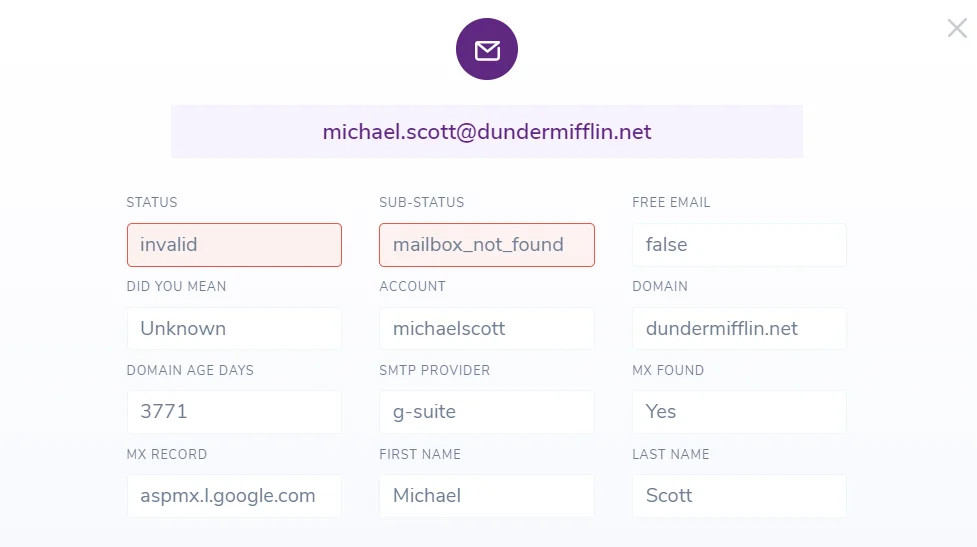
Each email address may receive all, some, or none of this information depending on whether or not it's available and able to be retrieved. If you also provide IP addresses with the email addresses, your Overview report can also show you the various demographics by country, region, and state.
Do you have questions about the data appends for your validated email list? Please reach out to the ZeroBounce support team at support or by visiting the live chat at here.
Why Is My File Taking So Long to Process?
Why do I need a password to open my processed file?
How do I get a password to decrypt my file?
Why is my Overview PDF report blank?
Why do I get the error “unable to expand” with Archive Utility?
Where can I get software to open the CSV file?
Why is my bounce rate high after email cleaning?
Why can’t I find my file on Windows?
Why is the CSV I downloaded incorrectly formatted in Excel?
If you download an email validation results file using Mac OS, you may encounter the error "Unable to expand 'file name'" with the Archive Utility.
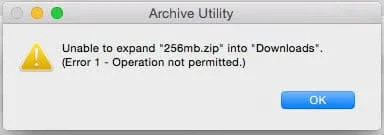
There are a few known fixes for this that you can implement, including this Terminal workaround in the video below:
For Mac Users Only: How to Unzip a File (Fixing Mac Error 1 - Operation Not Permitted)
For text-based instructions, the Terminal workaround is explained step-by-step below.
Access your Search function by clicking the magnifying glass in the top-right corner of your Home screen. Search for "Terminal" and double-click the option.

*Open the terminal by clicking the magnifying glass on the top right or by pushing "command + spacebar"
Your terminal will now be displayed on your screen. Type "unzip " with an intentional space.
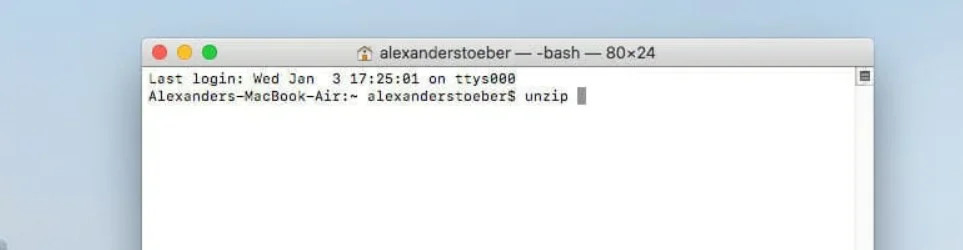
Terminal window
Drag the protected .zip file into this window and press enter.
![Terminal window in Mac OS that contains the ,[object Object], results file](https://www.zerobounce.net/cdn-cgi/image/fit=scale-down,format=auto,quality=90,width=1920,metadata=none/docs/assets_next_docs/docs/faq/issues6.webp)
Terminal window in Mac OS that contains the results file
You'll be prompted for a password denoted by a key character. Access your email to copy the password.
Example email from ZeroBounce that contains the password to decrypt a file
Paste the password into the Terminal and press "Enter." You'll see that your .zip file has been expanded under your user profile in "Users."
Terminal prompts you to enter the password to open your file
After successfully entering the zip file password, the Terminal will appear with new file information, similar to what's shown below.
After entering your password, Terminal will unzip the file and show the file names within
Enable "Hard disk" under "Show these items on the desktop:" in your Finder settings. This step will allow you to access your "Users" folder.
To do this, go to your Finder settings using the top menu and select "Finder Preferences."
Finder Preferences window in Mac OS
Access your "Macintosh HD" drive on your desktop and open the "Users" folder.
Finder window for the Macintosh HD drive
Open your user folder, and you will see the series of .csv files that were unpacked from your .zip file. For a more detailed description of each file, visit our "Analyzing Your Results" documentation.
![Unzipped ZeroBounce ,[object Object], results file in a Mac OS Finder window](https://www.zerobounce.net/cdn-cgi/image/fit=scale-down,format=auto,quality=90,width=1920,metadata=none/docs/assets_next_docs/docs/faq/issues12.webp)
Unzipped ZeroBounce email validationⓘ results file in the Finder window
If the above process doesn't solve the issue, please try these additional options:
Why Is My File Taking So Long to Process?
Why do I need a password to open my processed file?
How do I get a password to decrypt my file?
Why is my Overview PDF report blank?
Why are some emails missing append features?
Where can I get software to open the CSV file?
Why is my bounce rate high after email cleaning?
Why can’t I find my file on Windows?
Why is the CSV I downloaded incorrectly formatted in Excel?
There is a variety of free software available online that allows you to upload CSV files for viewing and editing. Below is a list of recommended software you can use today:
Beyond these recommendations, there are hundreds of freeware available online, including browser extensions as well as desktop and mobile apps. Be sure to review the security and privacy options available when uploading your data to new software.
If you have access to the Microsoft 365 Office Suite, Microsoft Excel is also a highly recommended product to use for CSV viewing. Realistically, any spreadsheet software should be able to accept any CSV file upload.
You may also upload a CSV file to virtually any platform that provides CRM software. ZeroBounce recommends reviewing your email validation results first before uploading your cleaned email contacts to your CRM. You'll gain insight into which email addresses were invalid or high-risk so that you can make more educated choices when replacing your existing email list.
Your email validation results file accommodates this by providing multiple CSV files - one file for each validation status result. Valid emails are safe to upload to your CRM, whereas invalids can be safely removed.
We generally recommend eliminating abuse email addresses, but feel free to examine your results to make your final choice. You may know your email contacts better, and it may be worth pursuing subscribers who are classified as spam abusers if they're legitimately interested in your products or services.
Finally, it's recommended to take the addresses in your catch-all CSV file and upload them for Email Scoring. This process will score those email addresses on a scale of 1-10, with "10" showing a high level of engagement and activity and "1" showing minimal to no activity ("0" indicates an unknown result).
Your CSV viewer of choice will allow you to review every CSV document in your zipped file so that you can improve your email list with ZeroBounce's 99.6% accurate email validation results.
Why Is My File Taking So Long to Process?
Why do I need a password to open my processed file?
How do I get a password to decrypt my file?
Why is my Overview PDF report blank?
Why are some emails missing append features?
Why do I get the error “unable to expand” with Archive Utility?
Why is my bounce rate high after email cleaning?
Why can’t I find my file on Windows?
Why is the CSV I downloaded incorrectly formatted in Excel?
While invalid email addresses are a significant factor for high bounce rates, they're not the only culprit. If your email bounce rate is still high after your email list cleaning is complete, many different factors may be at play. These variables are unrelated to whether or not the email address is valid or invalid.
Here are some examples of what can cause a high email bounce rate:
All of these examples can cause your emails to bounce even if the email address is "valid."
To understand what's causing a bounce, you'll need to access your Simple Mail Transfer Protocol (SMTP) logs and analyze the associated SMTP bounce codes. These are generally three-digit codes that have a universal meaning regardless of your email delivery service. Different mail service providers often have their own custom response codes, so be sure to investigate yours with your provider.
If you continue to experience a high email bounce rate, and it's not a result of one of the examples above, ZeroBounce will assist.
Reach out to the support team at support@zerobounce.net. Attach the bounced email in question along with the corresponding SMTP bounce code. The team will be happy to investigate any unexpected bounces as part of the company's accuracy guarantee.
For additional assistance with overcoming email deliverability issues, ZeroBounce put together The Complete Email Deliverability Guide, along with help from email marketing experts around the industry. The content covers how to navigate and troubleshoot common email delivery problems as well as best practices for your company to use moving forward.
Why Is My File Taking So Long to Process?
Why do I need a password to open my processed file?
How do I get a password to decrypt my file?
Why is my Overview PDF report blank?
Why are some emails missing append features?
Why do I get the error “unable to expand” with Archive Utility?
Where can I get software to open the CSV file?
Why can’t I find my file on Windows?
Why is the CSV I downloaded incorrectly formatted in Excel?
You may experience an error locating your email validationⓘ results file if the file name is too long. The reason for this is that Microsoft Windows caps the file name and path character limit to 260 characters. Because you're accessing another file within the zip file, the complete file name may exceed this limit.
There are numerous ways to work around the file access issue on Windows.
If none of these methods work, or if you're uncomfortable/uncertain about making changes, you can contact ZeroBounce support. The team can modify your results file name to ensure it meets the 260-character requirement when downloaded.
Be aware that even if you update your device's registry to allow for more than 260 characters, other software you might use can still impose this limit. This creates a scenario where Windows will let you download and store the file on your drive, but you'll still have issues opening the file with whichever software you use.
Microsoft Office 365 products like Excel or Word also have restrictions on file path names, whereas the Google product suite doesn't.
It's ultimately beneficial to use best practices when naming and storing files. To avoid having issues accessing your files with ZeroBounce or any other software, commit to these rules:
By using these best practices for file names, you'll encounter fewer issues with finding files. You'll rarely exceed the Windows character limit, and your files will be far more organized and accessible.
Why Is My File Taking So Long to Process?
Why do I need a password to open my processed file?
How do I get a password to decrypt my file?
Why is my Overview PDF report blank?
Why are some emails missing append features?
Why do I get the error “unable to expand” with Archive Utility?
Where can I get software to open the CSV file?
Why is my bounce rate high after email cleaning?
Why is the CSV I downloaded incorrectly formatted in Excel?
Incorrect formatting of your CSV email validationⓘ results file may occur in Microsoft Excel. This error occurs because Excel often doesn't auto-detect the file delimiter and, instead, puts all of the results data into a single column.
Thankfully, you can circumvent this issue by using the following steps:
![Screenshot of the Text/CSV transform section in Excel with an ,[object Object], results file](https://www.zerobounce.net/cdn-cgi/image/fit=scale-down,format=auto,quality=90,width=1200,metadata=none/docs/assets_next_docs/docs/faq/FAQ-22.webp)
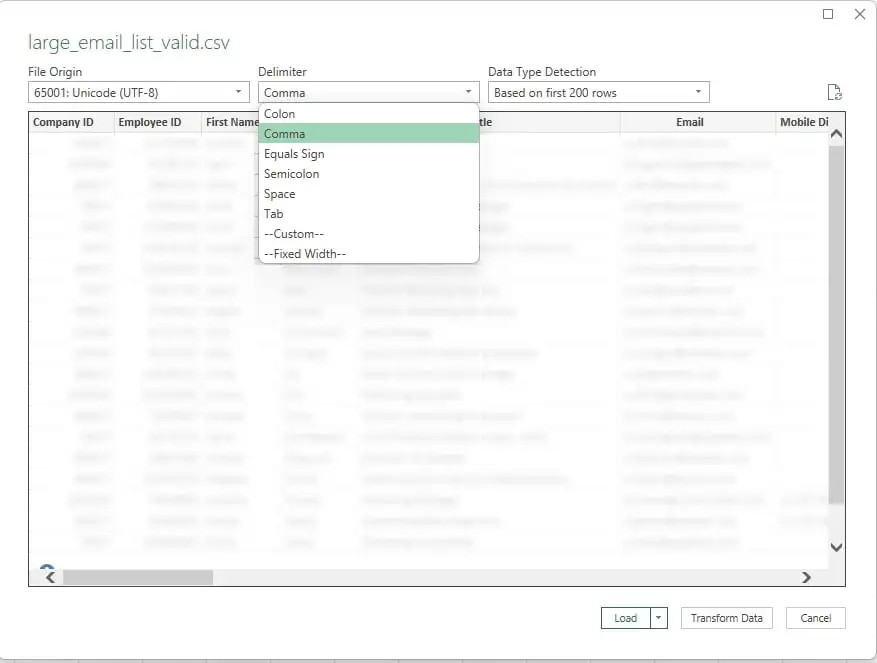
When you upload an email list file to ZeroBounce, the email validationⓘ tool auto-detects the file delimiter that's in use. After the email list cleaningⓘ or scoring is complete, the validator will use the same file delimiter that was used in your original file. When troubleshooting formatting errors in Excel, be sure to select the same file delimiter that you used in your original file.
If these troubleshooting steps fail, or if you experience other issues with your downloaded CSV being incorrectly formatted in software, contact ZeroBounce support. The support team can work with you to examine your results file and find a solution.
You can get in touch with ZeroBounce support 24/7, 365 days a year through your preferred method:
Why Is My File Taking So Long to Process?
Why do I need a password to open my processed file?
How do I get a password to decrypt my file?
Why is my Overview PDF report blank?
Why are some emails missing append features?
Why do I get the error “unable to expand” with Archive Utility?
Where can I get software to open the CSV file?
You can integrate ZeroBounce with your CRM or email marketing tool by following the instructions that correspond with the specific platform. While the setup for all ZeroBounce integrations is similar, the overall process varies based on the tool.
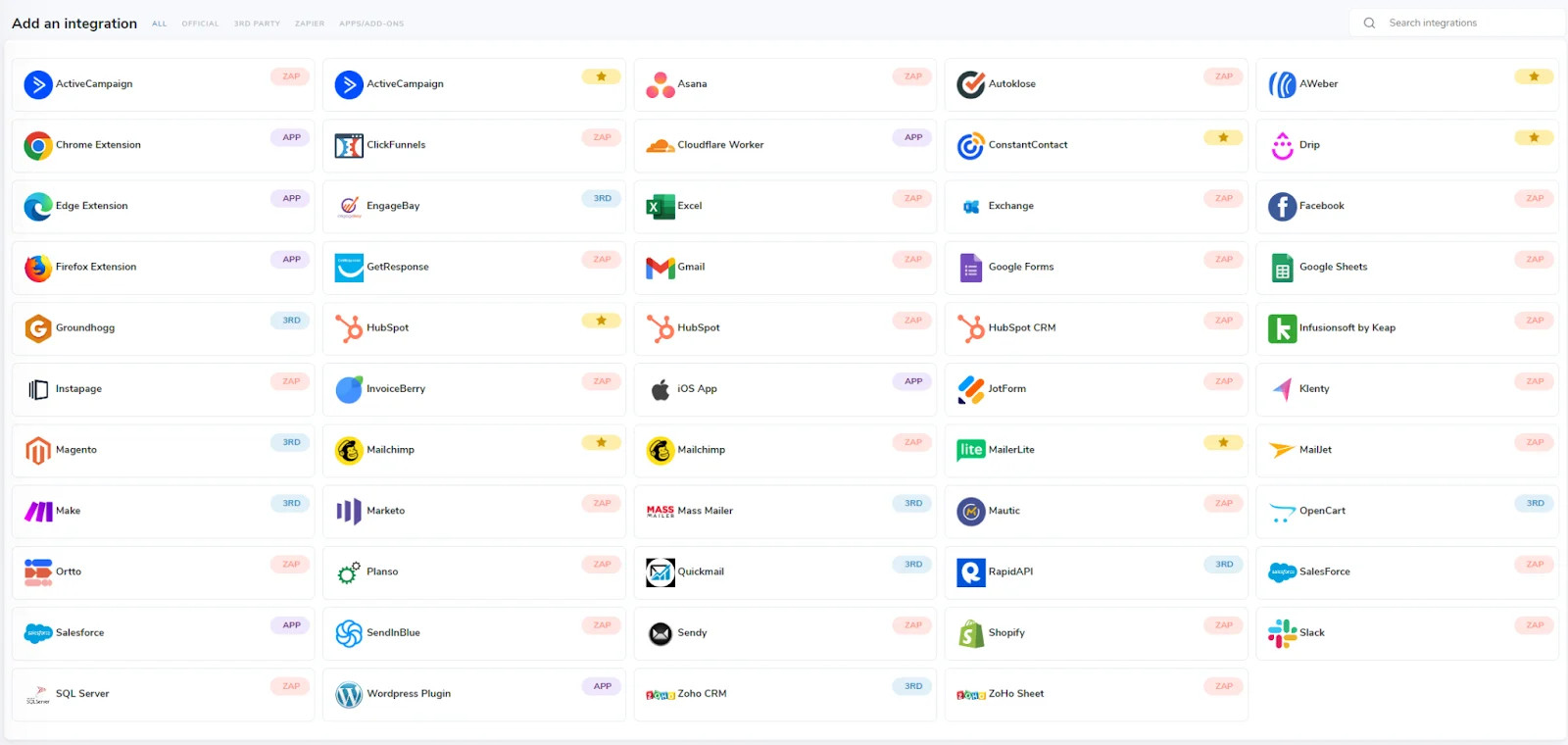
ZeroBounce currently features integrations for more than 60 email deliverability platforms. This list includes significant email service providers, email automation platforms, and CRMs, including:
To integrate ZeroBounce with your CRM or email marketing tool, you'll need a ZeroBounce account. By creating a free account, you'll be able to create and access your API key.
The API (which stands for application programming interface) is a programming interface that lets two pieces of software interact. In this case, your API key secures a connection between ZeroBounce and your CRM or mailing platform.
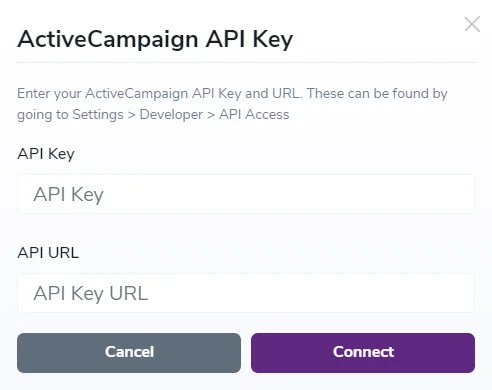
After connecting your accounts with your API key, you'll be able to view and retrieve data from your CRM with your ZeroBounce dashboard. Note that some ZeroBounce integrations will ask you to temporarily move to the other service's website for security purposes so that you can confirm the connection there.
Additionally, some integrations, such as the Salesforce integration, allow you to use ZeroBounce's email validationⓘ from their dashboard. The capabilities and limitations of each integration depend primarily on the service's requirements, allowances, and security measures.
ZeroBounce consistently adds new integrations, extensions, and add-ons to make its email deliverability solutions more accessible.
However, you can request an integration for a specific CRM or email delivery tool by submitting a message on our Feature Request page. The development team will do its best to bring ZeroBounce to the platforms you love. Be aware that different platforms provide different requirements for building and maintaining integrations, so we may or may not be able to fulfill your request in niche circumstances. But we'll do everything we can to work with your preferred provider so that you can enjoy ZeroBounce's email validation service with your everyday workflow.
You can find step-by-step instructions on how to use official ZeroBounce integrations by visiting the documentation.
For 3rd-party integrations, add-ons, and extensions, you can find links to the specific plugins and modules by visiting the Integrations area of the ZeroBounce website. This area contains a complete library of all ZeroBounce integrations along with handy instructions, including a complete list of features along with triggers and actions for your Zapier connections.
Is there a plugin or extension for popular platforms?
What programming languages do you support with your API?
ZeroBounce has more than 60 official, third-party, and Zapier-supported integrations, as well as several extensions for popular web browsers and software tools.
All of the ZeroBounce plugins and extensions allow users to benefit from single and bulk email validationⓘ. However, the extent to which you can benefit from these features varies depending on the type of software you use.
For example, platforms that are website builders like Shopify, PrestaShop, or ClickFunnels allow you to use real-time email verification. Whenever users enter an email address on your site, whether it's your mailing list signup or another registration form, ZeroBounce automatically verifies the email address.
Other integrations with platforms like Mailchimp or MailerLite allow you to connect your accounts and import all of your mailing lists for cleaning from your ZeroBounce dashboard.
ZeroBounce account owners gain access to a sleek, user-friendly integration interface that makes it easy to set up and manage plugins and extensions. Only some plugins or extensions require a download or installation, while others require you to connect your ZeroBounce account with the third-party platform via an API key.
The integrations page clearly labels each plugin by type and will either link you directly to the extension or provide instructions on how to complete the setup.
You can also review each integration in-depth by reviewing the complete catalog on the ZeroBounce website. Visitors can find a complete list of functionality for each plugin and extension, as well as the various functions available for Zapier-supported integrations.
Finally, you can review ZeroBounce's email validation API integration documentation for step-by-step instructions on how to use all official plugins and extensions.
How can I integrate ZeroBounce with my CRM or email marketing tool?
What programming languages do you support with your API?
ZeroBounce supports the following programming languages for use with the email deliverability service API:
You can find an up-to-date code sample library using the widget below
These API code samples make it easy for you to plug in your ZeroBounce account and email list data by providing the necessary code structure. You can also find handy instructions on how to test your programming language configuration in a Postman environment, as well as example response codes by visiting the complete documentation for each service:
ZeroBounce customers can benefit from the same robust email validation API and email-finding tools regardless of the programming language used.
Users will need to identify which programming languages are supported by the software they wish to integrate with the email API service. Some are device-specific, including iOS and Android.
Aside from those limitations, ZeroBounce users are free to use the email validation API with any of the programming languages listed above. Additional benefits or advantages come down to personal preference and how easily you can integrate the ZeroBounce API with your existing workflows.
ZeroBounce continuously adds new support for various platforms and programming languages as needed, including additional API wrapper and SDK support.
If you'd like to see a programming language supported that's not listed here, you can use the Feature Request form to submit new languages or tools.
If you have additional questions regarding the supported programming languages or need help configuring your email validation API, please contact ZeroBounce support. You can reach the team by emailing support@zerobounce.net or by opening a live chat at www.zerobounce.net. The team is available 24/7 to assist with your programming language questions and will help you get started with your new email deliverability tools.
How can I integrate ZeroBounce with my CRM or email marketing tool?
Is There a Plugin or Extension Available for Popular Platforms?
ZeroBounce finds business email addresses through a combination of company domain pattern detection and 99.6% accurate email validation. After determining several email address patterns that have a high confidence rating, those addresses undergo the email verification process to determine if the address is indeed valid, invalid, or another risky email type.
ZeroBounce offers two types of Email Finder searches - a domain-based search and a name-based search. The domain-based search attempts to discern the most likely email pattern in use. Compare this to a name-based search, which allows ZeroBounce to plug in the person's first and last name along with the domain to find a verified result.
A domain-based email finderⓘ search allows you to search for business email addresses by only providing the domain.
Often, your business knows that there are potential leads at a company that can benefit from your product, but you aren't sure how to contact someone. By providing a domain (their company name), you can find possible patterns for email addresses used by current employees.
Here's how it works:
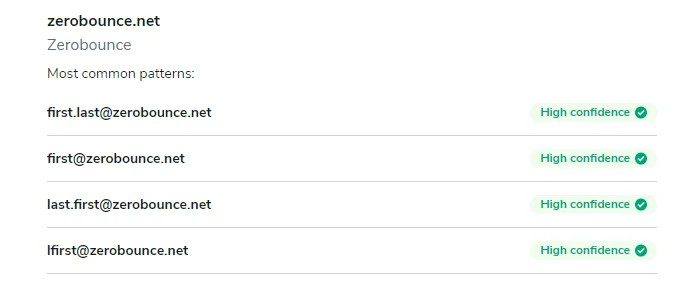
Be aware that it's possible to receive several "High confidence" results as more than one email address pattern may be in use.
This type of search is a great way to look up emails for contacts you may already know. If you met "John Smith" at "Email Company" at a recent event, and a high confidence pattern recommends "first.last@company," his email is likely john.smith@emailcompany.com.
A name-based email finderⓘ search uses the same elements as a domain search but is able to leverage the person's name for the address.
The process works like this:
![Name-based ,[object Object], search results showing a valid email address for Swen Vincke: swen.vincke@larian.com.](https://www.zerobounce.net/cdn-cgi/image/fit=scale-down,format=auto,quality=90,width=1920,metadata=none/docs/assets_next_docs/docs/faq/emailFinder2.webp)
Similar to the domain email finderⓘ search, your results may still show multiple high-confidence patterns if the company uses alternate email address structures.
It's critical to note that ZeroBounce never uses stored or processed customer information for any email finderⓘ searches. Every instance of an email finderⓘ search occurs 100% in real time using internal proprietary technologies, including real-time email validationⓘ.
ZeroBounce will always be fully compliant with data privacy and security regulations, giving you the confidence that your data is always in safe hands.
How does ZeroBounce ensure the accuracy of found emails?
What sources are used to enrich email data?
As an added perk with ZeroBounce email verification, ZeroBounce uses third-party sources to add appended data to your emails regarding social, email domain, and geolocation factors.
ZeroBounce cannot disclose these data sources for privacy and competitive reasons but can guarantee that all provided information is reliable. In fact, the honesty and accuracy of enriched email data are demonstrated by the data appends success rate.
ZeroBounce's ability to enrich email data depends upon the availability of such information from its sources. When available, you can learn more about an email address, such as:
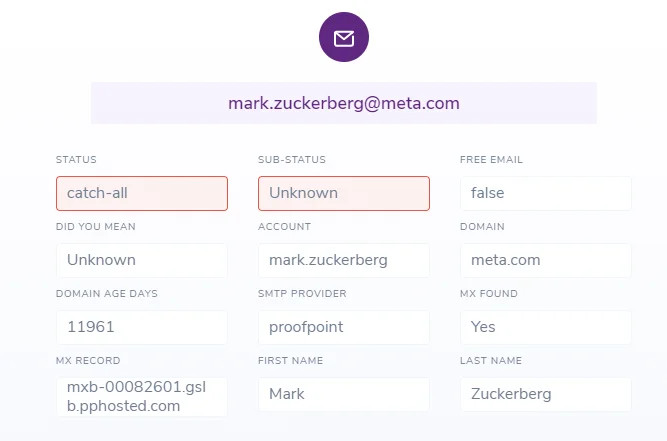
Data appending is a free feature included with email verification but is entirely dependent on ZeroBounce's sources. If data can be retrieved, it will be included in your Overview report.
No - ZeroBounce never uses stored or processed customer data for any of its email deliverability services or features. Any search for information occurs in real time and the retrieved data is only shared with you. All reports and files must be accessed with a unique encryption key that only you receive. Then, those files are deleted after 30 days from the platform.
To use customer data would be a significant violation of ZeroBounce's Privacy Policy.
You can learn more about their commitment to privacy by visiting their security page.
When possible, additional data is appended to email addresses, whether you validate a single email address or an entire list.
If your email address data is enriched with a bulk file uploaded, you can find it by reviewing your CSV results files. Additional data columns may be added to your "Valid" results file as well as to any other applicable results. You can find also find appended data to your Overview report, which can provide a top-level look at the top geographic locations for your entire list.
How Does ZeroBounce Find Emails?
How does ZeroBounce ensure the accuracy of found emails?
ZeroBounce ensures the accuracy of found emails with its guaranteed 99.6% accurate email validation. Any time you perform an email finder search with both a name and domain, ZeroBounce will continue to test and verify new patterns until it identifies a valid result.
Be aware that accuracy can only be assured with a name-based email finder search. If you perform a search with only the domain, ZeroBounce can only guess potential patterns.
When searching for business emails with only a domain, a confidence score is attached to possible patterns used by that domain, discerned by various factors, including internal technologies and public records.
However, you should note that even a high confidence score is not a guarantee. It's possible that specific email address patterns, while valid, are outdated or used as a catch-all. You may be able to deliver a message to the address successfully, but you aren't guaranteed a response.
It's always recommended to verify any email address before sending a message. While the occasional bounced message is nothing to worry about, it quickly becomes problematic if you attempt to email many addresses that haven't been validated.
If your email finderⓘ search delivers a valid email address, you can be confident in your result. Generally, the top email address pattern will match the pattern of your new business email.
But, your results may also show other patterns that also have a "high confidence" score. This doesn't mean that your email address is inaccurate but that ZeroBounce found other patterns on that domain that are also in use. The company may use multiple email structures, or they may have yet to do anything with otherwise unused email addresses.
Finally, ZeroBounce ensures its accuracy with a money-back guarantee. If it determines an email address to be valid, it stands by its results. If, after using ZeroBounce, you find your email addresses to be invalid or experience a high bounce volume, please contact ZeroBounce support. The team is ready to work with you to determine the issue with your email finderⓘ results and will do what's necessary to make it right for you.
If you're not satisfied with your results using ZeroBounce, please contact the team at your earliest convenience.
If you have a specific issue, such as an unexpectedly high bounce rate after using the email verifier or another error with the email deliverability tools, the team wants to know. Your feedback is essential to address potential problems or bugs with the email services, and you can help us create a better product for all customers.
Contact ZeroBounce via email >
Contact ZeroBounce via live chat >
ZeroBounce support is available worldwide 24/7 all year round, including holidays.
In exchange, the ZeroBounce support team will do whatever it takes to ensure your satisfaction. Customer support is continuously one of ZeroBounce's most frequently mentioned benefits by customers, and you can expect to receive the same love and care as all other clients.
Additionally, ZeroBounce comes with a 99.6% accuracy guarantee. So, if your issues are regarding unexpectedly high bounce rates or lackluster email list cleaning results, you're entitled to your money back.
A team member will also work with you to investigate the factors causing issues with your email list cleaning so that you can make better use of the email deliverability services. In some cases, there are external factors that influence your email validation results. Our email experts are passionate about helping customers navigate their delivery issues and will be happy to talk you through any problems you face.
Finally, ZeroBounce never asks you to sign any extended contracts, leaving you free to downgrade or cancel your plan at any moment.
If you're not happy with your current rate, ZeroBounce support also wants to hear from you. Please reach out to customer service and let them know the problem, such as finding a better price with another email verification provider. The team will work with you to find a plan that suits you and your company's needs.
How do I report a bug or issue?
What is the turnaround time for support requests?
If you encounter a bug or issue when using ZeroBounce, it's recommended to contact the Support team via email at support@zerobounce.net. Alternatively, you can visit the ZeroBounce website and open a live chat. The team is available 24/7 and will respond to your inquiry within seconds.
While we have a request form, using email allows you to provide us with additional information, including screenshots or files related to the issue. The first thing our development team will do is attempt to reproduce the bug or issue you're experiencing to understand why it's happening.
Whenever you reach out with a bug or issue with the service, please include the following with your message:
If you're uncertain of what you need to include for a particular bug or issue, don't worry. A ZeroBounce team member will work with you to understand the problem and help you locate additional information if needed.
If you prefer to communicate by phone, you can also reach out to ZeroBounce at 1-888-500-9521. The support team will do its best to assist you by phone but may request additional items, if necessary, via email to reproduce the bug or issue.
In a vast majority of cases, any issue with using email validationⓘ or any other email deliverabilityⓘ service can be solved swiftly with enough information. The team will likely be able to resolve the issue quickly or provide a workable solution to avoid any delays to your business.
For more serious issues like a potential network outage, the ZeroBounce team takes action immediately. The company has multiple safeguards in place to avoid any interruptions to your service and will be able to remedy any bugs or issues within minutes or hours. If an experience like this ever impacts your business, please let ZeroBounce support know immediately.
Finally, bugs or issues that impact a product or user experience are constantly being managed. The developers continuously incorporate your feedback to improve the ZeroBounce experience weekly and monthly.
What can I do if I’m not satisfied with my results?
What is the turnaround time for support requests?
When contacting ZeroBounce support, you can expect a response within minutes, if not seconds, based on the contact method used. The support live chat is available 24 hours a day, seven days a week, and has an average response time of six seconds. The support team also stands by email and phone all day and will reply to all support requests almost immediately.
ZeroBounce support works closely with customers to find the best solution for a support request as swiftly as possible.
For issues related to your account or payment, ZeroBounce support will contact you and request any details necessary to alleviate any bugs or issues you may be experiencing with your account.
If you're dissatisfied with a ZeroBounce product or your results, a support or sales team member will be in touch with you immediately. Once your representative is able to understand your issue, they'll work to provide an amenable solution, whether it's honoring our 99.6% accuracy guarantee or providing additional credits in response to any issues not caused by your error.
If you encounter a more complex bug or issue, or if you have a specific feature request, it may take ZeroBounce several hours or days to resolve your request.
You can shorten the amount of time it takes for ZeroBounce to assist with your support request by including as much relevant information as possible in your request.
The following is a list of information or assets that may be relevant to resolving your support request:
The more informed the ZeroBounce team is, the better prepared they will be to create a satisfying solution in a timely manner. The team's goal is to ensure your satisfaction, and you can help them by being prepared.
The ZeroBounce team works to provide updates to its email verification technology monthly. These updates include new user features, improvements to processing speeds, better ability to process complex domains and anti-spam configurations, and a reduction in the number of "unknown" results.
ZeroBounce continuously incorporates user feedback to investigate any notable weaknesses or drawbacks to the email verification technology as it currently exists. Your comments and suggestions have brought forth valuable updates. Some examples of these include:
Some updates are trickier to implement, but ZeroBounce continuously works daily to finetune its email verification technology. This commitment is what allows its platform to provide the most guaranteed accurate email validationⓘ available.
If you're curious about ZeroBounce's email verification updates or improvements to any other email services, you can find essential highlights in the monthly ZeroBounce Tech Newsletter. There, ZeroBounce Chief Technology Officer Paul Pintiliescu personally walks you through each improvement that rolls out monthly and why it matters for your email verification results.
You can also find the latest updates to ZeroBounce's email verification technology, along with all other critical product updates, by checking out the ZeroBounce website.
If you have thoughts, concerns, or suggestions regarding ZeroBounce's email verification technology, the team wants to hear from you. You can leave your feedback and requests almost anywhere, including:
You'll find that the ZeroBounce developers carefully read all feedback from customers like you, whether it be via email, online reviews, suggestions on social media, or anywhere else you can find us. Customers have helped not only with email verification technology but also improved essential email marketing services like Email Finderⓘ and DMARC monitoring.
How do I stay updated with ZeroBounce news and updates?
You can stay updated on ZeroBounce news and updates through one of these two methods:
The ZeroBounce newsletter will provide important updates, including new product announcements, essential notices regarding account and security changes, and a play-by-play tech update courtesy of the ZeroBounce Chief Technology Officer.
ZeroBounce CTO Paul Pintiliescu writes a monthly feature and product update via email - the ZeroBounce Tech Newsletter. There, you'll find a comprehensive list containing everything from major announcements like new tool launches as well as minor yet crucial updates to the existing email deliverabilityⓘ technology.
Pintiliescu's updates are a great way to gain personal insight into why the ZeroBounce team implements critical updates and why they matter for your company's email verification experience. You'll be able to learn more and try these new updates by following the links provided inside of the newsletter.
How Often is ZeroBounce’s Email Verification Technology Updated?
An HTTP Archive (HAR) file is a troubleshooting file that allows you to examine the call and response between a browser and a website. HAR files are JSON-formatted and allow you to capture critical data insights regarding web traffic at any given time.
HAR files are essential for diagnosing the overall health of your website and any issues experienced by your incoming web traffic, including:
HAR files use the JSON format (JavaScript object notation syntax). By capturing data regarding web traffic at any given time, you can gather critical insights into the health of your website.
Identifying and addressing website issues is essential for both your SEO and email marketing efforts. Problems with slow loading speeds, bad URLS and destinations, and unavailable content leaves a bad impression, and your emails feeling spammy.
The method for creating a HAR file depends upon your web browser. The most popular modern browsers natively support HAR files, including Chrome, Edge, and Firefox. You can generate HAR files for a given website by accessing the developer tools within your browser.

For more in-depth instructions on how to generate HAR files for a browser, use the tutorials linked below:
Once you generate your HAR file from your browser, you'll need software that lets you view HAR files. There are a variety of free tools available, but Google's HAR Analyzer is one of the top recommended tools available.

Inside, you'll find a log of pages documented along with a list of entries/responses captured during the period. You'll be able to identify the date and time the file was generated, along with the relevant pages and response codes.
Be sure to take advantage of HAR files, as they are free to generate and review. They are an excellent asset for improving your website experience for users and maintaining good standing for your domain with search engines.
Generating HAR files in various browsers
How to clean your email list effectively using ZeroBounce
Tips for improving email deliverability
Understanding email verification results and metrics
To generate a HAR file for your website health diagnosis, use the instructions for your specific web browser below. HAR files can be helpful in helping the ZeroBounce team identify any network errors that are interfering with your ability to use the platform.
To generate a HAR file in Chrome, follow these steps:
On Mac, press Command+Option+J.
On Windows or Linux, press Control+Shift+I.
If successful, your browser will display a menu similar to what’s pictured below.


You can now find the HAR file in your downloads or whichever destination you selected. You may review the data in a HAR viewer or submit it to the ZeroBouce team for troubleshooting.
To generate a HAR file in Firefox, use the following steps:
If successful, your browser should now display the menu pictured below:



You can now review the HAR file with a HAR viewer or submit it to the ZeroBounce team for troubleshooting.
To generate a HAR file in Safari, follow these steps:
You can review your new HAR file with a HAR viewer or submit it to the ZeroBounce team for review.
To generate a HAR file in Edge, use the following steps:
If successful, your browser will display a menu similar to what’s pictured below.


You can review your HAR file with a HAR viewer or submit it to the ZeroBounce team for review. If you have any issues with any of the instructions listed above, please contact the ZeroBounce support team at support@zerobounce.net for additional assistance.
How to clean your email list effectively using ZeroBounce
Tips for improving email deliverability
Understanding email verification results and metrics
ZeroBounce provides everything you need for comprehensive email list cleaning, including bulk email verification for your current list and a real-time verification API for new signups.
To help you clean your email list effectively using ZeroBounce, follow these step-by-step tips below.
If you've never cleaned your email list or haven't done so for a while, uploading your database for bulk email list cleaningⓘ is the best place to start.
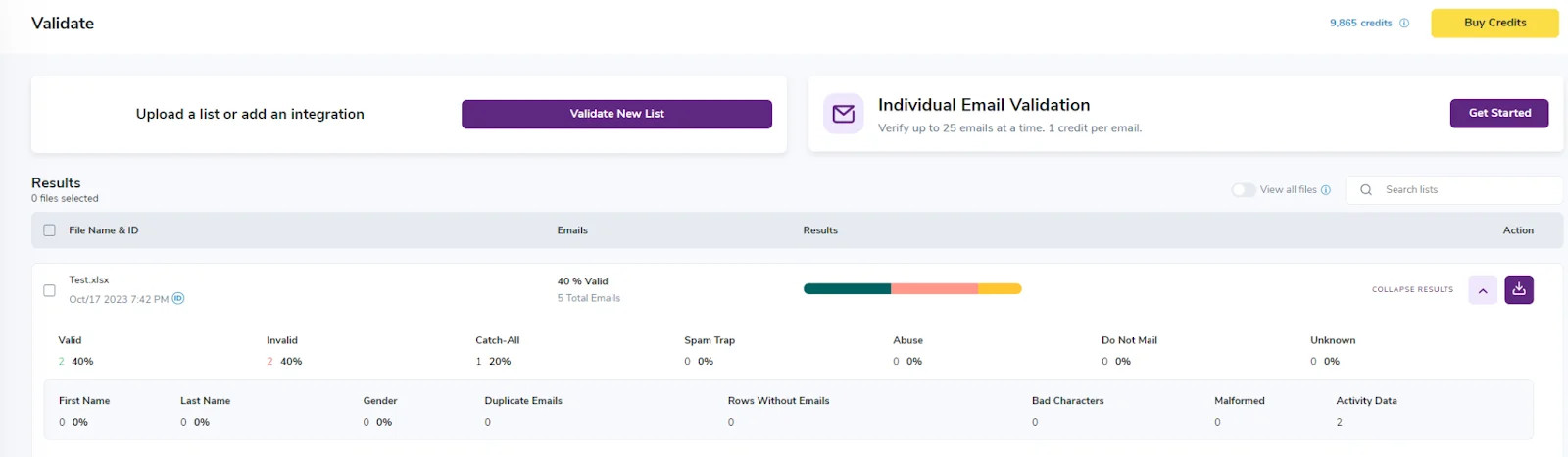
You can upload your entire email list for bulk email verification or clean a few emails at a time
There's no limit on how many contacts you can upload for bulk email verification. Just ensure that you have enough credits to verify each email address on the list.
It's recommended to use bulk email verification once every three months (at least). This process helps you keep up with natural email list decay, keeps your list up-to-date with valid email contacts, and boosts your email deliverability.
After the bulk email verificationⓘ process is completed, you can download your results.
This encrypted file will contain multiple CSV files categorizing the processed email addresses by type. You'll find CSV files titled "Valid," "Invalid," "Catch-all," etc.
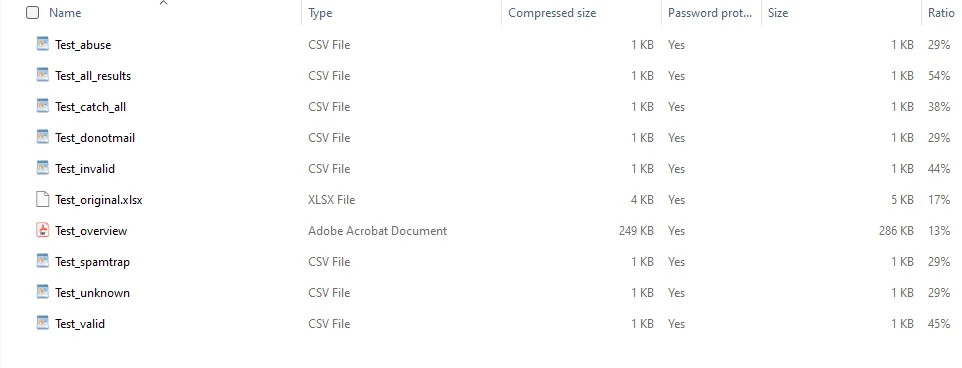
With your files, do the following:
See also: Email verification status codes >
Similar to the first step, ZeroBounce recommends cleaning any new email lists you obtain before adding them to your previously cleaned list. If you're sponsoring or attending events or running new campaigns and promotions, you're likely to gather many new email addresses that you're eager to email.
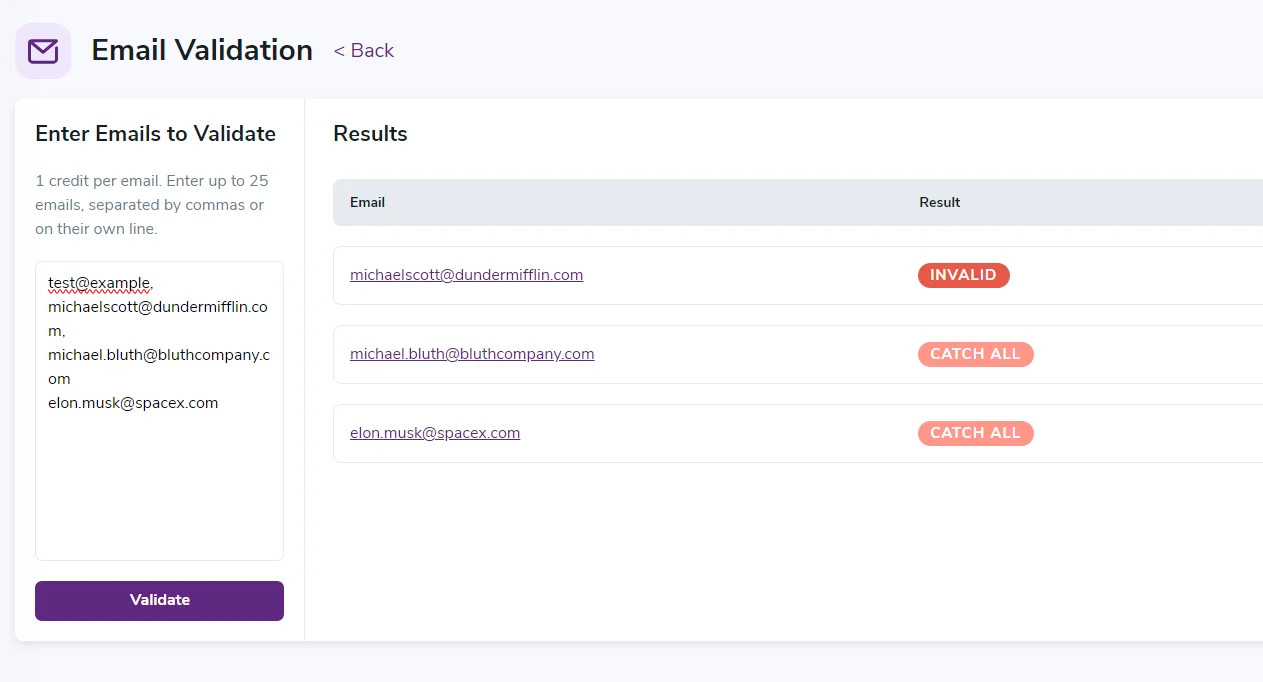
You can also verify small batches of emails (up to 25) with the single email validationⓘ tool*
Before you do that, upload those new, smaller lists for verification. Then, repeat step two to filter out your high-quality leads from the invalid ones.
While bulk email verification is used to manage your existing email list, you need a way to filter out the bad leads automatically.
The ZeroBounce real-time email verification API allows you to do this by adding the email verifier to your website, landing pages, and anywhere else you obtain new emails. When a user enters their name and email, the email verifier API verifies the email and rejects any invalid or high-risk addresses.
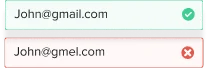
The real-time email verifier automatically spots invalid emails*
The real-time email verification API will also help you boost legitimate signups and conversions by advising users to correct mistakes with their addresses, such as typos or misspellings.
ZeroBounce's email service API is available in more than a dozen programming languages with complete documentation on how to use it.
If you're not familiar with or comfortable with using the API, there are still solutions for you. ZeroBounce offers more than 60 integrations and plugins with popular CRMs, marketing platforms, and email service providers. In many cases, you can leverage the ZeroBounce API just by connecting your two accounts with an API key.
With a combination of bulk and real-time email verification, you can clean your email list effectively using ZeroBounce - and keep it clean.
If you have any questions about the ZeroBounce email verification service, the team is available 24/7 via email and live chat. Reach out to ZeroBounce today at support@zerobounce.net for more details.
Generating HAR files in various browsers
Tips for improving email deliverability
Understanding email verification results and metrics
Email deliverabilityⓘ is the likelihood or guarantee that your email messages will reach the inbox. A "delivered" email receipt isn't the same as deliverability, as many messages can end up in the spam folder if your email deliverabilityⓘ is poor. The inbox is where your subscribers check most frequently and will provide your company with the highest engagement and conversion rate.
Below, you can find quick tips for improving email deliverabilityⓘ so that your email marketing is worth the investment.
First and foremost, you need to practice regular email list cleaning. Email verification will identify and eliminate any invalid or high-risk email addresses that are either guaranteed or likely to bounce. You can’t deliver emails if the destination doesn’t exist.
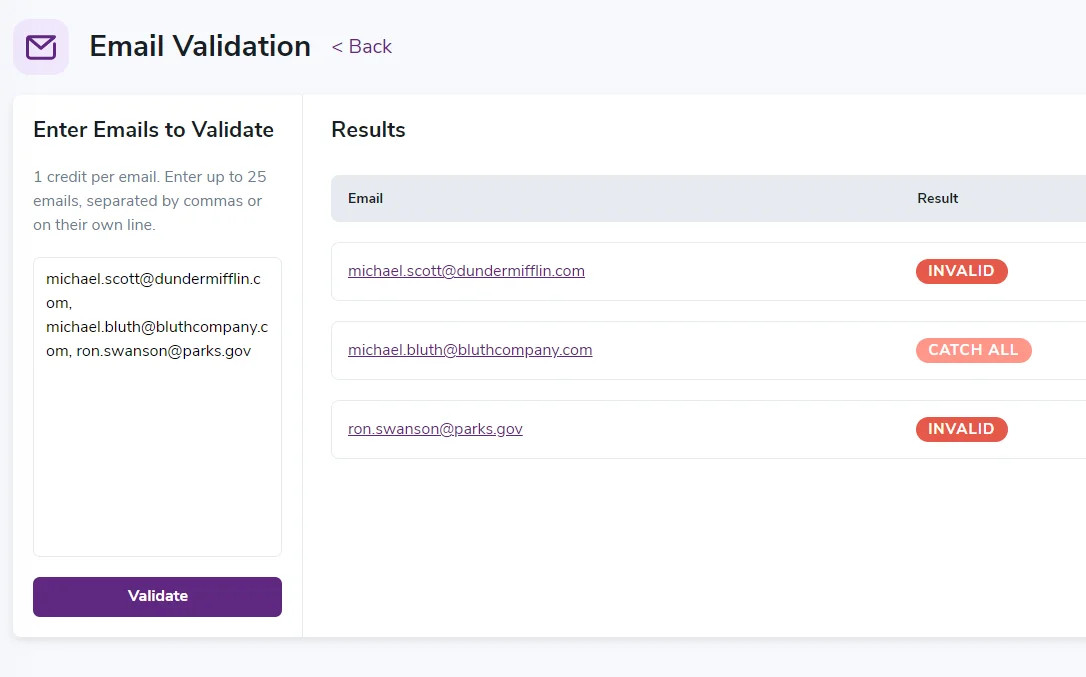
Plus - the higher your email bounce rate is - the worse your email deliverability will be. Internet service providers (ISPs) use email campaign metrics like bounce rate to determine the trustworthiness and reliability of a sender.
If you're regularly bouncing emails at a high rate (more than 2%), you look less like a legitimate company and more like a spammer.
Use an email verification service, at minimum, every three months. Email lists decay on average at roughly 23% annually. Therefore, regularly cleaning your list will combat this gradual decay and keep your email database up to date.
While uploading your email list for email validation periodically is essential, a real-time email verifier can further safeguard your email marketing. Here’s how it works.
Email verification companies provide an API, which stands for Application Programming Interface, and allows the email verifier to communicate with another application. This API connection makes it possible for you to begin verifying emails in other key locations, including your websites, landing pages, and other spots where you have email registration or signup forms.
With the real-time email verification API active, it will auto-verify emails entered into your form. If the verifier detects an invalid or other high-risk email type, it will block it. Then, it advises the user to use a valid email address.
In other words, a real-time email verifier stops invalid emails from entering your database in the first place. This technology keeps your email list clean, leading to low email bounce rates, better email engagement, and more conversions.
It can also aid your customers by alerting them to accidental entry issues, such as typos or misspellings with their data. You'll connect with more customers who want email content from your business.
Email authenticationⓘ is a system or process of providing an email domain with identifying information to prove that the party sending the message is legitimate and authorized.
The most commonly used ways of authenticating emails include:
Each process provides a different way of authenticating an email, including creating a list of allowed domain or IP addresses, as well as adding digital signatures to sent emails. DMARC is then a policy that tells receiving email domains what to do if a sender fails or passes these checks. You may choose to allow, reject, or even quarantine messages from suspicious senders.
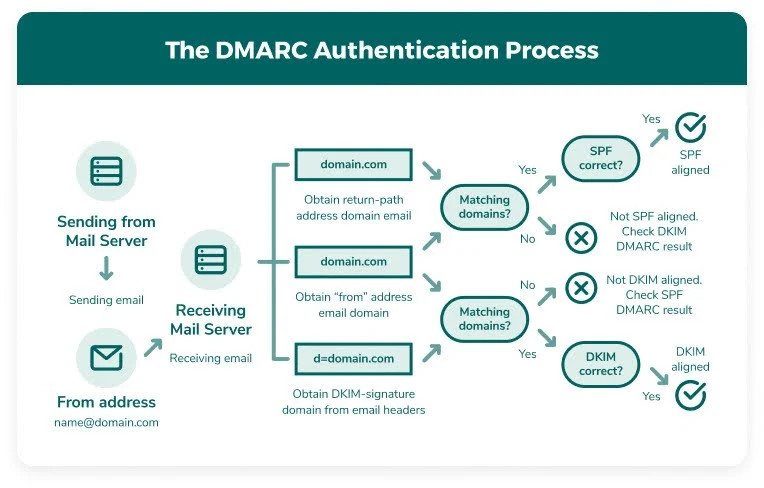
Email authentication is not only a free way to protect your emails and sender reputation, it will be a requirement for popular domains like Google and Yahoo.
Take advantage of free email authentication generators to add protection to your email domain for better email deliverability. Plus, you can supervise your domain's email authentication with tools like DMARC monitor and get instant alerts to suspicious email activity.
ISPs also look at engagement metrics like open and click rates, spam complaints, and unsubscribes. The better your emails perform, the better your sender reputation is and the higher your email deliverability will be.
ISPs want to ensure that their users are receiving the email content they want to read.
One of the best ways to improve your email campaign performance is to segment your email lists.
When your email marketing list has tens of thousands of subscribers, it’s unlikely that one email will speak to every person with the same impact. While those contacts willingly subscribed to your list, each person comes from a different walk of life and has different things they’d like to hear from your company.
By segmenting your email lists, you give yourself the opportunity to personalize the content for the reader.
Segment your audience by their stage in the buyer's journey, demographic, products or services used, last purchase date, and any other categories that may be relevant to their experience. The better you're able to meet their specific needs, the better your emails will perform.
Continuing with segmentation, you must continue to test new types of email content and revise based on performance.
If you've followed the previous email deliverabilityⓘ tips, you should have a clean email listⓘ of valid contacts and a few segmented email lists to test. Next, it's time to try some catchy, intriguing subject lines that will attract a higher open rate. Make it clear what's inside (being vague or indirect is annoying), but leave some excitement to be found inside.
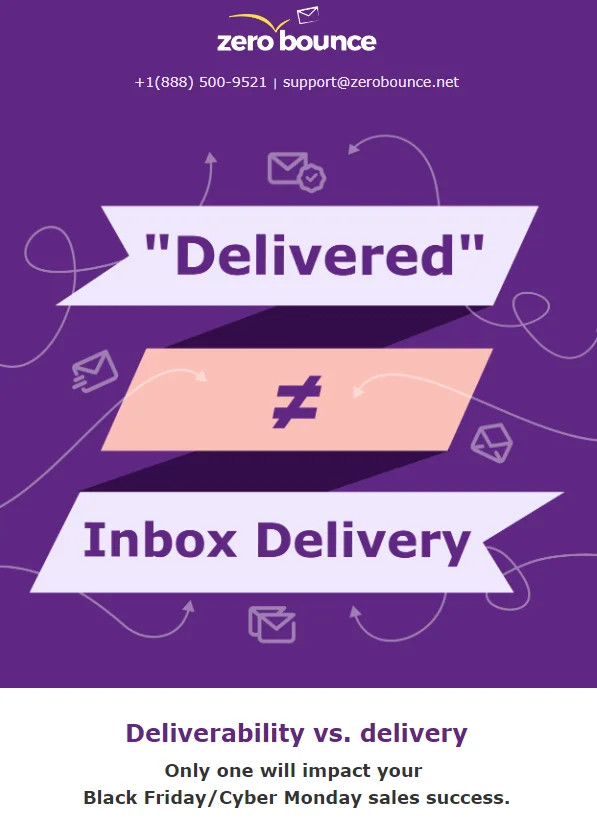
The body of the email also needs to be lean and valuable. Though you earned the reader's subscription, they likely receive dozens of emails like yours daily. For the few seconds that you have their attention, you need to ensure your words count by offering something memorable and of value.
Don't settle for just addressing the reader by name - that's the bare minimum. Acknowledge who they are as a customer or professional, call out their specific problem, and provide the solution. A great way to do this is to provide resources and education that benefit them at no cost.
It can take time to find the right formula for your brand's particular email content. Be diligent about testing and measuring results, and make changes in the areas needed.
Finally - you can also take a direct approach by asking your readers what they want to see.
You've cleaned up your database, authenticated your emails, and created great email content. Now, it's time to supervise your domain and sender reputation.
Even with email marketing best practices, there are always factors that can negatively affect your sender reputation and email deliverability. All it takes is one too many spam complaints, emailing a spam trap, or an instance of email fraud to flag your company's email domain.
There are a variety of email monitoring tools online that can assist with monitoring different aspects of your reputation. DMARC monitor, for example, allows you to get notified whenever attackers or imposters are trying to spoof your email domain. The sooner you're aware of suspicious activity, the quicker you can take action to protect yourself.
Likewise, blacklist monitoring is the best way to get notified of any unintentional or accidental email infractions. If you see your domain or IP appear on a blacklist, you can act fast and work with the blacklist service to resolve the issue.
After all, ISPs don't want to stop legitimate companies from reaching customers. The more proactive you are in managing your email domain and reputation, the more likely you are to be awarded with strong email deliverability.
To summarize quickly, every email sender needs to use the following tips to boost their email deliverabilityⓘ:
So long as you're always striving to deliver great email content and protect your readers, ISPs will award you with strong email deliverability.
For even more in-depth email deliverability tactics, check out the Complete Guide to Email Deliverability.
Generating HAR files in various browsers
How to clean your email list effectively using ZeroBounce
Understanding email verification results and metrics
After completing the email verification process, ZeroBounce provides you with your validation results in an encrypted file. You'll also see a variety of metrics on your dashboard that reflect key highlights for each email list you upload for cleaning.
Here's how to review your results and metrics so that you can put your clean emails to great use.
Any time you upload a list of emails to ZeroBounce's email verifier, you'll see an overview report of your results along with a link to download the file.

This section will show the name of your uploaded file along with the processing date.
To the right of the file name, you'll see two additional sections titled "Emails" and "Results". "Emails" will highlight the overall validity of the email list as a percentage (i.e., 40% Valid). It also shows the total number of emails validated in that particular file.
The "Results" column shows a color-coded bar that segments your email verification results into categories by color. When you hover over a color, you'll see the email type along with the corresponding percentage. For example, if the bar reads “Valid - 40%,” this means 40% of the emails in your file were valid.
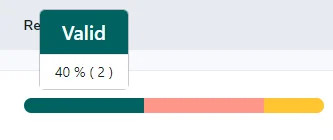
You can also obtain a more detailed breakdown of your entire email list by clicking "Expand Results."

This screen will show you the number of emails that were determined to belong to each category, along with the corresponding percentage. The email address types are as follows:
In the row beneath the email address types, you'll find additional data about your email list, including:
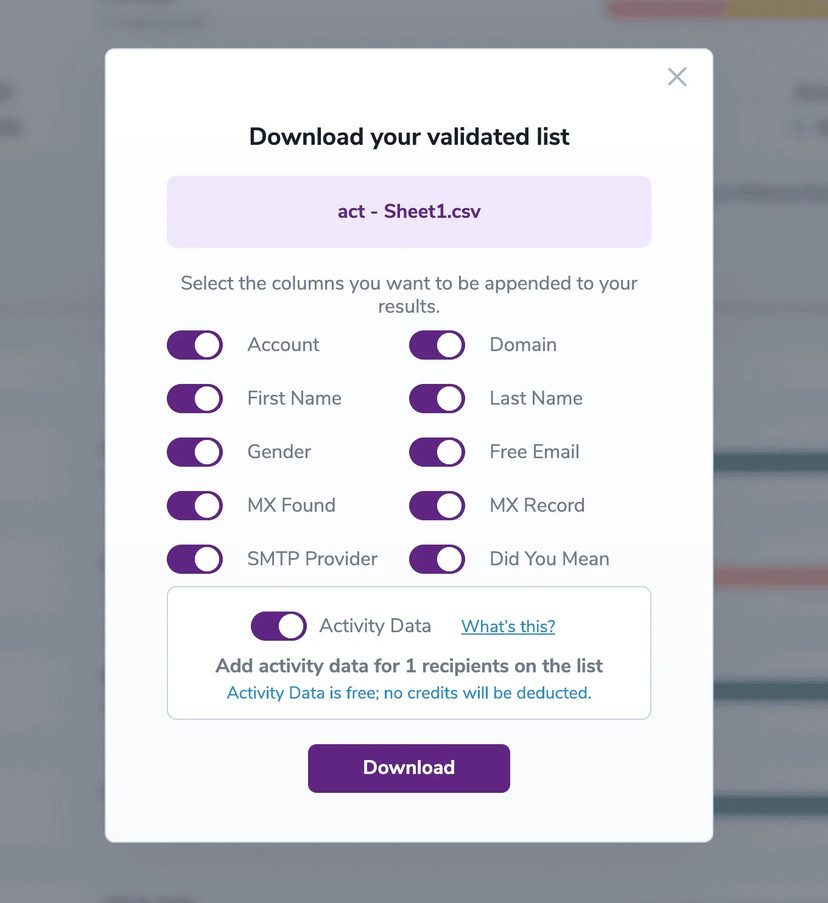
All appended data is free. However, there's no guarantee that it will be available for inclusion.
Important Note - The final section also provides the option to add Activity Data. Activity Data gives you deeper insights into the recent activity level of the email address, including opens, clicks, forwards, and unsubscribers.
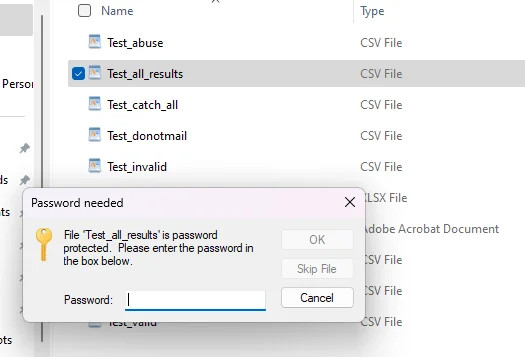
To find the password, check your inbox for an email from ZeroBounce. This unique encryption key ensures that no other users can ever access your email verification results or email list data. ZeroBounce generates a new password every time you click the download link.
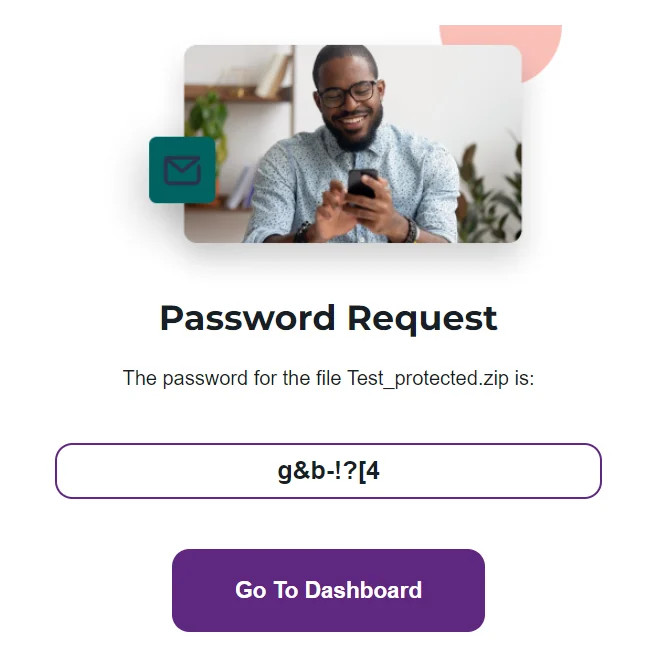
With your email verification results file opened, you have a few places to start.
First, you can start with your Overview file indicated by "filename_overview". This PDF provides a top-level look at what happened with your email list cleaning.
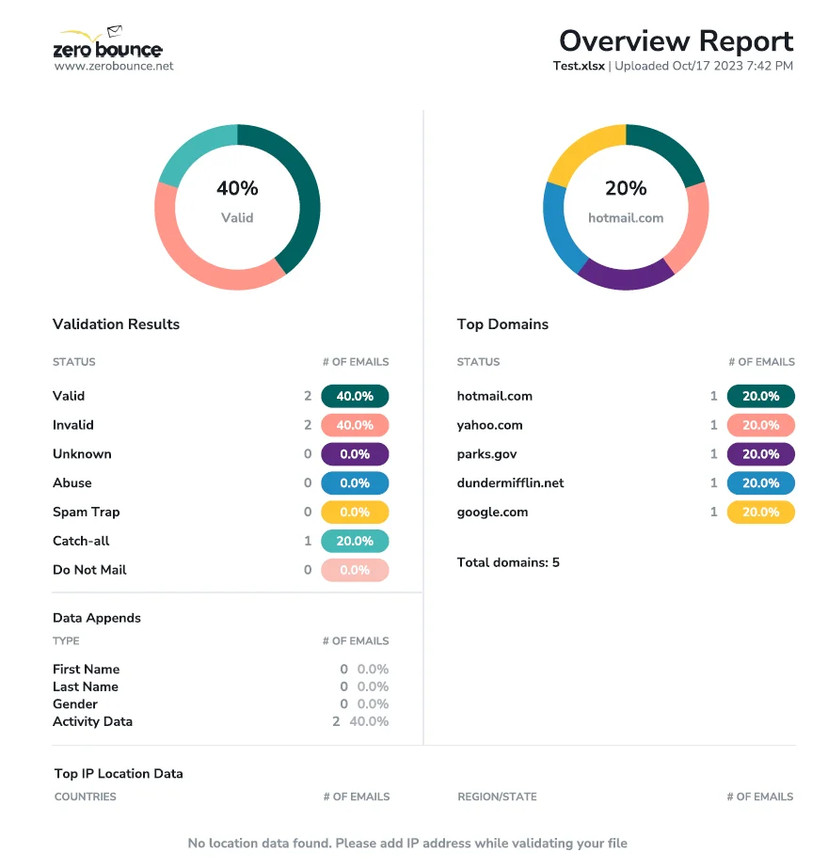
Similar to the report found in your ZeroBounce dashboard, the Overview report provides various visual representations of your email list cleaningⓘ results. The 'Validation Results' section shows each email status, the number of emails in that category, and the percentage of them across your whole list.
“Data Appends” once again shows added data, including names, gender, and Activity Data. The colored graph simply provides a different visual breakdown.
The ‘Top Domains’ section breaks down all of the email domains found on the list. It details the number of emails that fall into each domain, along with the percentage across the entire list.
Finally, the bottom section features geolocation data (if available), including the country or region where the email address originates from based on IP information.
The last results area to check is the CSV files within the results folder. Inside, you'll find one CSV that shows all results, along with additional CSV files that segment your emails by status.
If you need a refresher on the various email statuses, scroll back up to the earlier section in this section regarding your dashboard results.
Once you’ve familiarized yourself with your email verification results, you can use the CSV files as needed to replace your existing email list. It’s recommended to use your “Valid” file as it contains all of the email addresses that are safe for use.
However, you should also review the other email statuses to get a better idea of what was lurking on your email list. If you notice a high volume of risky emails from particular sources, you can use the data to start implementing safeguards for your future marketing campaigns, such as blacklisting or whitelisting certain email domains.
After uploading your file for email verification, you'll be able to download the results for 30 days. Once the period expires, ZeroBounce automatically deletes all data. This security measure protects your account and email data from unnecessary risks. Be sure to download your results and store them in a safe place to avoid losing them.
ZeroBounce's email verification results all provide the same data, whether you're using the bulk upload tool, the single email verifier, or the email verification API.
Additional resources
Understanding the Executive Report
Generating HAR files in various browsers
A 403 forbidden error can occur for a variety of reasons when using the ZeroBounce email service API. However, the most likely reason is that you're in violation of the Web Application Firewall (WAF) rules when using ZeroBounce API endpoints.
A 403 Forbidden error is an HTTP status response code that indicates that you do not have permission to access the website, platform, or tool in question. The server successfully receives the quest but denies it for various reasons.
ZeroBounce introduced a new set of WAF rules to enhance its platform security measures in June 2023. These rules meticulously examine all incoming API requests based on a predefined schema that aligns with the ZeroBounce API usage guidelines.
Consequently, if your API request does not adhere to this schema, you will be blocked by the WAF, which results in a 403 Forbidden error.
If you encounter a 403 error, it's recommended to investigate the syntax used for your email service API requests. With the new WAF rules, even minor errors previously tolerated by the API endpoints may now be rejected as non-compliant.
Common examples of such API syntax errors include the following:
To avoid encountering the 403 Forbidden error, carefully review your API requests and verify that they conform to the ZeroBounce API's specified syntax guidelines.
If you've ensured that your API requests meet the new WAF guidelines and are still experiencing a 403 error, don't hesitate to contact ZeroBounce support.
You can contact ZeroBounce via email at support@zerobounce.net or reach out via live chat - available 24/7. The team can help investigate your requests as well as other potential causes for your 403 error. ZeroBounce support is always there to ensure a seamless API integration experience for you.
How do I thread the API or call the API asynchronously?
Why does ZeroBounce only support TLS 1.2 and above?
When using .NET, C#, or Visual Basic with the ZeroBounce email service API, you are limited to 2 outgoing Hypertext Transfer Protocol (HTTP) requests. In order to increase this to allow for threading or asynchronous API calls, you'll need to adjust the 'ServicePointManager.DefaultConnectionLimit' property. This property sets the maximum number of concurrent requests allowed by a ServicePoint object.
You can find documentation regarding this property via Microsoft's .NET and API browser documentation.
Threading is a way for a program to split itself into two or more running tasks simultaneously (or pseudo-simultaneously). Multiple threads can be executed in parallel on many computer systems.
API threading can assist in improving the processing speed and performance of the ZeroBounce API from your device.
Asynchronous means that multiple things will happen or process simultaneously. If you start a new action while running a program, the new action will take place without interrupting the other program.
In a majority of cases, calling any API is considered an outgoing HTTP request. The potential issue with this is that most programming languages, as well as operating systems, have default limits in place that restrict the number of outgoing HTTP requests you may attempt. With these restrictions, you may face a slowdown when attempting to make multiple requests in a short period.
By threading the API, you can increase the limits so that you process a higher number of API requests asynchronously.
If you're struggling with API threading using the documentation provided, please contact ZeroBounce support at support or via live chat.
The team can assist with all aspects of the email service API, including examining your API configuration and HTTP request limits. ZeroBounce's goal is for you to enjoy a seamless API experience with satisfactory results.
Why Am I Receiving a 403 Forbidden Error?
Why does ZeroBounce only support TLS 1.2 and above?
The PCI Security Council is the body responsible for creating and enforcing rules on which technologies are acceptable for use in transmitting cardholder payment data. As such, they've explicitly identified that TLS 1.0 is no longer an adequate form of data encryption as it is vulnerable to many known attack methods. Due to this, ZeroBounce no longer supports TLS 1.0 and 1.1.
ZeroBounce joins the company of most company websites in adapting to the latest versions of TLS for better customer security and privacy.
If you are not a ZeroBounce API user, it's doubtful that the change will affect you. There may be a few outlying scenarios if you operate on an old, outdated browser or operating system.
To determine if your current operating system or browser supports TLS 1.2 or higher, test your system for free courtesy of Qualys SSL Labs.
If you are a ZeroBounce API user and have any code that connects with any API endpoint, you'll need to ensure that it will continue to work. Every programming language and API library is different, so your mileage may vary.
The languages listed below will require significant changes or upgrades to support TLS 1.2 or higher:
Please be advised - ZeroBounce doesn't have experts for every programming language or framework. You'll need to test and update your code as needed to support the ZeroBounce API.
Below, you can find some additional instructions for various versions of .NET:
Please refer to Microsoft's developer guidance for more support for TLS System Default Versions included in .NET.
All modern browsers now support TLS 1.2 and higher. You will only experience an impact if you're using an outdated version of a web browser.
The following web browsers do not support TLS 1.2:
If you're using one of these browsers or older versions, consider upgrading as soon as possible to support TLS 1.2 and higher for better payment security.
Email warmupⓘ is an email deliverabilityⓘ tool that boosts your domain's reputation. The Warmup tool sends a small percentage of emails to seed email addresses, which yield positive engagement signals, like favoriting your email, opening it, or marking it as "not spam". As your reputation improves, Warmup will send increasingly higher volumes of emails to continue boosting and maintaining your email domain's reputation.
Anyone who sends bulk emails to a mailing list can benefit from email warmupⓘ. If your email domain doesn't have a history of sending bulk emails, ISPs won't trust a sudden increase in volume and will relegate your emails to the spam folder. Warmup helps senders avoid this issue by automatically sending a small percentage of emails from the domain with a gradual ramp-up in volume. Through this act of "warming up" your domain, ISPs will see the positive engagement signals and learn to trust your emails, allowing them to reach the inbox successfully.
The email warmupⓘ provides a fully automated option in which ZeroBounce manages the process for you. After completing the initial setup, ZeroBounce will handle the sending and interactions for you. You can monitor your Warmup progress by checking your Inbox Score from your dashboard.
Our email warmupⓘ provides two options: the automated method, which ZeroBounce fully manages. Users can make adjustments, disable, or delete the service at any time. The manual method provides users with the seed email addresses so that they can send their Warmup emails manually using their email service provider.
We recommend sending emails equivalent to approximately 0.1% of your typical daily sending volume, as this is the recommended maximum for possible negative engagement signals (e.g., being reported as spam). This is a general starting recommendation, but your actual recommended volume can differ depending on your domain's current reputation, sending volume, and desired engagement rules. Use the AI Warmup Wizard featured with the Warmup tool to find the optimal volume.
Warmup currently supports Gmail/G-Suite, Office 365/Outlook, Proton, and SMTP connections.
In the Advanced Rules portion of the setup, you can choose when to start Warmup, what your time zone is, and whether to send emails daily or only on weekdays. You can also access this menu by clicking on your Warmup account and selecting Settings.
You can quickly filter Warmup emails by setting up identifiers in the Settings menu. Locate Email Identifiers and enter any alphanumeric characters you wish to use as keywords. When sending your Warmup emails, we'll use these possible keywords in our replies. You can search for these identifiers to locate your Warmup emails.
Our email warmupⓘ tool automatically checks for SPF, DKIM, and DMARC alignment with the associated domain. It's recommended that you use Warmup in conjunction with the DMARC Monitorⓘ tool so that you can manage everything from one account.
To disable an email warmup account, locate it in your list of Warmup domains. On the right, click the ellipses and click Disable.
Yes, we retain your email warmupⓘ history. You will only lose your information if the account is deleted.
Locate the email Warmup account you wish to edit in the main menu under "Warmup Accounts". Click the ellipses, then click on Settings to find your sender information and engagement rules.
You can locate your seed email addresses by accessing the Settings menu tied to any of your email warmup accounts.
You can delete an email warmup account by clicking the red text that reads Delete Account to the right of any Warmup account in your main dashboard.
