
The Out-of-Office Illusion
What Our Email Habits Reveal About Work Culture
New data shows how pressure, habit, and fear are part of modern work – and keep people checking email even when they're "off."
This report is part of ZeroBounce Insights Studio, our editorial series exploring digital culture, communication, and the way we work.
When was the last time you went on vacation and didn’t check your work email – not even once?
For many people, time off no longer means being offline. Even with out-of-office messages turned on, work email follows us into weekends, vacations, and personal moments we once considered off-limits – like the bedroom and bathroom, romantic dates, weddings, and even funerals.
Email is often one of the first things we check when waking up. Eyes still adjusting, we open the inbox for a “quick look” before the first cup of coffee. Just to see what came in.
Is it pressure or curiosity? Our data shows it’s both, but pressure plays a larger role.
Here’s how professionals interact with email at work – and the patterns that help explain how email has changed modern work culture and why it’s so hard to switch off.
Key takeaways on work email habits
- More than half of professionals check work email outside regular working hours.
- Nearly 3 in 4 professionals feel pressure to respond to emails off the clock, and that pressure is even higher among top earners.
- Time off is not truly off: 71% of respondents check work email on vacation.
- Most people don’t check work email on vacation because they have to – they do it because they’re afraid. And that fear is strongest at the top of the pay scale.
- 7 in 10 high earners feel overwhelmed when they return from vacation, compared to fewer than 5 in 10 overall.
- Roughly 80% of respondents admit to checking work email in at least one deeply personal moment, including the bathroom, bed, weddings, funerals, dates, or while driving.
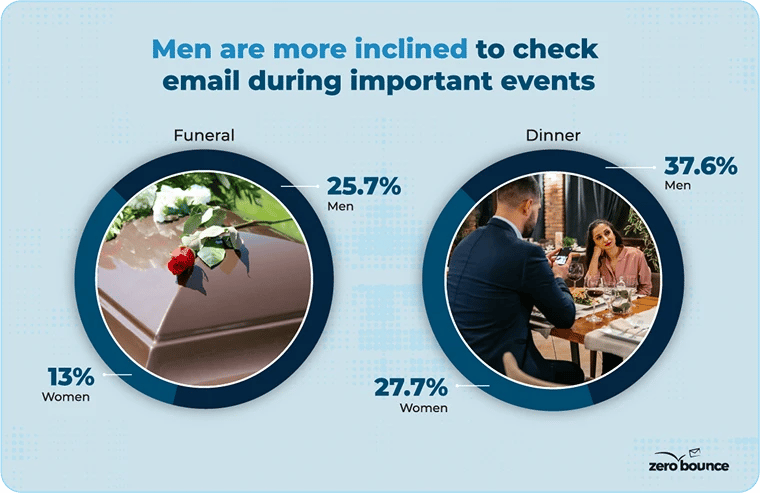
- Men are more likely than women to check email in public or ceremonial moments, like funerals or romantic dinners.
- Women are more likely to check email in intimate, everyday moments, like in bed with their partner or while driving.
Work email extends far beyond work hours
With remote and hybrid work more common, the line between work and personal time is blurred, a shift that reflects in today’s work culture. Without a clear physical or temporal boundary between “on” and “off,” checking the inbox can start to feel like a low-effort way to stay connected, even outside work hours.
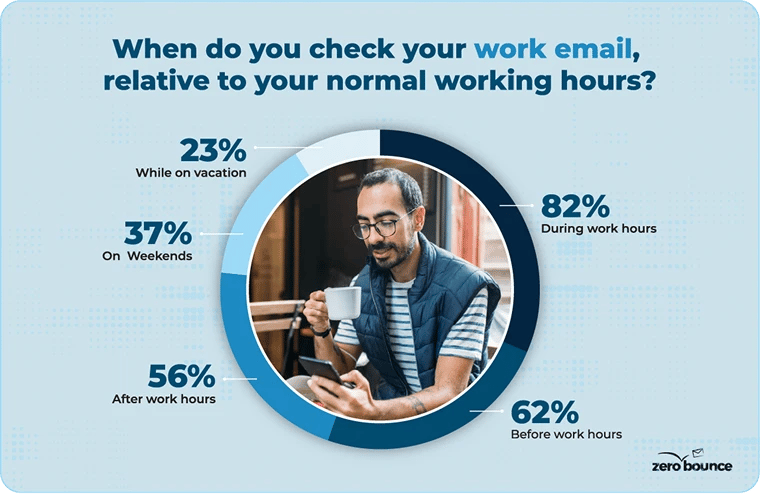
A majority check their email before work (62%) and after work (56%), and more than a third check it on weekends (37%). About one in five people check their email even on vacation.
Most people feel pressure to respond to emails right away
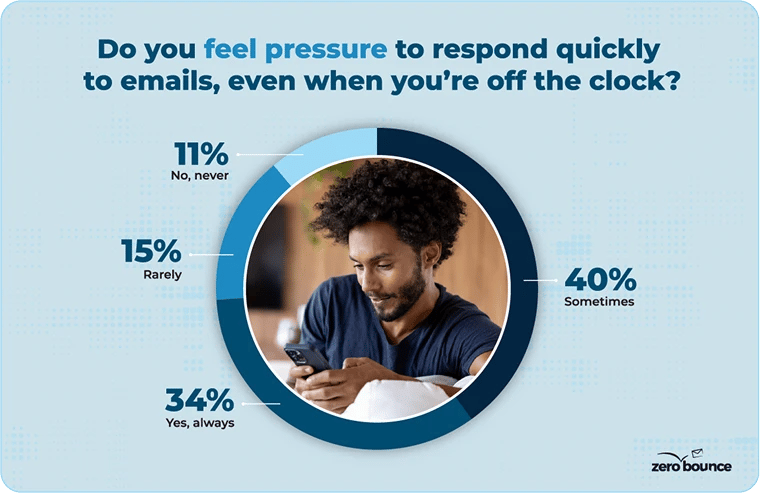
One of the most convenient aspects of email is that it’s asynchronous. In theory, that means responses don’t have to be immediate unless something is explicitly urgent. In practice, though, most workers (74%) feel pressure to reply quickly, even when they’re off the clock. Only 11% say they never experience that pressure.
Vacation – yes, but not from the work inbox
Time away from work doesn’t always mean stepping away from email. Only 29% of respondents fully disconnect while on vacation. Everyone else engages with email in some way, whether by checking occasionally, monitoring daily, or continuing to respond.
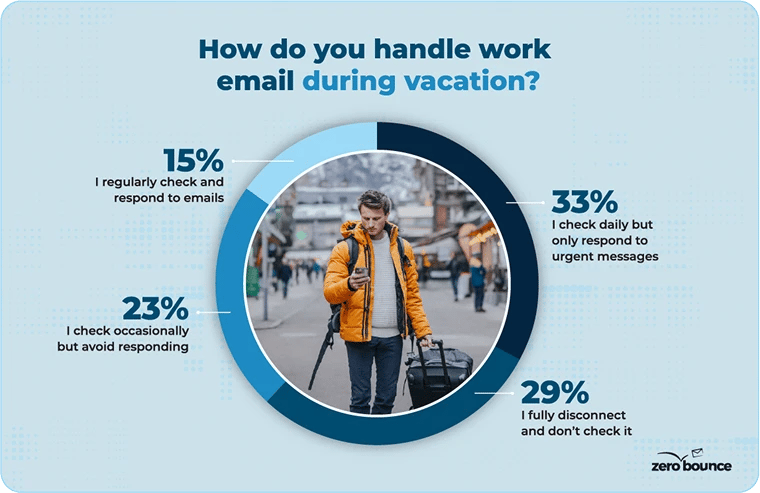

While 29% of respondents say they fully disconnect from email on vacation, only 19% explicitly selected “I don’t check work email on vacation” in a follow-up question. Also, 23% reported checking email during vacation on a separate item. It highlights a gap between how people say they handle time off and what they actually do.
Why workers check work email on vacation
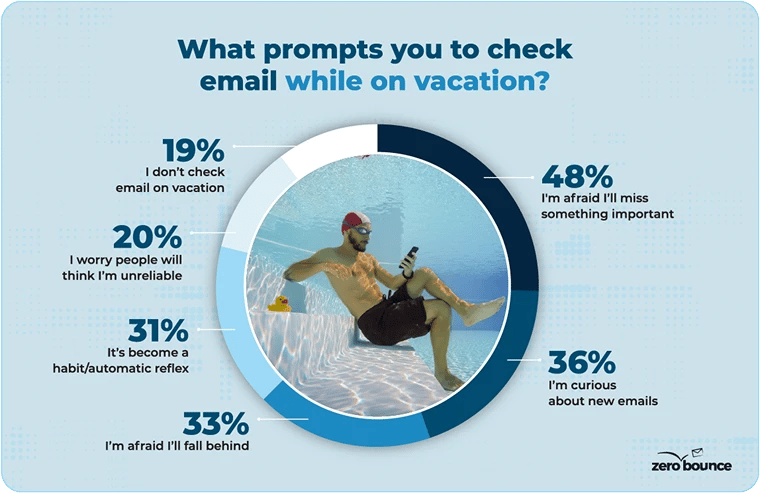
Fear is what drives most professionals to check email on vacation. Nearly half of respondents (48%) say they check email because they’re afraid of missing something important, while one-third (33%) worry about falling behind and one in five (20%) worry about how they’ll be perceived if they don’t stay on top of their inbox. Curiosity plays a role (36%), but anxiety-driven motivations clearly dominate.
Habit is also a major driver. Nearly one in three respondents (31%) say checking work email on vacation has become a reflex.
The inbox hits hard after vacation
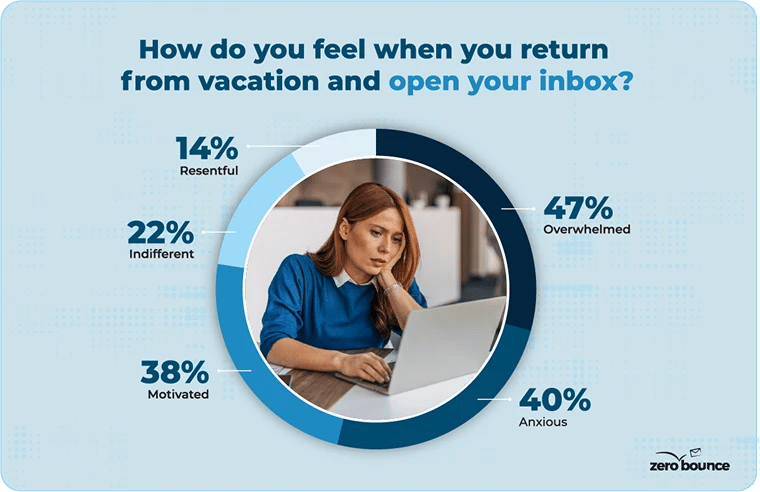
Instead of returning refreshed from time off, many respondents report feeling overwhelmed (47%) or anxious (40%) when they open their inbox again, while just 22% feel indifferent. But at the same time, 38% of respondents say they also feel motivated.
In other words, motivation and stress often carpool. People may be eager to catch up, but that doesn’t mean the pressure goes away.
Work email follows us everywhere
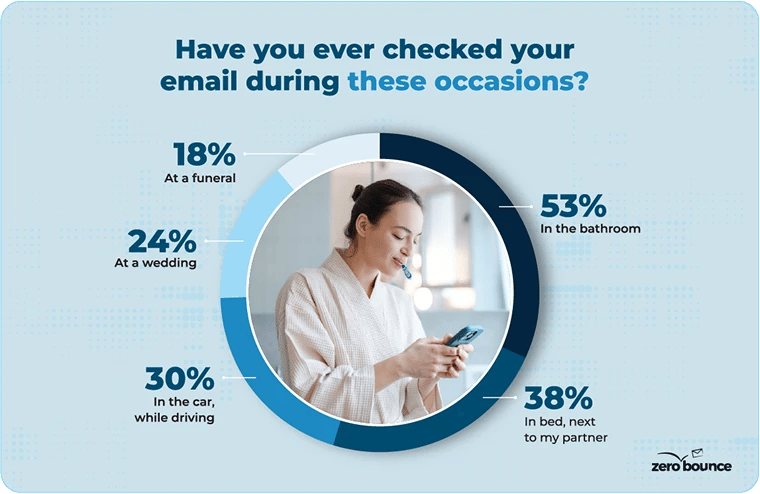
Many professionals refresh their work inboxes anywhere, no matter the setting. More than half of respondents (53%) say they’ve checked work email in the bathroom. Over a third report checking email in bed next to their partner (38%) or during important personal events (33%).
Even socially “hard lines” aren’t so hard anymore. Nearly one in five respondents (18%) say they’ve checked work email at a funeral, while others have done so at a wedding or while driving. These behaviors point to how deeply normalized constant email access has become.
Out-of-office messages rarely mean “out”
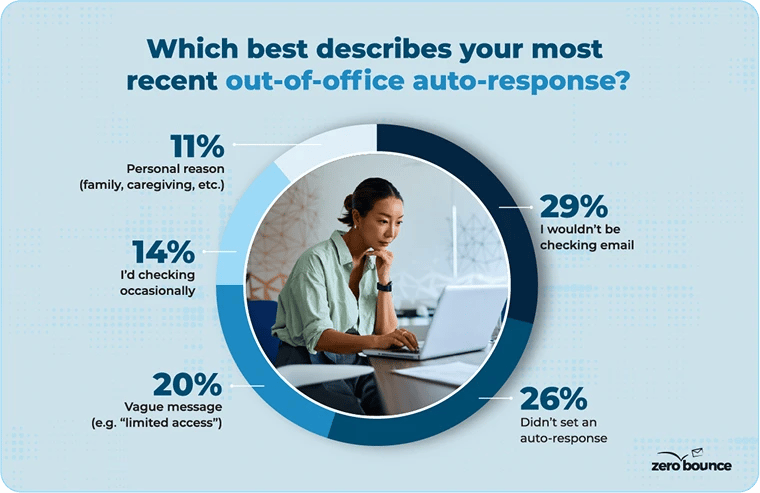
Out-of-office messages are meant to signal a clear break from work. In practice, they often reveal something else. Only 29% of respondents say their most recent out-of-office message clearly stated they wouldn’t be checking email.
Instead, 20% used vague language like “limited access,” while 14% explicitly said they’d be checking occasionally. Notably, 26% didn’t set an out-of-office message at all, either because they’re always available or because drawing that boundary still feels uncomfortable.
Inbox Zero reveals a split mindset
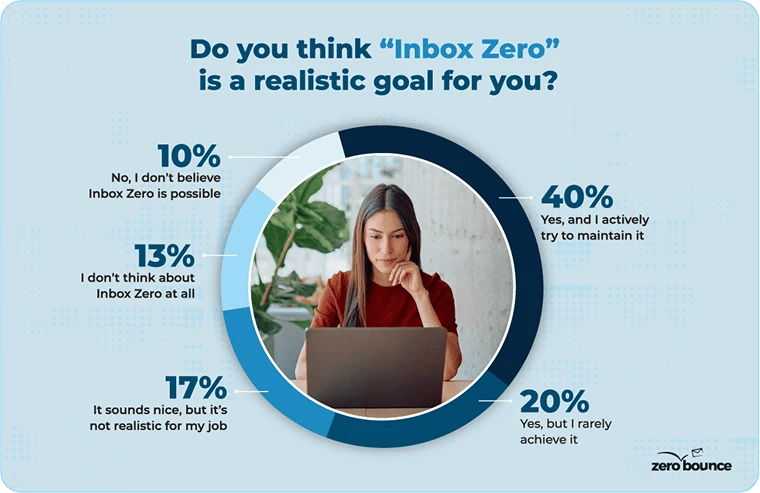
Inbox Zero is still something many people believe in, at least in theory. In practice, though, confidence in actually achieving it appears far shakier: 20% of workers say they rarely clear their inboxes. More than a quarter of respondents (27%) either don’t believe Inbox Zero is possible or say they don’t think about it at all.
Bigger paychecks may come with more stress
While work email spills into time off across income levels, the pattern is even more pronounced among higher earners. The data suggests that higher pay doesn’t necessarily translate into stronger boundaries and may even come with greater pressure to stay connected.
Here are the biggest contrasts between respondents making over $200,000 a year and the overall group.
High earners are more likely to be “always on”
Compared to the overall sample, high earners are significantly more likely to check work email outside traditional working hours:
- On weekends: 50% vs. 37% (+13 points)
- While on vacation: 32% vs. 23% (+9 points)
- After work hours: 59% vs. 56% (+3 points)
- Before work hours: 65% vs. 62% (+3 points)
What’s notable is where the gap shows up. Email checking among high earners spikes at the edges of the workday – evenings, weekends, and vacations – rather than during core working hours, where both groups report identical behavior (82%).
Pressure is heavier at the top
High earners report significantly more pressure to respond to emails off the clock. The contrast is clear:
- “Yes, always”: 42% vs. 34% (+8 points)
- “No, never”: 7% vs. 11% (–4 points)
Taken together, the data suggests that the pressure to stay responsive increases with income. Higher-earning professionals are much less inclined to feel they can simply ignore a work email, even outside working hours.
Worry and fear are higher for top earners
Those at the top of the pay scale are far less likely to disconnect from email on vacation (9% vs. 19% overall). The reasons are more often tied to fear and a concern about how they’re perceived. Compared to the overall group, top earners say they check their inboxes during time off because of:
- Fear of missing something important: 54% vs. 48%
- Fear of falling behind: 46% vs. 33% (+13 points)
- Worry about appearing unreliable: 30% vs. 20% (+10 points)
- Habit or automatic reflex: 38% vs. 31%
70% are overwhelmed when they return from vacation
This is one of the most striking differences in the dataset. When higher-income professionals return from vacation, their emotional response to the inbox is much more intense.
Compared to the overall group, they feel:
- Overwhelmed: 70% vs. 47% (+23 points)
- Anxious: 41% vs. 40% (roughly the same)
- Indifferent: 11% vs. 22% (–11 points)
Top earners are often seen as having more autonomy and flexibility, yet they’re far more likely to feel overwhelmed when they return to their inbox. Email may carry greater cognitive weight at income levels above $200,000, possibly because the stakes are higher.
What else stands out for high-income professionals
Here are a few additional patterns that stood out when we looked more closely at respondents earning over $200,000 a year. On their own, these differences may seem subtle. But together, they reinforce how people at the top either can’t or don’t want to ever fully switch off.
- Higher earners report checking email more often in the bathroom (61% vs. 53%), while driving (38% vs. 30%), at a funeral (24% vs. 18%), and in bed next to their partner (41% vs. 38%).
- They’re more likely to check email daily while on vacation (39% vs. 33%), but less likely to regularly check and respond (9% vs. 15%). In practice, they’re not fully switching off; they’re staying selectively on call.
Did you know?
Over 2 in 5 managers (41%) admit they have used AI to draft or revise a performance review. Learn more about how AI is impacting work culture.
Men and women check work email differently
Men and women often approach work differently, and those differences show up in how they use email. It’s not so much about who checks email more, but about what drives that behavior – pressure, habit, fear, or expectations – and how those forces play out during time off.
What stood out
- Men are more likely to check email intentionally. They’re much more driven by fear of falling behind (41% vs. 28% of women) and curiosity (40% vs. 33%). When men check email on vacation, it’s more often framed as staying in the loop.
- Women are more likely to describe email checking as a habit. More women than men say checking email has become automatic (30% vs. 27% of men) and describe it as something they’re trying not to do, rather than a deliberate choice
- Men are more likely to check email in significant social settings, such as at a funeral (26% vs. 13% of women) or during a romantic dinner (38% vs. 28%).
- Women, on the other hand, check email in private, everyday contexts, particularly in bed next to their partner (42% vs. 30% of men).
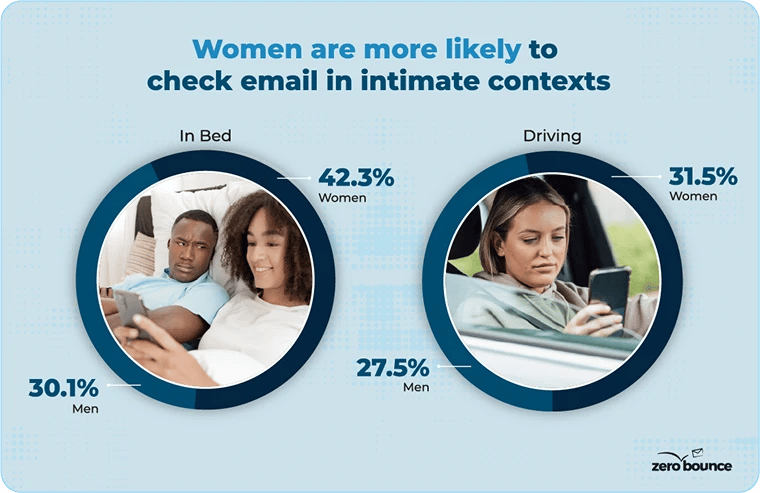
The data suggests that both genders cross social boundaries, but it often happens in different spaces: men tend to let work intrude into public or ceremonial moments, while women experience that intrusion in intimate, personal settings.
Did you know?
Roughly 1 in 3 people say they spend up to five hours a day in their inboxes. Learn more about how consumers interact with email.
Fun facts (and not-so-fun ones)
- About 3 in 10 people say they disconnect on vacation, but when asked about specific behaviors, 7 in 10 admit they still engage with work email.
- Pressure doesn’t necessarily make people respond more. It makes them monitor and reflects a work culture where staying available is often expected.
- People who feel pressure to respond off the clock are far more likely to return from vacation feeling overwhelmed.
- Roughly 8 in 10 respondents admit to checking work email in at least one traditionally off-limits situation, from the bathroom to weddings and funerals.
- Professionals earning over $200,000 a year are much more likely to check email on weekends and during vacation than the average respondent.
- Inbox Zero has cultural power, but not much confidence: 6 in 10 people believe it’s realistic, but one in three say they rarely or never achieve it.
Methodology
For this study, ZeroBounce surveyed 1,157 professionals in the United States and Europe to better understand how people use work email, particularly outside traditional working hours and during time off.
Collected in February 2026, the responses reflect self-reported behaviors from workers across a range of industries and roles. The sample was evenly split by gender (51% male, 49% female). The largest share of respondents reported a household income between $50,000 and $75,000, with representation across a wide range of income levels.

We encourage you to share these findings for noncommercial purposes. Please include proper attribution with a link back to this page if you do. For questions or media inquiries about this report, contact Corina Leslie at corina@zerobounce.net.