
“Sorry for my late reply”
The 15 Most Common Phrases People Use to Soften Emails
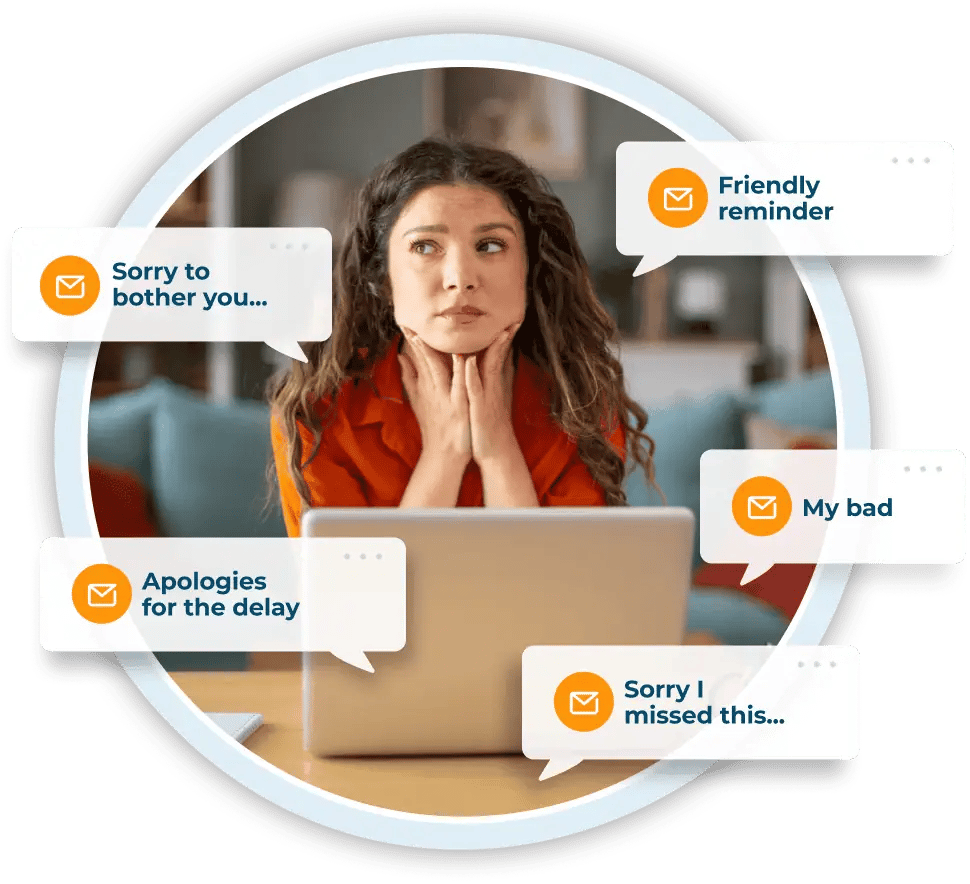
We analyzed more than 1.6 million emails to find out which phrases professionals use most to apologize and soften communication. Here’s what tops the list – and yes, people are still saying “sorry to bother you.”
This report is part of the ZeroBounce Insights Studio, our editorial series exploring email behavior, digital culture, and the way we work.
Key takeaways
- “Friendly reminder” is the most common phrase people use to soften tone in workplace emails, appearing 1,772 times across the dataset.
- Many phrases are tied to delayed replies, suggesting that answering emails late remains a major source of workplace guilt.
- Lower-ranking phrases focus on not sounding intrusive, including “sorry to trouble you,” “sorry to ask,” and “sorry to disturb you.”
“Apologies for the late response.”
“Gentle reminder.”
“Sorry for the delay.”
In many work emails, the real message begins only after the softener.
Some acknowledge an actual mistake or delay. Others seem almost automatic. People use them to sound more polite, less demanding, or less intrusive in crowded inboxes and busy workdays.
Many professionals apologize for following up. For asking questions. Sometimes, for existing in someone else’s inbox at all.
To see just how common these phrases really are, ZeroBounce analyzed more than 1.6 million emails and ranked the apology and softening phrases that appear most often in professional communication.
The most common apology and softening phrases in work emails
Among the 35 phrases analyzed, some stood out far more than others. “Friendly reminder” topped the list, followed closely by phrases tied to delayed replies and politeness. The data reveals just how deeply these habits are embedded in workplace communication.
Here are the 15 most common phrases people use to manage tone in emails. The numbers below show how often each phrase appeared across the dataset.
- “friendly reminder” – 1,772
- “sorry for the delay” – 1,385
- “my apologies” – 1,202
- “apologies for the delay” – 933
- “sorry for the late reply” – 603
- “sorry for any inconvenience” – 488
- “my bad” – 486
- “sorry for the confusion” – 447
- “sorry for the delayed response” – 350
- “sorry it took” – 342
- “I’m sorry about that” – 324
- “gentle reminder” – 321
- “sorry to bother” – 244
- “apologies for the inconvenience” – 210
- “apologies for the delayed response” – 208
What else people say to make emails sound less direct
Aside from the “friendly reminder” and late-reply apologies, people also rely on a wide range of phrases to sound less demanding or to say sorry – sometimes even before anything goes wrong.
- “sorry for the late response” – 205
- “quick nudge” – 132
- “sorry for my late reply” – 125
- “apologies for the confusion” – 123
- “sorry I missed this” – 110
- “apologies in advance” – 104
- “sorry for this delay” – 96
- “apologies for the late response” – 61
- “sorry for the slow response” – 55
- “sorry for getting back to you late” – 55
- “sorry for the delayed reply” – 51
- “sorry for bothering you” – 50
- “apologies for the delayed reply” – 45
- “sorry to bug you” – 43
- “sorry to trouble you” – 38
- “sorry to ask” – 35
- “apologies for my late reply” – 28
- “sorry for getting back late” – 23
- “sorry in advance” – 22
- “sorry to disturb you” – 21
Beyond persistent classics like “sorry for the late response,” a huge share of the remaining phrases are still tied to delayed replies. It suggests that one of the biggest sources of workplace guilt and anxiety is simply replying to emails late.
Even lower-ranking phrases – like “sorry to trouble you” or “sorry to ask” – revolve around not wanting to interrupt, inconvenience people, or seem demanding.
Why people still use these phrases
When you think about it, many of these phrases go far beyond accountability.
People apologize for asking questions or sending reminders. Sometimes, simply for having the audacity to send an email in the first place. In many cases, there’s no actual mistake or offense. And yet, apologies and disclaimers are still very much alive in inboxes.
A few things may help explain why these habits persist.
1. Email feels interruptive by default
Even though email is asynchronous, people still feel like they’re taking someone’s time or adding to their workload. So they soften their tone with “sorry to bother” or “sorry to bug you” – or by adding words like “friendly” or “gentle” to their reminders.
2. Workplace politeness norms
Especially in professional settings, there’s an instinct to sound agreeable and avoid friction. People often hedge their language because a more direct tone can feel uncomfortable, even though clear, straightforward emails are often more effective.
3. The language we inherit
For many people, using these phrases has become a reflex. Expressions like “gentle reminder” or “apologies for the delayed response” have been around for decades, passed from one generation of workers to the next.
4. Power dynamics
People are more likely to say “sorry to bother you” to a manager or to someone they don’t know well. It’s often seen as a subtle way of signaling respect or caution. The less familiar the recipient is or the more senior they are, the more carefully people tend to manage their tone in emails.
How to sound polite without over-apologizing
Many of these phrases aren’t necessarily wrong. In some situations, apologizing makes perfect sense. But workplace emails don’t always need layers of disclaimers and unnecessary guilt to sound respectful.
In many cases, clearer and more direct emails can sound more confident and are more likely to get a response or move a conversation forward.
Phrases like “sorry to bother you” or “sorry to ask” can unintentionally make a perfectly reasonable request sound like an interruption rather than normal communication.
Here’s how to sound clear, respectful, and confident
Instead of:
“Sorry to bother you”
Try:
- “Quick question about…”
- “When you have a moment…”
- “Could you help clarify…”
- “Wanted to ask about…”
- “Would love your thoughts on…”
- “Would appreciate your input on…”
- “Can you help me understand…”
- “Wanted to see what you think about…”
- You can even drop all of the padding you’ve added to a question. For example: “What days are best for you?” or “Does this interest you?”
Instead of:
“Friendly reminder”
Try:
- “Wanted to see if you had any thoughts on this”
- “Wanted to check whether you had a chance to look at this”
- “Would love to hear your thoughts when you have a moment”
- “Checking whether you had a chance to review this”
- “Wanted to bring this back to your attention”
Instead of:
“Sorry for the delay”
Try:
- “Thanks for bearing with me”
- “Here’s an update on this”
- “Thanks for waiting”
- “Sharing an update here”
- “Wanted to keep you posted”
- “Here’s where things stand”
Instead of:
“My apologies”
Try:
- “Thanks for your patience”
- “Appreciate your flexibility”
- “Here’s an update”
- “Wanted to clarify…”
Instead of:
“Sorry for any inconvenience”
Try:
- “Thanks for your understanding”
- “Appreciate your patience while this gets resolved”
- “Here’s what’s happening next”
- “Wanted to keep you updated”
Instead of:
“Apologies in advance”
Try:
- “Thanks in advance”
- “Appreciate your help with this”
- “Looking forward to your thoughts”
- “Let me know what you think”
Instead of:
“Sorry for the confusion”
Try:
- “Let me clarify”
- “Here’s a clearer explanation”
- “Here’s what I meant”
- “Let me explain.”
Work culture evolves, and every generation brings its own communication style. But as much as we may joke about workplace email language, some email etiquette habits survive generational shifts. Most people are simply trying to sound thoughtful, even if clarity and confidence sometimes get lost in the process.
Methodology
ZeroBounce analyzed 1,652,405 emails across multiple inboxes to determine which apology and tone-management phrases professionals use most often. The analysis relied on aggregated, anonymized data. No human reviewed, read, or accessed the content of any individual’s private emails. Instead, the study used keyword frequency searches to determine how often specific phrases appeared across the dataset.
Fair use statement
We encourage you to share these findings for noncommercial purposes. If you do, please include proper attribution with a link back to this page.
For questions or media inquiries about this report, contact Corina Leslie at corina@zerobounce.net.