To determine contact validity accurately, you need greylist countermeasures.
Before we talk about anti-greylisting's impact on email validation results, let's establish what greylisting is as our foundation.
What is greylisting?
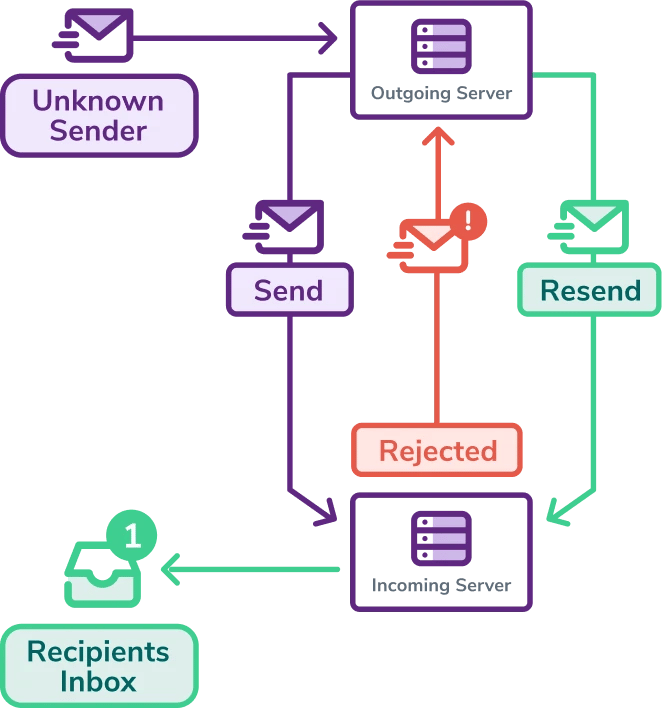
Greylisting is a popular anti-spam technology that temporarily rejects email messages from unknown senders. Most greylisting is time-based, meaning they only block messages for a specified duration - usually 15 minutes.
The recipient server issues a 4xx status code during this window, indicating a temporary issue. A legitimate, well-configured mail server will anticipate this and reattempt delivery before bouncing back. After the greylisting period elapses, the recipient server accepts the message and directs it to the inbox.
Once the delivery is successful, the receiving mail server remembers the address and marks it as a safe, trusted sender.
How greylisting negatively impacts email validation
While greylisting is necessary for spam prevention, it makes email validation tricky.
The email validation service solicits a response from the recipient's email server to validate an address. After the process, it marks the address as valid or invalid based on the results.
However, with email greylisting in place, the server temporarily rejects the incoming attempt as it would with a real email message. The validation result comes back as "unknown" as the service cannot verify one way or the other.
Unknown results won't tell you anything. An email validator needs to inform you whether or not an address is valid. This is particularly frustrating because many email addresses on your list that feature email greylist checks are valid, active leads.
Are your emails valid? Ditch unknown results and use ZeroBounce's anti-greylisting email verifier now!
Verify Your Emails FreeBeyond that, you need to know if an email address is potentially harmful (abuse emails, catch-alls, etc.). Without a way to circumvent greylisting, your email verifier isn't as useful as it could be.
How to bypass greylisting when using an email validator
The most effective way to avoid greylisting is to use an email verifier with anti-greylisting technology. This allows the email validator to behave similarly to a well-configured email server.
Here's how it works.
1. To avoid greylisting, brands appropriately configure their Simple Mail Transfer Protocol (SMTP). This allows messages to remain in the queue when receiving a 4xx reply code from the recipient server.
2. Instead of bouncing, the message remains in the queue for the necessary duration, usually 15 minutes.
3. Once the period expires, the sending server re-attempts delivery and is successful.
This anti-greylist solution allows an email validator to achieve the same result. Whenever you enter an email address for validation, the tool provides greylist mitigation and will continue to retry until it obtains an accurate result.
With this greylist bypass method, you will drastically reduce the number of unknown results you obtain when validating your list. You maintain the greatest level of control of your email list health and the performance of your campaigns.
Try these free email deliverability calculators
Additional greylist avoidance strategies
While ZeroBounce's anti-greylisting technology helps with your validation results, greylisting can still impact your email deliverability.
To help with greylist mitigation, be sure to monitor the following regularly:
- Your SMTP configuration - Incorrectly configuring your email server prevents message delivery. Check your configuration to help avoid greylisting.
- Your email sender score - Email servers want to stop messages from untrustworthy senders. Maintain your email reputation to assist with greylisting prevention.
- Best email practices - Optimizations like clean titles, preview text, an unsubscribe button, and a reply-to address work wonders as greylist bypass methods.
- SPF, DMARC and DKIM - Configuring your email server with the appropriate records allow email servers to confirm your domain identity. Not only do they better secure your domain, but they serve as effective greylist countermeasures.