TOP 10
Passive-Aggressive
Email Phrases
The ones people roll their eyes at – but still use

Some of the same email phrases professionals see as passive-aggressive are also among the ones they use most often.
This report is part of the ZeroBounce Insights Studio, our editorial series exploring digital culture, communication, and the way we work.
Key findings
- Forget “Per my last email.” Professionals crowned “Just to be clear” the most passive-aggressive workplace email phrase. It topped both rankings in our survey: 52% said it comes across as passive-aggressive, while 21% chose it as the single worst offender.
- Many professionals still use phrases they see as passive-aggressive. Thirty percent said “Any updates on this?” comes across as passive-aggressive – and yet, an identical 30% said it’s one of the workplace phrases they use most often.
- The highest-ranked passive-aggressive phrases all share one thing in common: they sound like corrections.
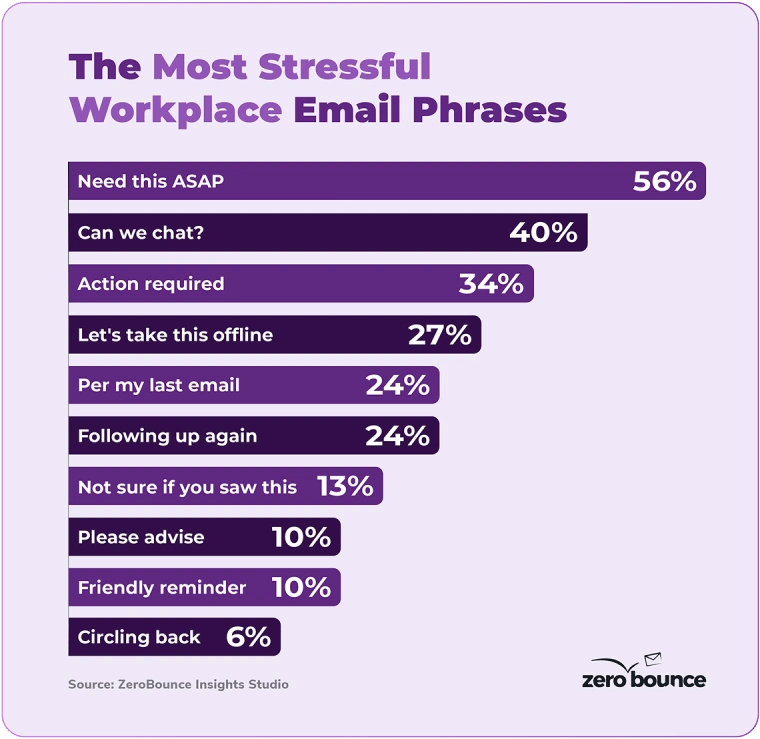
- “Need this ASAP” is the most stressful phrase in workplace email. More than half of professionals (56%) said it increases their stress or anxiety, followed by “Can we chat?” (40%) and “Action required” (34%).
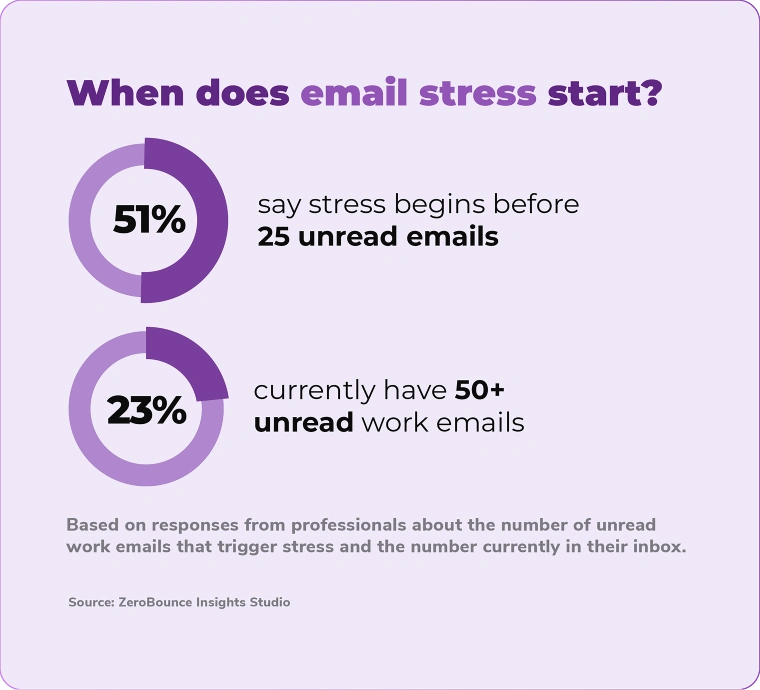
- Email stress starts surprisingly early. More than half of professionals (51%) said they begin feeling stressed before reaching 25 unread work emails, yet nearly one in four (23%) currently have 50 or more unread work emails.
Is “Just checking in” polite or pushy? Does “moving forward” sound irritating? We’ve all second-guessed a work email before hitting send. Even well-intentioned phrases can land very differently depending on who’s reading them.
To better understand how professionals interpret these everyday expressions, we surveyed workers about common email phrases and how they perceive them.
It’s not that these phrases are inherently passive-aggressive. But language doesn’t exist in a vacuum. Tone, context, relationships, and previous interactions all influence how an email is received.
The most passive-aggressive email phrases
Some email phrases have earned a negative reputation over the years, but not all evoke the same reaction. First, we asked professionals which common email expressions come across as passive-aggressive. Then, we asked them to choose the worst offender.
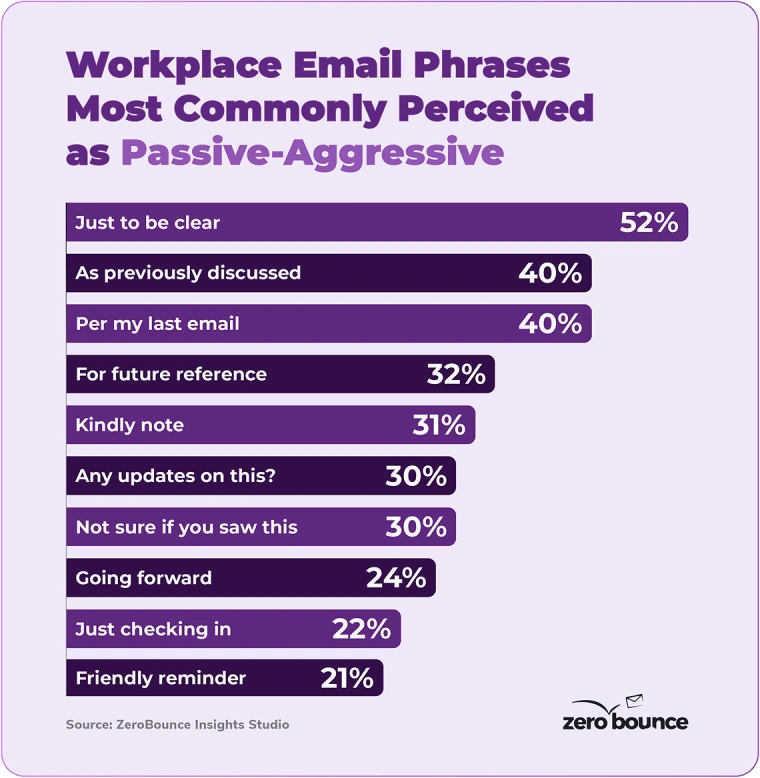
More than half of respondents (52%) said “Just to be clear” comes across as passive-aggressive – it’s the highest-ranked phrase in our survey. “As previously discussed” and “Per my last email” tied for second place at 40%, followed by “For future reference” (32%) and “Kindly note” (31%).
A common thread
The highest-ranked passive-aggressive email phrases all have one thing in common: they sound like corrections.
- “Just to be clear”
- “Per my last email”
- “As previously discussed”
- “Kindly note”
- “For future reference”
These phrases often imply the recipient has overlooked, misunderstood, or forgotten something. But correction phrases weren’t the only expressions professionals viewed negatively.
- Three in ten respondents pointed to “Any updates on this?” and “Not sure if you saw this.”
- One in four associated “Going forward/Moving forward” with a passive-aggressive tone.
- More than one in five viewed “Just checking in” (22%), “Friendly reminder” (21%), and “Just bumping this up” (21%) as passive-aggressive.
On the other hand, fewer respondents viewed “Circling back” (18%), “Thanks in advance” (12%), “Please advise” (12%), and “Following up” (8%) as passive-aggressive. But the results show that even routine workplace language can be interpreted very differently depending on the reader.
One phrase beat the internet’s favorite
Recognizing a phrase as passive-aggressive isn’t the same as calling it the worst offender. When we asked respondents to choose just one expression, one phrase pulled ahead of the rest.
Despite its long-running reputation, “Per my last email” wasn’t the phrase respondents considered the most passive-aggressive. Instead, “Just to be clear” claimed the top spot: it received 21% of the vote compared with 14% for “Per my last email.”
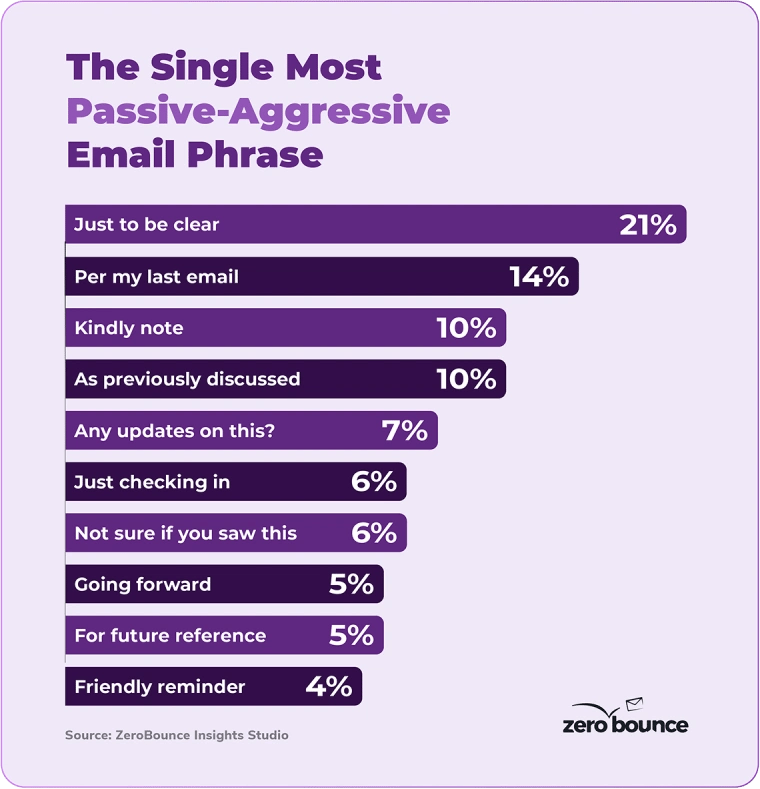
Other phrases earned a handful of votes, but none came close to challenging the leaders.
Elsewhere in the ranking, “Friendly reminder” (4%), “Thanks in advance” (3%), “Circling back” (3%), “Please advise” (3%), and “Just bumping this up” (3%) attracted relatively few votes as the single most passive-aggressive expression.
Notably, “Following up” received the fewest votes, with fewer than 1% selecting it as the single most passive-aggressive phrase.
The passive-aggressive email phrases people still use
Knowing a phrase can sound passive-aggressive doesn’t necessarily stop people from using it. Several of the phrases professionals perceive as passive-aggressive also rank among the expressions they use most often in work emails.
These expressions have become so embedded in workplace communication that they serve as the default language for follow-ups or asking for updates.
The contrast is especially striking for phrases like “Any updates on this?” Thirty percent of respondents said it comes across as passive-aggressive – and an identical 30% said it’s one of the expressions they use most often. A similar pattern emerged with “Friendly reminder,” which 21% viewed as passive-aggressive while 22% said they use it regularly in work emails.
Overall, “Thanks in advance” topped the list of the most commonly used email phrases from our list (37%), followed by “Following up” (34%), “Just checking in” (32%), and “Any updates on this?” (30%).
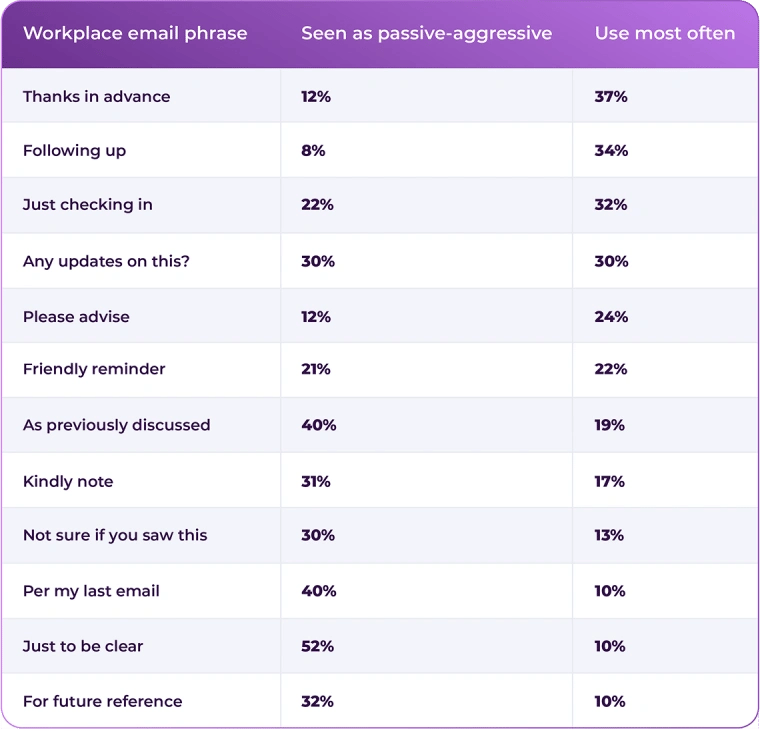
However, phrases that topped the ranking are far less common in everyday emails. Only 10% said they most often use “Just to be clear,” “Per my last email,” “For future reference,” or “Going forward/Moving forward.”
The most stressful email phrases
Some email phrases may sound passive-aggressive, but others create stress because they signal urgency or difficult conversations. More than half of respondents (56%) said “Need this ASAP” increases their stress or anxiety at work, followed by “Can we chat?” (40%) and “Action required” (34%).
A manic Monday for work email
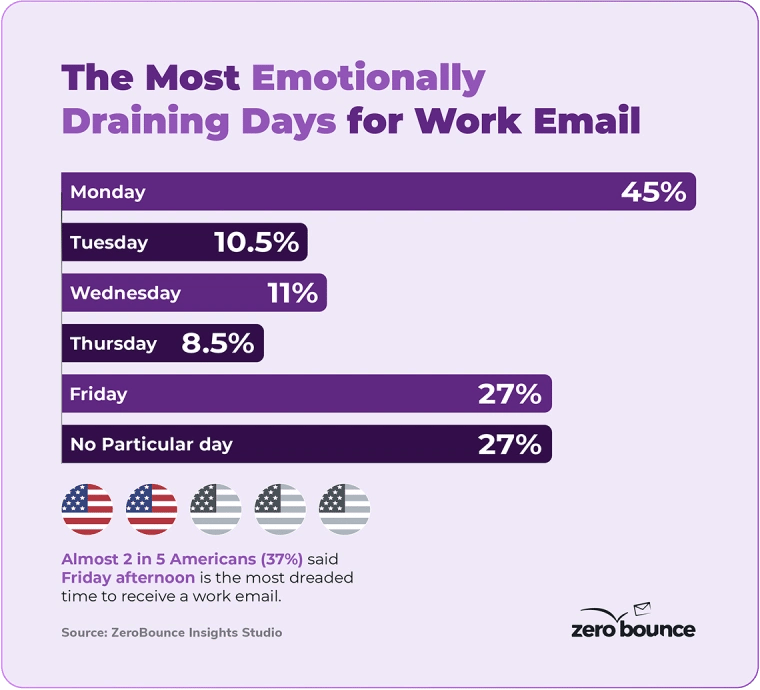
Email stress hits differently throughout the week. Monday is the most emotionally draining day for work email (45%), well ahead of Friday (27%). Tuesday (10.5%), Wednesday (11%), and Thursday (8.5%) were much less likely to be associated with email stress.
How many emails are too many?
Respondents also told us how many unread work emails it takes before they begin to feel stressed – and how many they currently have in their inbox. More than half said stress starts before reaching 25 unread emails, yet nearly one in four reported currently having 50 or more unread work emails.
Methodology
ZeroBounce surveyed 2,000 professionals across the U.S. and Europe in August 2026 to better understand how people interpret common workplace email language. Respondents were asked which email phrases they perceive as passive-aggressive, which ones they use most often, which expressions increase workplace stress, and how unread emails affect their stress levels. The average age of respondents was 40; 47% were female, and 52% were male.

We encourage you to share these findings for noncommercial purposes. Please include proper attribution with a link back to this page if you do. For questions or media inquiries about this report, contact PR Director Corina Leslie at corina@zerobounce.net.
More research from ZeroBounce Insights Studio

CASE STUDY
“Sorry for my late reply”: The 15 Most Common Phrases People Use to Soften Emails
From “friendly reminder” to “sorry to bother you,” new data from more than 1.6 million emails reveals the phrases professionals use most to soften communication – and what they say about modern work culture.
Read the report
CASE STUDY
The Out-of-Office Illusion: What Our Email Habits Reveal About Work Culture
Are you among the 71% of workers who check email on vacation? New data shows how pressure, habit, and fear are part of modern work – and keep people glued to the inbox even when they’re “off.”
Read the report
CASE STUDY
The Top 10 Email Buzzwords – Based on 1 Million+ Real Emails
We analyzed 1M+ business emails to uncover the most overused phrases in the inbox. From “Hope this email finds you well” to “Just circling back,” here’s what people can’t stop writing – and why it matters.
Read the reportTrusted by journalists worldwide
ZeroBounce Insights Studio publishes original research on email, digital culture, human behavior, and workplace trends, with a particular focus on workplace communication. Our studies have been featured by Bloomberg, Fast Company, CNBC, Forbes, Axios, The Times, Times of India, and hundreds of other media outlets.