Looking spammy can hurt even legitimate email senders. Small mistakes can raise red flags with both mailbox providers and recipients.
People are quick to judge suspicious emails. In fact, 80% of consumers say they’ll mark an email as spam simply because it looks like spam.
Trust starts before someone opens your email. Clear subject lines, clean design, and authentic messaging help your emails reach the inbox and earn credibility.
Just because you’re not a spammer doesn’t mean your emails won’t raise red flags. If you want to land in the inbox, your emails need to inspire confidence from the moment they arrive.
Email is one of the world’s primary communication channels. For many businesses, it’s a brand-building tool and a revenue driver. Whether you’re sending newsletters, promotions, or transactional messages, every email contributes to how people perceive your brand.
And if your emails look like spam, those opportunities disappear before your audience even sees them.
The struggle to arrive in the inbox has never been tougher. Major providers, like Google and Yahoo, have ramped up efforts to combat spam, so email deliverability doesn’t happen without due diligence.
But checking off the deliverability boxes is not enough.
What happens when your emails look like spam
It’s not “just an email.” Sending one that raises flags can be a disaster. A ZeroBounce survey found that 80% of people report an email as spam simply because it looks like spam.
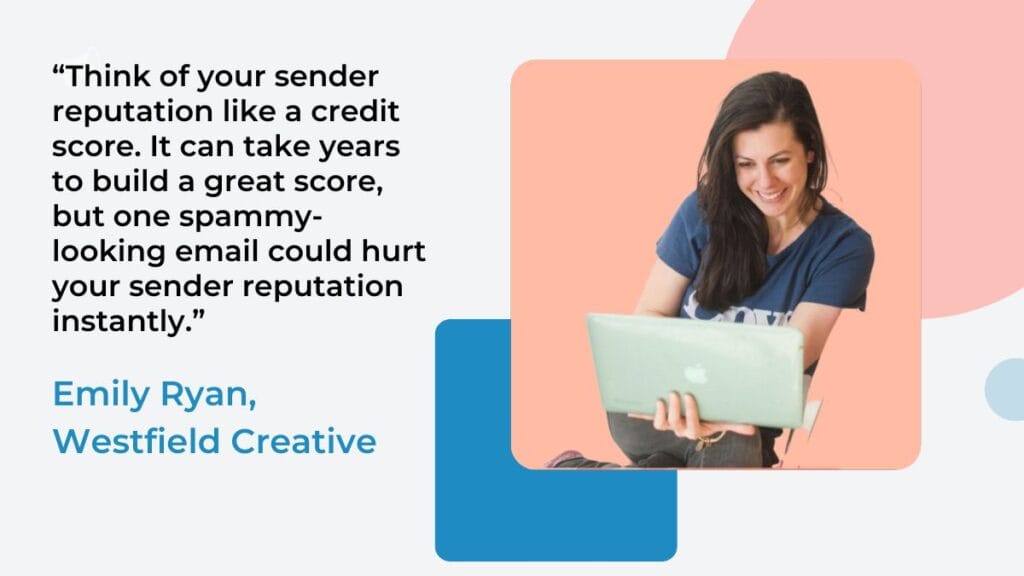
“Think of your sender reputation like a credit score,” said Emily Ryan of Westfield Creative. The email expert explains: “It can take years to build a great score, but one spammy-looking email (or one bill that ends up in collections) could hurt your sender reputation instantly. Sending a spammy email is risky and not worth it.”
Skip that quandary altogether by always avoiding seeming spammy – both to email service providers, and most of all, to people.
If your emails look spammy, recipients will ignore them, delete them, or worst of all, mark them as junk. Avoid that scene because recovering a damaged sender reputation is unnecessary stress.
But how can you tell if your email looks like spam? Here are the mistakes to watch out for – and how to fix them before hitting send.
You can’t afford to send even “just one” spammy email.
1. Misleading subject lines raise suspicions
Subject lines set expectations for what your email is actually about. When you use unusual capitalization, excessive punctuation, or fake “Re:” and “Fwd:” tactics, recipients may feel like you’re trying to pull a fast one before they even open the message.
Be direct about what’s inside the email and always deliver. A clear, honest subject line builds trust and encourages engagement.
One common misstep is using all capital letters in the subject line, thinking it will get your subscribers’ attention.
It just might, but probably the wrong kind of attention.
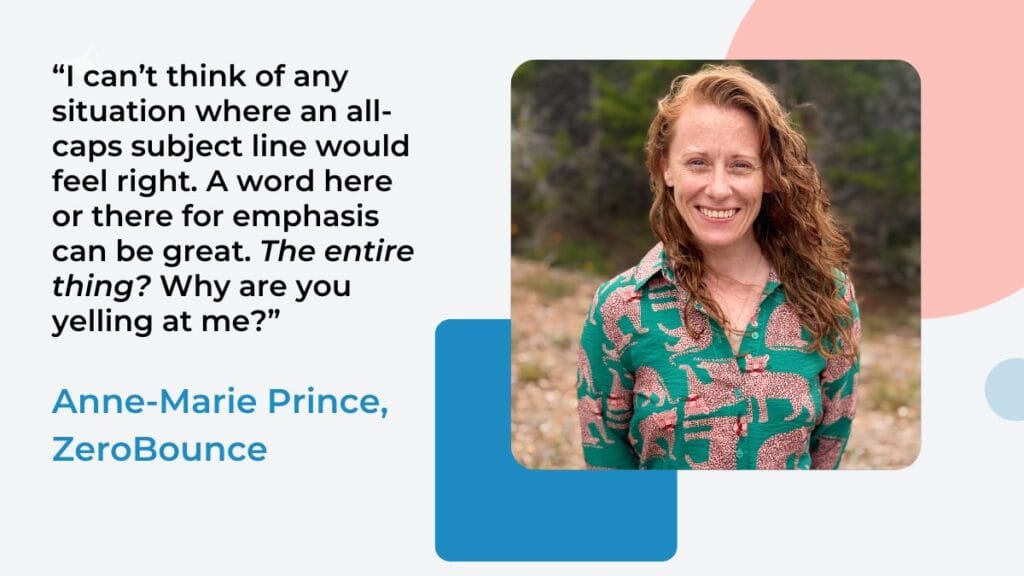
“Subject lines in all caps feel both spammy and aggressive to me,” said Anne-Marie Prince.
The ZeroBounce Email Marketing Manager went on: “I can’t think of any reason or situation where an all-caps subject line would feel right. A word here or there for emphasis can be great. The entire thing? Why are you yelling at me? I don’t need my emails to yell at me.”
It’s worth driving home the point about subject lines because it is the first thing a person sees. Anne-Marie Prince advises against crafting emails with “subject lines are designed to look like a reply from a previous email, or a forward of an email.”
It diminishes trust, and for both email service providers (ESP) and people, it’s not a big jump from low trust to “spammer.”
Capitalize a word or two, but not the whole subject line!
2. Broken personalization makes you look careless
Personalization can improve engagement, but only when it’s accurate and looks credible.
I’ve gotten emails that say “Dear PAUL.” Think about how that lands. It’s pretty clear that this is how the data was saved in the sender’s CRM or email marketing system.
Even worse is when placeholder text like “Dear %%first_name%%” or incorrect names slip through. That can instantly damage credibility.
Before sending, verify that your merge tags work correctly and that your customer data is clean.
Anne-Marie Prince weighs in:
“In a perfect world, it’s nice to personalize emails with someone’s first name, among other things, but you need three things:
Adequate fallback values for your blank fields.
Rules and restrictions on form data inputs (e.g., restricting emojis)
Proper name clean-up rules and processes in place”
Many email marketers are meticulous about their automations, but errors can still occur. “You can end up with some strange personalization without realizing it. And even though the consumer is sometimes the reason for that mangled personalization, it can still strike a nerve with the receiver on the wrong day.”
Image-only emails are more likely to raise eyebrows than your click-through rate (CTR). The problem with sending these image-only emails is that all too often, they create accessibility issues.
And guess what else. Sending an email that is only images resembles the tactics used by spammers trying to hide text from the filters designed to detect spam.
The solution is to include meaningful text alongside your images so both recipients and mailbox providers can have some confidence in your message.
Also, avoid overcrowding your emails with images. Include only the visuals that support your message. If you have a lot of pictures that you think your subscribers really want to see, you can always provide them with a link to a social media post or a web page.
4. Too much clutter overwhelms readers
It’s always smart thinking to regularly examine the emails you get. If you like a particular email, ask yourself why. Try to learn about what makes it a good one.
You may notice this: less is more when it comes to email design. For whatever reason, you’ll also notice that a lot of spam looks messy.
When an email is packed with images, links, buttons, uses lots of different colors and has competing messages, it always feels chaotic rather than helpful.
A clean design with order and simplicity makes your content more trustworthy and easier to digest. The other advantage to being straightforward is that your emails will be much more likely to inspire action.
I’ve seen some email signatures that have really left me scratching my head. In one case, the sender name and signature didn’t match up. Oops!
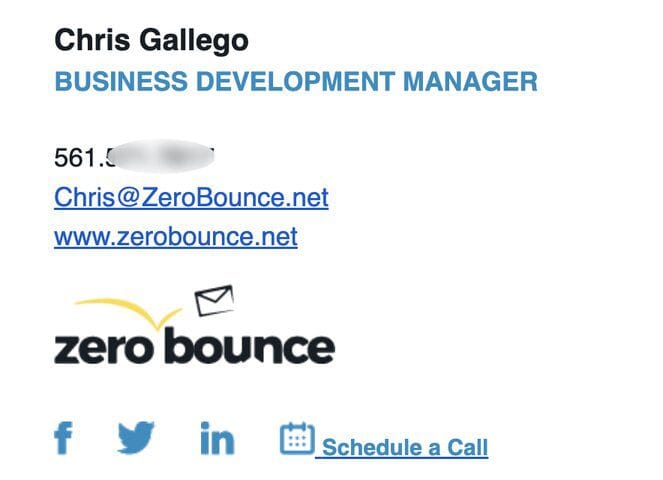
Although that’s an extreme example, the signature is one place where it’s appropriate to showcase your credibility. Some senders will share their credentials and further ways to connect like a link to schedule a meeting.
People expect legitimate emails to include accurate information in the signature. Missing or confusing details, broken links, or formatting errors can make an email appear unprofessional or like spam.
There are tales of email marketers who have sent an email for many months with a broken social media link. Who knows what kind of missed opportunities that mistake caused?
People are paying attention to your email signature. So, concentrate on design and copy that makes a good impression.
Where a lot of people go wrong is by not routinely testing the links and details in the email signature. Every other month or so, review your signature to ensure that everything works and accurately reflects your brand.
Your email signature is a great way to accommodate further communication.
6. Too many calls-to-action create confusion
It’s easy to understand why so many email marketers make the mistake of using too many calls-to-action (CTA). You’ve got goals, objectives, and targets. The pressure is there, but it’s just too bad that so many senders don’t realize that multiple CTAs weaken the strength of your messaging.
If every button and link in your email asks recipients to do something different, they probably won’t know where to focus. Their ultimate decision may be to just tune out entirely.
You’ve got to make a decision – what matters most to you? Let your email focus on that one thing.
Choose one primary goal for each email you craft, and make it the clear centerpiece of your message and design. It always helps if the recipients see themselves in the CTA. What if you aren’t sure they’ll see themselves and their interests in the CTA? Don’t send that email until you get clear on the message.
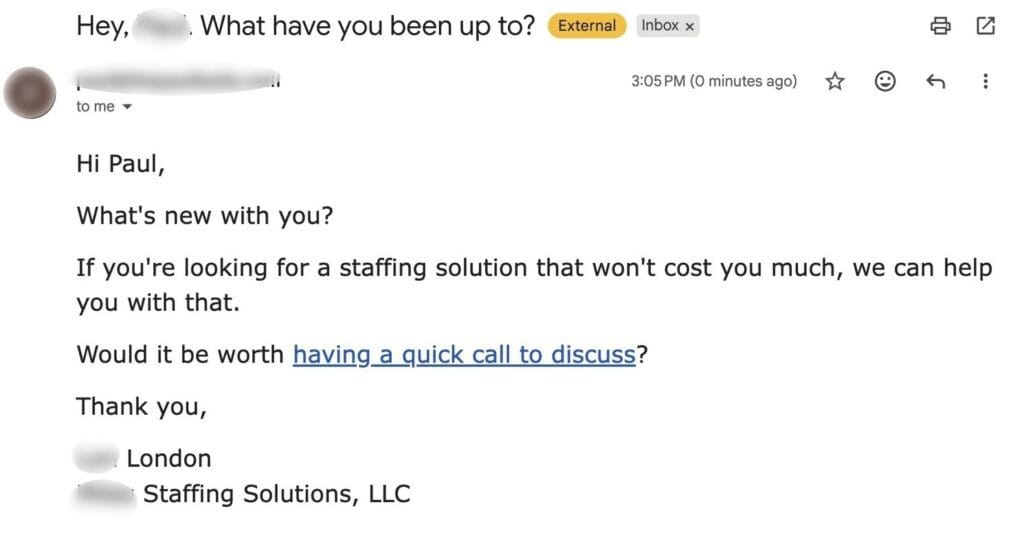
If there is anything that spammers and phishers always do, it’s pretending like they know you. But what happens the moment you realize you’ve never heard of this person before? You immediately discount whoever devised that scheme.
Few things feel spammier than an email that acts overly familiar to someone who never met you or signed up to your list. You’ve seen plenty of those emails that assume a relationship where none exists.
And yes, there are legitimate email marketers who try this, but it always does more harm than good. Being manipulative should never be a part of your branding.
Send emails to people who have opted in, and be transparent about who you are and why they’re hearing from you. If you have to pretend to be someone else or that a relationship really exists, then you need to reexamine your strategies.
If you’re cold emailing someone because you’re in sales or are trying to make a partnership happen, be upfront about it. Introduce yourself just as you would in the real world.
Want your emails to resonate? Keep it real
There’s a bigger picture to email that will keep you far away from spam land. Instead, it will let you find your way into plenty of inboxes, and maybe even a few hearts. More than anything, you’ve got to keep things real.
Here’s the thing: an email will always come across as spam-like if it seems like a person isn’t behind it. Whether or not you use AI is your personal preference, but many people will hit the spam button if they doubt your humanity.
And many of us can tell the difference right away. Some emails reek of AI. Others have a wonderful human quality to them. The greater the level of true intimacy, the more your emails will resonate.
People ask, “how can I write emails that don’t come across as formulaic?”
The answer is simple: don’t follow a formula.
And finally, don’t sweat the small mistakes. Everyone occasionally sends an email with a wrong date or a grammatical error. If anything, it will probably endear you a little bit. In the age of AI, all you need to be is exactly who you are. It’s the most effective way to differentiate your brand from others.
From content marketing to PR campaigns, Paul creates stories that inform and inspire. With more than two decades of experience as a writer and interviewer, he’s conducted over 1,100 conversations with authors, artists, and entrepreneurs. He brings his radio and podcasting skills to our webinars, where he breaks down complex topics in a clear, engaging way.
At ZeroBounce, Paul contributes to content and media initiatives that set the brand apart. He has a knack for turning everyday moments and cultural trends into creative campaigns and stories that make email relevant in new ways. He also writes extensively about email marketing, covering deliverability, data quality, and what actually makes emails perform.
In his free time, Paul enjoys long walks, a good movie, and trying out new restaurants.


 Read Story
 Read Story
 Read Story
 Read Story
 Read Story
 Read Story