5 Email Phrases That Make You Sound Less Confident at Work — And What to Say Instead


The most common workplace email phrases may seem polite, but they can also make your communications feel hesitant, defensive, uncertain, and even insecure. Here are five common email expressions that could use some rethinking. But, no worries, we’ll also provide stronger alternatives that are still professional and gracious.
Elton John famously sang “Sorry Seems to Be the Hardest Word,” but it’s obviously not a hard thing to write in an email. Do a search in your inbox for “sorry for” or “my apologies” and you’ll probably see dozens and maybe even hundreds of examples.
And it’s not just a hunch. In a recent ZeroBounce study analyzing more than 1.6 million emails, we found that professionals frequently apologize, hedge, and soften their language, even when there’s little reason to do so.
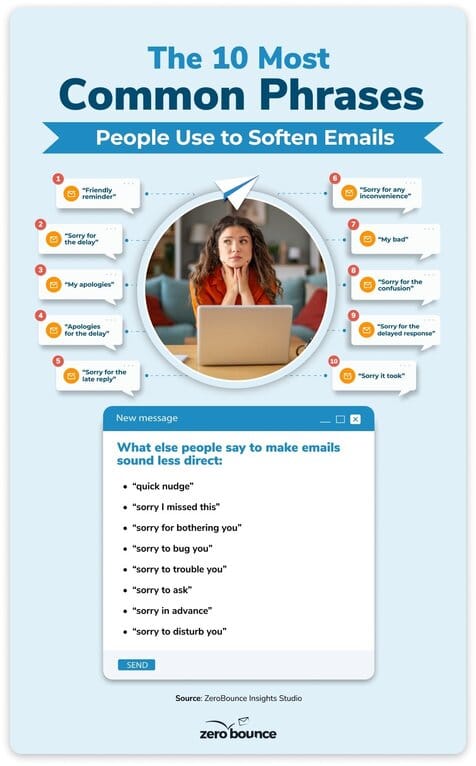
Here are the 10 most common tone-softening phrases we found in workplace emails:
- “Friendly reminder” — 1,772
- “Sorry for the delay” — 1,385
- “My apologies” — 1,202
- “Apologies for the delay” — 933
- “Sorry for the late reply” — 603
- “Sorry for any inconvenience” — 488
- “My bad” — 486
- “Sorry for the confusion” — 447
- “Sorry for the delayed response” — 350
- “Sorry it took” — 342
Most of the time, apologies aren’t really in order. We just don’t want to sound presumptuous or too demanding. It’s admirable that you don’t want to be a bother when emailing.
Here’s the thing, though: you’re just doing your job. Being confident and fearless in the inbox will help you fulfill your responsibilities and meet your goals.
Let’s look at some of these common phrases that permeate the inbox, and bolder alternatives you should consider.
Related: “Reaching out” Tops the List of Most Overused Email Clichés (ZeroBounce Study)
1. “Friendly reminder”
You’re trying to remind the recipient of your previous email without being overbearing. But the problem with “friendly reminder” is that it usually lands one of two ways, and neither are things you want to communicate.
“Friendly reminder” can come across as passive-aggressive or overly cautious, so consider saying something different in your emails.
You could use these instead:
- “Have you had a chance to look at this?”
- “Would love your thoughts when you have a moment.”
- “Let me know what you think.”
- “Wanted to see where things stand.”
Consider being even bolder. Go for it. Ask explicitly for the thing you want. Let’s say you’re trying to schedule an in-person meeting so you can present an idea.
Think of the best-case scenario and ask for that exactly. You’ll be surprised how often you may get it. You’d say something like: “If I came into the office on Wednesday at 1:30 PM, would you have ten minutes to sit down with me?”
You’ve got nothing to lose.
2. “Apologies for the delay” / “Sorry for the delay”
The 2026 ZeroBounce study analyzed over 1.6 million emails and found that a lot of people believe that emails require an immediate reply. For so many professionals, a “sorry for the delay” is always on standby. Even when a delay in responding was minor or understandable, apologizing has become the norm.
Of course, say you’re sorry when something is way overdue. But “sorry I was driving” is hardly necessary.
If you’re sending your “apologies for the delay” just to be deferential, you need a reframe. Why? Because apologizing needlessly sends a message to others that they have a right to your time.
Say this instead:
- “Thanks for your patience.”
- “I appreciate you waiting.”
- “Here’s the update.”
- “Thanks for bearing with me.”
All of these things show a bit more confidence and allow you to not feel bad for what’s beyond your control.
3. “My apologies” / “My bad”
If you make a mistake or cross a line, by all means, apologize. Say that you’re sorry if that’s the right move. But all too often, more timid people throw out a “my bad” when it’s really the other party that erred.
A more confident approach is to acknowledge the issue and then emphasize the solution or correct information.
Say one of these instead:
- “Thanks for catching that!”
- “I’ll correct it.”
- “I appreciate your understanding.”
- “Here’s the revised version.”
Don’t dwell on mistakes. Just fix anything as best you can and keep on trucking.
4. “Sorry for the confusion” / “Sorry for any inconvenience”
“Sorry for the inconvenience” or “sorry for any confusion” are a bit overused. No need to dwell on a blip. In some cases, you’re not the one who caused the confusion. Not to worry, you can always clarify.
If you’re trying to make a deal or move things along, you’re better off avoiding phrases that can be unnecessarily negative or draw more attention to a small issue.
Say one of these instead:
- “Let me clarify.”
- “Here’s what I mean.”
- “Thanks for your flexibility.”
- “I appreciate your understanding.”
5. “Sorry to bother” / “Gentle reminder”
These are phrases that can unintentionally make a very reasonable email seem like an interruption. Most of the time, the reader doesn’t think you’re bothering them, but suddenly you’ve inadvertently injected that idea. That can make you seem insecure.
If you have an honest question or you’re trying to present your idea, be steadfast and confident. Be direct.
Say this instead:
- “Wanted to remind you.”
- “When you get a chance”
- “Looking forward to your thoughts.”
ABC – Always Be Confident when you communicate
One of the ways you can be respectful of people’s time is by getting to the point. You can start an email with a friendly “Hi.” Then, get to it!
Practicing confident workplace communication doesn’t mean being cold. Most of the time, small changes in the words you choose makes your emails clearer, respectful, and more direct at the same time.
Table of Contents
- Here are the 10 most common tone-softening phrases we found in workplace emails:
- 1. “Friendly reminder”
- You could use these instead:
- 2. “Apologies for the delay” / “Sorry for the delay”
- Say this instead:
- 3. “My apologies” / “My bad”
- Say one of these instead:
- 4. “Sorry for the confusion” / “Sorry for any inconvenience”
- Say one of these instead:
- 5. “Sorry to bother” / “Gentle reminder”
- Say this instead:
- ABC - Always Be Confident when you communicate
Related Posts
-
 Read Story
New ZeroBounce research shows professionals check email long after the workday ends and even during vacations. Here’s how to reduc...
-
 Read Story
Learn how DMARC works, how it helps email security and deliverability, and how to set up, monitor, and strengthen your email authe...
-
 Read Story
Are you looking to change your Gmail sender name? Gmail is the number one inbox provider worldwide, but sometimes your sender name...
-
 Read Story
Need to find an email address for someone who's a professional connection or potential customer? There are several ways to look so...
-
 Read Story
Feeling a bit nervous about sending Mom an email? Use these guidelines and tips to relieve some of the stress – and keep the commu...
-
 Read Story
Email list management is essential for any marketer looking to get the most value out of their email list. That's why we put toget...