SalesCaptain’s Bill Stathopoulos on How to Win at Cold Email in 2026

Quick Answer
How do marketers succeed with cold email in 2026?
Short answer: Use AI to automate and scale the repetitive parts of outreach, but focus on experimentation, relevance, and proper email warmup to get replies. Cold email expert Bill Stathopoulos emphasizes that while tools can help, human judgment and thoughtful messaging are still critical.Why it matters: Cold email is more competitive than ever, and spam filters are smarter. Without domain warmup and a strategy for testing what works, even the best AI-generated campaigns can fail. By combining technology with experimentation and attention to audience needs, marketers can improve email deliverability, engagement, and results.
Bill Stathopoulos can tell you how to win with cold email. As co-founder and CEO of SalesCaptain, a B2B marketing and go-to-market (GTM) firm, and author of Cold Email Secrets, he knows what works, and he’s learned the hard way what doesn’t. He also knows a thing or two about how to use AI and experimentation to get better results.
In this interview, Bill Stathopoulos shares some of his best advice on how to run winning cold email campaigns. For instance, he says, you’ll gain an increasing advantage if you use AI well. Throw in a little experimentation and pay close attention to email deliverability so that your emails will land in the inbox. Hitting the mark in these areas can radically improve responses.
Stathopoulos explains the simple way marketers can avoid the spam folder and get more replies. Following his suggestions will get you better results with your cold email outreach.
You’ll learn:
- How marketers can use AI to automate and scale outbound campaigns
- Why email warmup is a non-negotiable for successful outreach
- How experimentation is the ticket to better responses and campaign performance
- Tips to avoid the spam folder
- How to make the most out of technology, but never forget human judgment
You can also watch our interview below!
“We’re entering a B2B data renaissance.”
As we head into 2026, what’s working in cold email and how should people prepare for the year ahead?
At SalesCaptain, we’re putting together a report on exactly this topic. It’s a great coincidence that you asked.
What we’ve seen so far, and where things are going in 2026, can be summed up like this: the biggest impact has come from AI. Throughout 2025, we’ve become more mature and aware of how to use it effectively. AI has been a huge help with processing data.
We’re seeing this in solutions like Clay, which focus on go-to-market data and workflows, but also in new tools that integrate AI agents directly inside CRMs. These can handle outbound tasks and enrich data automatically. There’s a bit of a “data war” happening right now.
What I like to call it is a B2B data renaissance. We now have the ability to process data from all over the web using AI tools like Clay and Apollo. It doesn’t really matter which one you use, the point is we can now produce secondary firmographics, secondary company characteristics, and use those to target companies and build segmented, specific audiences. Basically, we can do what a Business Development Representative (BDR) would do without needing them for that part of the process.
That doesn’t mean BDRs are obsolete. We still need them to be part of the strategy. That’s actually a major theme moving forward: AI taking a bigger role in go-to-market, but not replacing people entirely.
We haven’t seen AI BDRs live up to the hype yet. They do work in some cases, but not across the board. What’s happening now is that AI is being used in specific areas: one AI for copywriting, another for identifying data sources, another for segmenting data across different platforms. That trend will continue.
In 2026 and beyond, the initial touchpoint with a prospect will likely be almost completely automated.
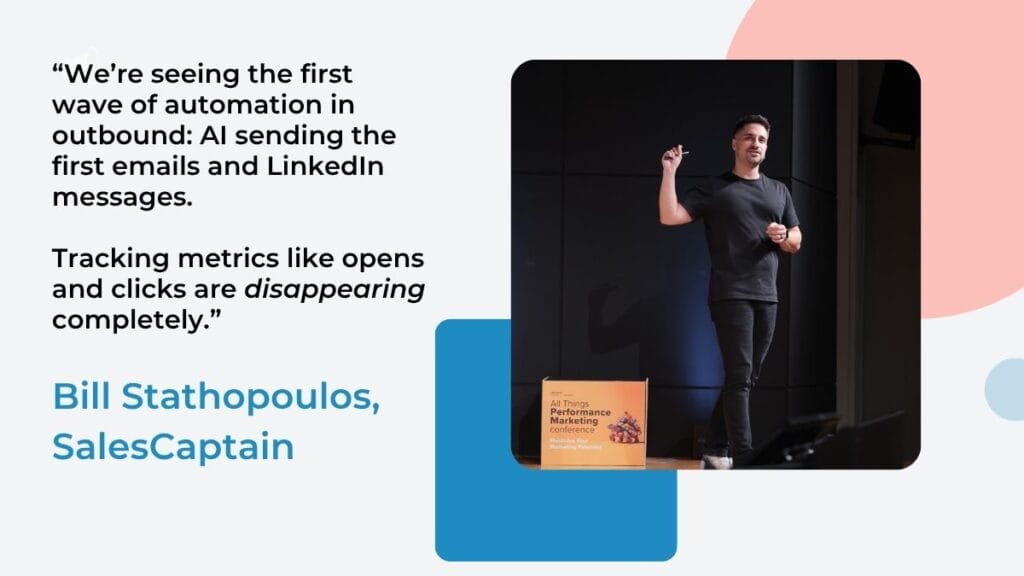
We’re also seeing the first wave of automation in outbound: AI sending the first emails and LinkedIn messages. Tracking metrics like opens and clicks are disappearing completely. Messages often include no links at all, and senders are using much smaller volumes per inbox.
I was just talking with a team member about this: the new standard is around ten emails per inbox per day. Some providers are even suggesting just two or three. The war between spam filters and outbound tools is still going strong.
That’s raised the cost of getting started. It used to be $50 a month; now it’s closer to $250–$500 to have the data quality and infrastructure you need. Still, it remains one of the most effective go-to-market channels: alongside LinkedIn outreach and cold email itself.
“AI is changing how we scale outbound.”
What role does AI play in scaling cold email campaigns?
It all goes back to the Predictable Revenue model from Aaron Ross’s book. In that book, he describes how outbound teams were built at companies like Salesforce and Adobe.
The secret behind their success was simple: they hired, trained, and upskilled BDRs. Each BDR had an email address and a LinkedIn profile, and their job was to generate prospects for the company.
In the past, scaling outbound meant hiring more BDRs. You could have a few people coordinating in the background, but most of the work depended on the BDRs themselves.
Now, in 2025, 2026, and beyond, AI is taking over many of those manual parts of the process, from scraping and collecting data to writing personalized messages. AI can include variables for each prospect, emulating the same kind of research, qualification, and segmentation a BDR would do, but at scale.
That information can then feed directly into email-sending or LinkedIn outreach tools. So the way to scale outbound with AI is by breaking down what a BDR used to do manually and automating each piece of it.
What’s interesting is that outbound is shifting away from being strictly a sales function. More marketing, growth, and go-to-market teams are taking the lead on outbound – always in collaboration with sales, but with a much bigger role in that first touchpoint.
“Experimentation is becoming core to outbound.”
How important is experimentation in email marketing?
It’s super important, and I think that’s one of the reasons outbound is shifting from sales to marketing.
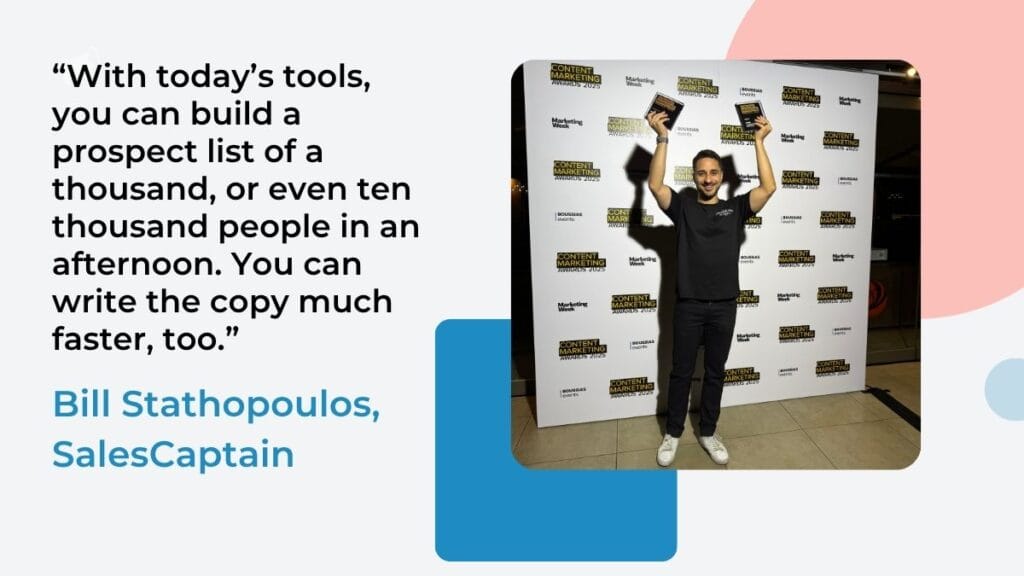
In the old model, if you wanted to experiment, you had to build a strategy, communicate it to the whole team, and have everyone find leads in a different way. It was a long process. But with today’s tools, you can build a prospect list of a thousand, or even ten thousand people in an afternoon. You can write the copy much faster, too.
That means one person can now replicate the work of five or ten people, and iterate much faster. The tools have made that possible. Add to that the fact that it’s become harder to reach the inbox and competition is tougher than ever. The need for experimentation is obvious.
Sales hasn’t traditionally worked that way. It’s been more about making a plan, sticking to it, tracking the numbers, and retraining or replacing people if results don’t follow. Marketing, on the other hand, is built on experimentation. It’s experimentation on steroids, no matter the channel.
So I think marketing teams are uniquely equipped for this. Not to discount sales leaders who have the willingness and appetite to experiment, but marketing already operates in that mindset.
At the core, you have two main variables: your data sources and your messaging. Both are now influenced by AI. But AI isn’t a god; it’s not AGI, and it can’t think like a human. It doesn’t always know what’s going to work. The only real judge is the market itself.
That’s why we have to test, iterate, and experiment quickly to get to the results we want. Experimentation has become a fundamental part of the outbound process. In the past, it might’ve meant blasting 10,000 people with the same message or changing your whole SDR workflow, but now it’s faster, leaner, and smarter.
“Email warmup is mandatory in 2025.”
People are saying the phrase ‘email warmup’ more and more. I used a warmup tool myself, and it made a night-and-day difference. What kind of impact can email warmup have for marketers?
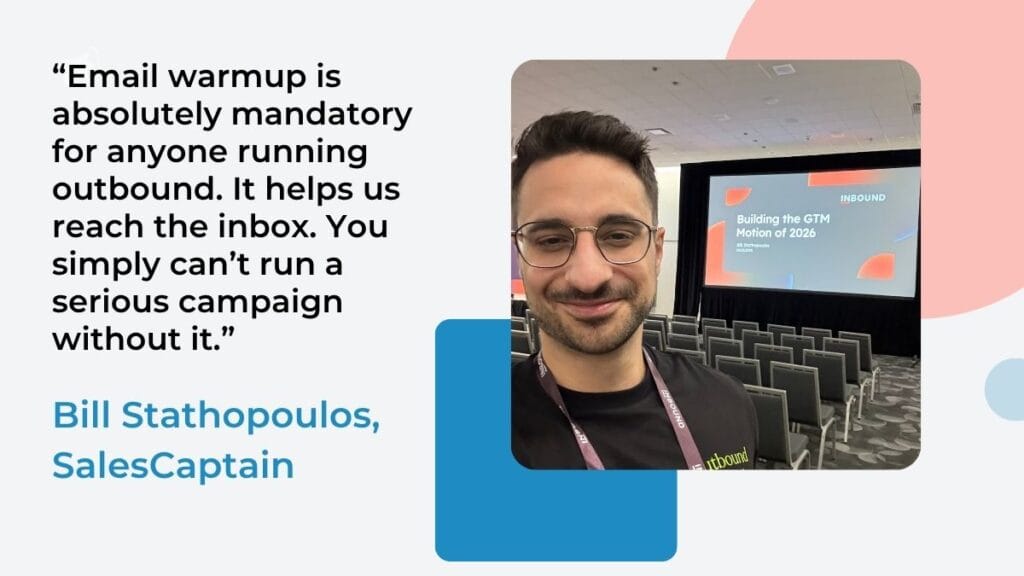
Email warmup is absolutely mandatory for anyone running outbound in 2025. We first started using it back in 2021, right when the concept emerged, and the impact was massive. It helped us reach the inbox again, and today, you simply can’t run a serious campaign without it.
The main reason is that spam filters have become extremely sensitive. They’re also using AI. So on one side, you have AI-driven outbound campaigns, and on the other, AI-driven spam filters that analyze data at scale. If you send the same email to a hundred people a day, filters can detect that pattern and assume it’s spam or automated. It’s a constant back-and-forth battle.
Warmup needs to begin before a campaign launches—at least two to three weeks ahead of time. But it also needs to stay active throughout the campaign. If you pause it, deliverability can drop fast.
When a campaign starts underperforming, it’s often because of a mismatch between the target audience and the messaging. Maybe the offer isn’t compelling, the copy doesn’t resonate, or the audience itself is off. When that happens, email deliverability takes a hit.
At that point, the best move is to pause, let the inboxes warm up again for another week or two, and then resume. That’s how essential warmup has become. It’s not just a setup step; it’s part of the ongoing process.
“Don’t send out spam.”
Nobody wants to end up in the spam folder. What tips can marketers use to avoid it?
Yeah. Don’t send out spam. That’s my short answer.
What does that mean? It means really going deep into who your audience is, and that includes using AI to filter the audience. It also means creating copy and offers that resonate. And it also means experimentation, because you’re going to test out different things. Some of them won’t work, maybe one or two will, and those are the ones you need to scale.
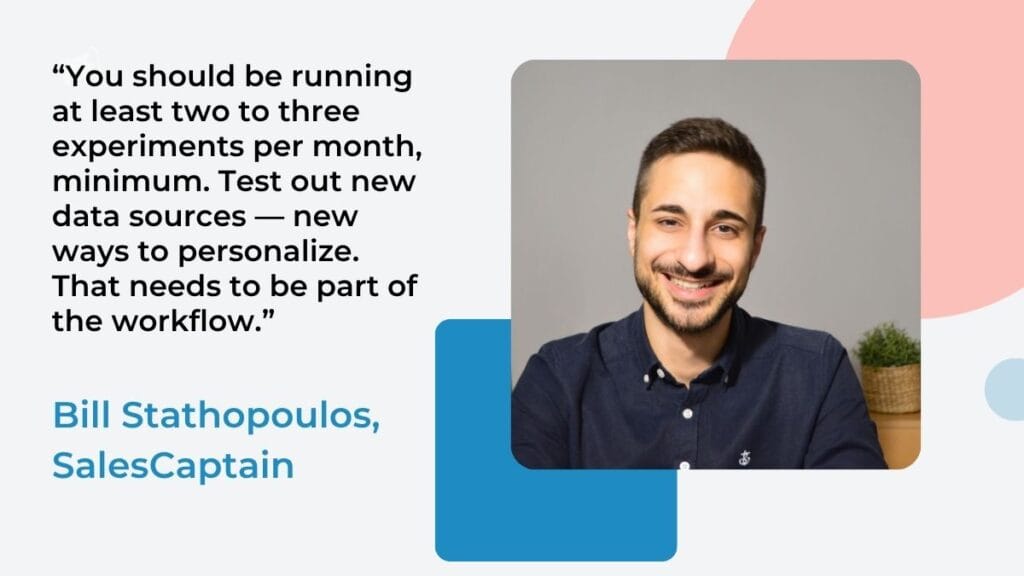
You need to be keeping an eye on that. You should be running at least two to three experiments per month, minimum. Test out new data sources, new ways to personalize, and that needs to be part of the workflow.
Going to the spam folder can happen with just two or three people clicking the spam button when they receive your email. If they can’t resonate with it or if there is low relevance, they’ll hit the spam button. When that happens, it’s only a matter of time before you have to pause your campaigns. Spam filters have become so good that we’re counter-incentivized from sending out spam. The only option is to not be spammy and to be perceived as relevant so people engage with the campaigns.
Related: See what Gmail creator Paul Buccheit says about spam reports
Another thing we’ve seen is that even if people aren’t reporting you as spam, Google monitors negative replies. They track campaign engagement and the types of replies you receive. They can deprioritize or punish a sender who only receives negative replies. It’s not just about the spam folder. It’s also about the responses you get, which is another strong signal that needs to be monitored.
So you need to be keeping an eye on that. You need to be running at least two to three experiments per month, minimum. You need to be testing out new data sources, new ways to personalize, and that needs to be part of the workflow.
The reason behind it is that going to the spam folder is as easy as two or three people clicking the spam button when they receive your email. If they can’t resonate with it, if there is low relevance, it can happen. It’s not just lack of personalization, but low relevance they’ll hit the spam button. When that happens, it’s only a matter of time before you have to pause your campaigns.
We’ve come to a point where we’re actually counter-incentivized from sending spam because spam filters have become so good. Our only option is to not be spammy, to be perceived as relevant, so people engage with the campaigns.
Related: A staggering 80% of people report an email as spam only because they perceive it as spam. Read ZeroBounce’s latest consumer behavior insights so you can send better emails.
Another thing we’ve seen is that even if people aren’t reporting you as spam, Google monitors negative replies. They monitor campaign engagement and the types of replies you receive or that people send back. They can deprioritize and punish a sender who only receives negative replies.
So it’s not just about going into the spam folder because people reported you as spammy. It’s also because of people responding negatively, which is another really strong signal that needs to be monitored.
“Getting replies is all about relevance.”
What do people need to know about getting replies?
Getting replies is all about being relevant. Whenever I write a cold email, I have two basic filters. Two questions I always try to answer: Why me? and Why now?
Why me? Why did you reach out to me? Why am I a good target for Clay, ZeroBounce, lemlist, or whatever it is? Why now?
Because a lot of emails do contain a value proposition and make sense, but we all know we receive hundreds of emails in our inbox. The fancier your title on LinkedIn, the more high-level it looks, and typically, the more emails you receive. Our attention span is limited.
If we are going to engage with an email, we need a good incentive. Answering why me gives the relevance, and answering why now drives action. It’s closer to incentivizing the call to action. When you get these two right, responses should naturally increase.
“Most answers are already inside of us.”
If you could go back to the young Bill just starting out in life, what advice would you give him?
Meditate – start meditating faster. That’s it. That’s all I’d say.
If the young Bill asked why he should meditate, what would you tell him?
Most of the answers are already inside of us, and no one outside of you can give you safety, love, purpose, or drive. All of these things have to come from within. The more time we spend listening to ourselves, rather than consuming other people’s content or focusing on the outside world — the closer we get to our own sense of truth.
Along with that, it’s important to trust that things will work out. But just being told that isn’t really helpful. What is helpful is having a practice where you sit with yourself and spend time contemplating –not necessarily with a goal in mind, just giving yourself time and space. That’s one of the biggest gifts you can give yourself.
Everything else tends to unfold naturally. If your goal is to become a CEO, the path will lead you there. If your goal is to become Elon Musk, or head of growth, or head of marketing, you’ll get there. For me, it was straightforward because I already had a passion for technology and marketing. If I were a different person, the advice might have been different.
Look at the things you enjoy and try to turn them into your work. For me, I knew what I wanted, and I’ve always had that instinct. The biggest takeaway? Spend more time listening to yourself.
Related: ZeroBounce’s Zach Nonnemacher on How to Write Emails People Actually Want to Read
“Straight to the point, like the Gladiator theme.”
What song would best describe your approach to email?
Song? That’s interesting because by definition most songs are creative. I would say my approach to marketing overall is quite structured.
In my head, I have a specific recipe, and I’m just trying to hit the boxes:
- Define the ideal customer profile (ICP) super clearly
- Define a big problem your industry is facing
- Make sure you have full context on the people you’re targeting
- Have your value proposition clearly laid out
- Provide enough proof.
It’s all about checking the boxes.
If I had to pick one, it would be the Gladiator theme, an epic song by Hans Zimmer. It fits because my copywriting and the way I write is super straight, super to the point. No fluff, no trying to bullshit: just a clear reason for reaching out, done with purpose and providing value. If you follow that approach, it tends to work.
“Spend time listening to yourself and celebrating progress.”
What can anyone do to make today better?
Go spend five minutes meditating.
But more broadly, genuinely listen to what your body and mind need. Since we’re recording on a Friday night, I’d also recommend going out, having a drink, and spending time with people who love you and friends.
On a more work-related level, I’d suggest writing down a list of what you accomplished today. We spend so much time reacting to things, but not enough time acknowledging what we’ve achieved. The higher up you climb, the harder it is to get praise – or even give yourself praise.
I do this on paper, with a checkbox at the end that asks: “Have I gotten closer to my goals?” The answer is usually yes.
It’s a good reminder that progress isn’t always linear. You might have to divert or adjust your plan, but as long as you move even a step forward toward your goals – in life and in your career – that’s what matters.
That is a great answer. I’m so used to writing down what I’m supposed to do, and then sometimes at the end of the day it can be like, well, I didn’t do them all. You flipped it on its head. Write down what you’ve done, because sometimes unexpected things pop up, and if you get those done, you should give yourself credit for it. I love that, Bill.
Exactly. A big part of my day is spent on calls, and I don’t always get the sense that I’m accomplishing things. But if you look back and think, okay, I resolved the conflict, I did this, I saved the website, we won a client, you realize you don’t have to do everything yourself – especially if you have a team you’re working with. Hopefully, we all have that.
There are also things you tackle in the moment that you didn’t even realize. You handle them as they come up, even if they weren’t on the checklist. When that happens, give yourself a round of applause.
Learn more about Bill Stathopoulos and connect with him on LinkedIn. Does your email marketing need a boost? Try ZeroBounce ONE today – all the tools you need to land in the inbox and make cold email work for you.
Table of Contents
- Quick Answer
- “We’re entering a B2B data renaissance.”
- “AI is changing how we scale outbound.”
- “Experimentation is becoming core to outbound.”
- “Email warmup is mandatory in 2025.”
- “Don’t send out spam.”
- “Getting replies is all about relevance.”
- “Most answers are already inside of us.”
- “Straight to the point, like the Gladiator theme.”
- “Spend time listening to yourself and celebrating progress.”
Related Posts
-
 Read Story
Quick Answer What’s the most important thing you can do to improve your email marketing? Short answer: Take compliance seriously a...
-
 Read Story
Quick Answer What’s the smartest way to stand out in crowded inboxes? Short answer: Do something unexpected. Email expert Beth O’M...
-
 Read Story
Quick Answer What’s the simplest way to build stronger relationships with your email subscribers? Short answer: Don’t overthink em...
-
 Read Story
Quick Answer What’s the real reason your email didn’t get clicks?Short answer: Your email likely flopped because it was boring, ir...
-
 Read Story
Still only emailing your list when there’s a sale? Email expert and Mailchimp Pro Partner Donna Duggan says that’s one of the bigg...
-
 Read Story
Email marketing is more than just about strategies and technology, it’s also about relationships. In this soulful interview with V...