
Before You Hit Send: Why Email Verification Is Essential for Compliance and Inbox Placement

Sending emails without verifying your list is a little like launching a rocket without checking the fuel lines. It might go somewhere, but probably not where you want it to land, and the odds of it crashing and burning aren’t zero. If compliance and inbox placement matter to your business, email verification isn’t optional. It’s one of the very first steps.
Why email verification and compliance go hand-in-hand
You’ve built your list, crafted your content, set up your deployment, and you’re ready to hit send. But pause for a second, because one of the most important steps in the entire email process happens before your message leaves the server.
Email verification doesn’t get the spotlight nearly as often as creative or segmentation strategy, but it should. Why? Because email list quality directly impacts inbox placement, sender reputation, and your ability to stay compliant with regulations like CAN-SPAM, GDPR, and more.
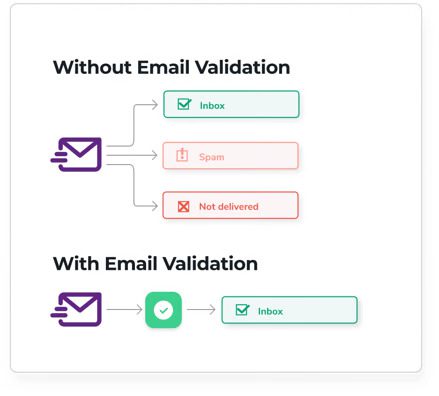
Sending to invalid, mistyped, or outdated email addresses can quickly tank your email deliverability. In some cases, it can also raise compliance concerns, depending on how that data was collected and where your recipients are located.
One of the most consistent threats to email performance is skipping proper list verification. It’s a common misstep that can quietly derail even well-planned campaigns. If your deployment goals include reach and reputation, and they should, then email verification belongs at the top of your pre-send checklist.
What is email verification?
Email verification is the process of checking that the addresses on your list are valid, active, and safe to send to, before you actually send to them. It filters out invalid, fake, disposable, or otherwise risky email addresses that can lead to bounces, spam complaints, or traps that damage your reputation.
Good verification tools analyze syntax (is the address formatted correctly?), domain (does it exist?), mailbox (is it active?), and often even intent signals (is it a likely spam trap?).
In short, email verification gives you confidence that your messages are going to real people, at real addresses, who are capable of engaging and responding.
Why email verification matters for compliance
Let’s start with the legal side. If you’re sending emails in 2025, you’re navigating a multitude of regulations: CAN-SPAM in the U.S., GDPR in Europe, CASL in Canada, EAA accessibility requirements, and other country and even state-specific rules. Many of these laws concern both what you send and to whom you send it.
Email verification supports compliance in several ways:
- It prevents misfires to expired, reassigned, or malformed email addresses.
- It limits bounces and blocks that could lead to investigations or blacklists.
Also, importantly, it reinforces good data hygiene, which every compliance framework expects. It’s great risk management.
Poor list hygiene puts your inbox placement at risk
You can write the perfect email. You can personalize it, time it, test it, and target it. But if you send it to a high percentage of invalid or low-quality addresses, you’re inviting delivery problems.
Here’s why:
- High bounce rates tell inbox providers that you’re not maintaining your list.
- Invalid addresses may be recycled into spam traps by ISPs, hitting one has the potential to sink your sender reputation overnight.
- Low-quality signals (such as repeatedly sending to unengaged users) can also increase your complaint rate and spam folder placement.
A bad send doesn’t just hurt that one campaign; it can damage your sender reputation, affecting future sends, even to your most engaged and valuable recipients. Inbox placement in 2025 and beyond is becoming more and more about trust. Trust is built on consistency, engagement, and high-quality data.
How to include email verification in your pre-send checklist
Email verification is a fundamental step that protects your sending infrastructure. Skip it, and you’re exposing your email program to unnecessary risk, including poor deliverability.
Here’s how advanced email programs fold it into their daily workflows:
- Verify before import: Don’t let unverified data reach your ESP. Run it through an email verification servicefirst, whether it came from a form, a partner, or an offline event. Clean your data at the point of entry and avoid potential issues.
- Verify at scale: You don’t need to run email verification before every send, but if you’re planning to deploy to a legacy list or one that hasn’t been mailed in six months or more, it’s smart to validate it first. Even addresses that were valid a year ago may have gone stale, and sending to them without a quality check risks higher bounce rates and hurts deliverability.
- Set up automation: Many platforms (like ZeroBounce) offer real-time email verification via API. This means you can validate every new subscriber as they sign up, cutting down bad data from the start.
- Combine with consent tracking: Verification confirms the address is real and active. Layering that with suppression management and consent tracking strengthens your program’s integrity. Having a clear record of how and when a recipient opted in helps support a more transparent, high-performing, and responsible email program.
- Re-verify periodically: Email data decays faster than you think. People change jobs, abandon inboxes, and recycle old accounts. Running periodic checks keeps your list fresh and helps you avoid potential problems.
Advanced marketers verify because performance depends on it
At the high-volume level, email verification isn’t just about avoiding bounces. It’s about maximizing engagement, minimizing complaints, and increasing email deliverability.
You can see brands improve deliverability simply by removing 2–3% of bad addresses. With inbox providers watching every signal more closely than ever, quality matters more than quantity.
Verification is part of a broader trend toward smarter deployment: sending fewer, better emails to the right people at the right time, instead of just mass email blasts. It directly supports smarter segmentation, dynamic content, and other modern email marketing best practices. But without email verification, those strategies may never get off the ground, because your emails may not even be reaching real humans.
Treat email verification as your reputation safeguard
No email marketer has ever said, “I wish I didn’t verify my list.” But plenty say the opposite, after a bounce spike, a spamtrap hit, or, in the worst case, a suspension from their ESP.
If you want to protect your brand, sender reputation, and compliance posture, treat email verification as a non-negotiable component of your email deployment strategy. You lock your doors, you wash your hands, you verify your list. It’s just what smart teams do now.
Author: Antonio Jones is the Marketing Manager at OPTIZMO Technologies, a leading email compliance, suppression list management, and email deployment platform. He oversees and implements OPTIZMO’s daily marketing activities, including writing on email strategy, privacy, deployment, and deliverability.
Table of Contents
- Why email verification and compliance go hand-in-hand
- What is email verification?
- Why email verification matters for compliance
- Poor list hygiene puts your inbox placement at risk
- How to include email verification in your pre-send checklist
- Advanced marketers verify because performance depends on it
- Treat email verification as your reputation safeguard
Related Posts
-
 Read Story
If you’re sending marketing emails and you’ve never cleaned your email list, stay with us. We have a few things to share with...
-
 Read Story
Ready to learn some more about email scoring and see how much it influences the results of your email marketing? You’re in the ...
-
 Read Story
We’re excited to share with you that we’ve just rolled out a Cloudflare integration designed to improve your email hygiene. T...
-
 Read Story
Finding a trustworthy email list cleaning software provider can be tricky. While some of them guarantee a high accuracy, they may...
-
 Read Story
A good spam email checker improves the health of your email list and allows you to reach your customers. Read on to learn how an ...
-
 Read Story
We’re so excited to share this great news with you! CRMDialer has recently integrated ZeroBounce on their platform to provide b...